

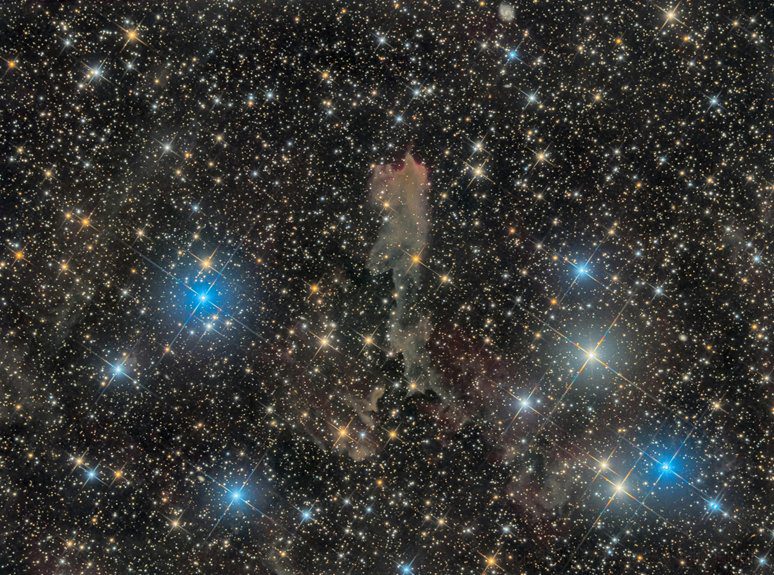
You’re watching Betelgeuse, a red supergiant star nearing the end of its life cycle. It shows signs like brightness fluctuations and temperature changes, hinting at an imminent supernova—a colossal explosion marking its core collapse. When it occurs, the star will shine exceptionally bright in our night sky, offering a rare chance to observe stellar death and element formation. While Earth won’t be harmed, this event will deepen our understanding of cosmic phenomena and stellar evolution. More detailed insights follow.
The Life Cycle of Betelgeuse
Betelgeuse, a red supergiant star, is in a late stage of its stellar evolution. As a red supergiant, it has expanded considerably after exhausting the hydrogen fuel in its core.
You can think of stellar evolution as a series of changes a star undergoes as it ages and burns different elements. In this phase, Betelgeuse fuses heavier elements like helium and carbon in shells around its core.
You’ll notice that its size and brightness fluctuate due to these internal processes. Eventually, the star will progress through the final stages of stellar evolution, where it can no longer support fusion in its core.
Understanding this life cycle helps you grasp why Betelgeuse’s current state is both critical and transient in the grand timeline of stars.
Signs Pointing to an Imminent Supernova
Although predicting the exact timing remains challenging, certain signs can indicate that a supernova is approaching.
You should watch for changes in star activity that suggest imminent signs of collapse. Key indicators include:
- Sudden Brightness Fluctuations – Rapid changes in luminosity may signal instability within the star’s core.
- Surface Temperature Variations – Noticeable cooling or heating can reflect internal processes accelerating toward collapse.
- Increased Stellar Wind – Enhanced mass loss through stellar winds points to significant changes in the star’s outer layers.
- Emission of High-Energy Particles – Detecting elevated cosmic rays or neutrinos can reveal core reactions preluding the explosion.
The Science Behind the Supernova Explosion
Understanding the signs that signal a star’s impending collapse sets the stage for exploring what actually happens during a supernova explosion.
When Betelgeuse exhausts its nuclear fuel, its core can no longer support the star’s immense gravity. This imbalance triggers a rapid core collapse, followed by a violent rebound that blasts the star’s outer layers into space.
The supernova mechanics involve shock waves and intense energy release, creating conditions for stellar nucleosynthesis. During this process, heavier elements form as atomic nuclei fuse under extreme temperatures and pressures.
These newly formed elements disperse throughout the cosmos, contributing to the chemical richness of future stars and planets. By understanding these processes, you gain insight into how supernovae like Betelgeuse’s play a critical role in cosmic evolution.
Observing Betelgeuse: What Skywatchers Can Expect
When Betelgeuse enters its final stages before a supernova, you can expect noticeable changes in its brightness and appearance from Earth.
As a star gazing enthusiast, you’ll observe these cosmic phenomena with keen interest. Here’s what to look for:
- Gradual dimming and brightening cycles, indicating instability in the star’s outer layers.
- Changes in color, shifting from deep red to more orange hues as the star’s temperature fluctuates.
- Occasional irregularities in brightness that deviate from its typical patterns, signaling internal changes.
- The star becoming visibly brighter in the night sky when the supernova event occurs, potentially outshining other stars temporarily.
The Impact of Betelgeuse’s Supernova on Earth and Astronomy
Since Betelgeuse lies relatively close to Earth in cosmic terms, its supernova will offer a unique opportunity for both scientists and skywatchers to study a massive stellar explosion up close.
You’ll witness firsthand a key phase in stellar evolution, gaining insights into how massive stars end their life cycles. For Earth, the supernova poses no harmful effects due to the star’s safe distance, but it will brighten the night sky considerably.
From an astronomical perspective, this event will help refine models of stellar death and element formation, deepening our understanding of cosmic processes.
As you observe, you’ll grasp the astronomical implications of such explosions, including their role in distributing heavy elements essential for forming planets and life, making this supernova a landmark moment in modern astronomy.
Frequently Asked Questions
How Was Betelgeuse Originally Discovered and Named?
You’ll find Betelgeuse’s name comes from star nomenclature rooted in Arabic, reflecting historical astronomy’s influence. Early astronomers documented it as part of Orion, and its bright, reddish hue made it stand out centuries ago.
What Cultural or Mythological Significance Does Betelgeuse Hold?
You’ll find Betelgeuse mythology tied to ancient cultures, where its fiery glow symbolized warriors or gods. Betelgeuse naming stems from Arabic, meaning “the armpit of the giant,” reflecting its position in Orion’s constellation.
Are There Any Ongoing Missions Specifically Studying Betelgeuse?
You won’t find Betelgeuse missions dedicated solely to it, but Betelgeuse observations happen through telescopes like Hubble and space observatories. Scientists keep monitoring its changes, hoping to understand its future supernova event better.
What Other Stars Are Similar to Betelgeuse in Size or Type?
You’ll find stars like Antares and Mu Cephei are Red Supergiants similar to Betelgeuse. Studying these stars helps you understand Stellar Evolution, especially how massive stars end their lives in spectacular supernovae.
How Does Betelgeuse Compare to Other Supernova Candidates in Our Galaxy?
You’ll find Betelgeuse stands out among supernova candidates for its size and brightness, showcasing unique supernova characteristics. Its advanced stellar evolution stage makes it a prime candidate compared to others in our galaxy.
