

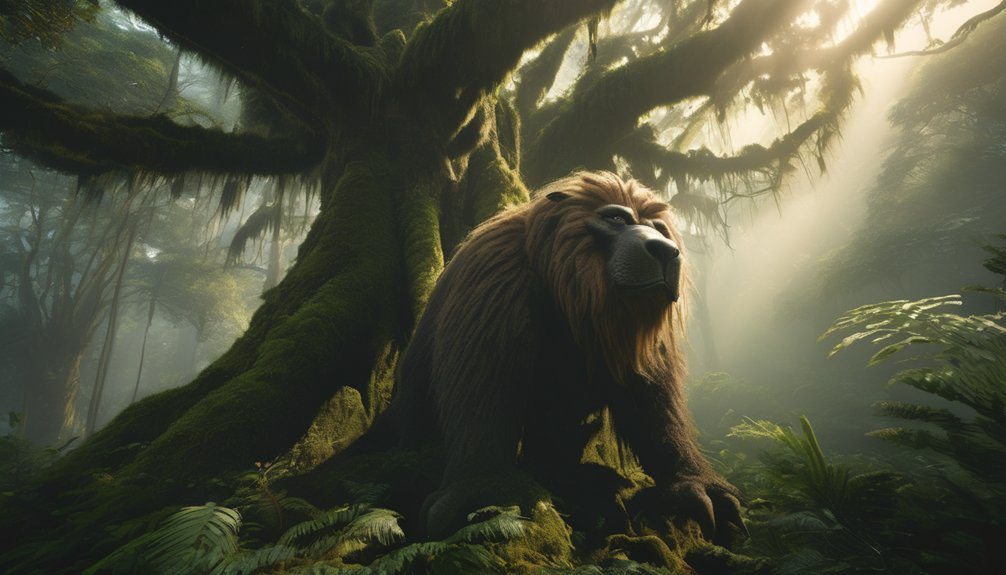
You might hear claims that giant sloths still live in remote forests, but scientific evidence shows they went extinct around 10,000 years ago. Fossils reveal their size and habitat, while eyewitness reports often come from misidentifications or local myths. Cultural stories have mixed fact and fiction, shaping how people imagine these creatures today. Understanding the real history behind giant sloths will clarify what’s true and what’s legend about their existence.
The History and Extinction of Giant Sloths
Although giant sloths once roamed vast areas of the Americas, they became extinct approximately 10,000 years ago.
You can explore their evolutionary adaptations, which helped them survive in diverse prehistoric habitats, from dense forests to open grasslands. These adaptations included massive claws for climbing and defense, as well as slow metabolisms suited to their environments.
Understanding their history reveals how changing climates and human activity likely contributed to their decline.
Reported Sightings and Eyewitness Accounts
When people report sightings of giant sloths today, these accounts often come from remote or heavily forested areas where the animals were once known to live. Eyewitness testimonies describe large, slow-moving creatures resembling ancient sloths, though such reported encounters lack physical evidence.
You’ll find these reports intriguing but must consider their anecdotal nature carefully. Common themes in these accounts include:
- Observations during dawn or dusk, when visibility is low
- Descriptions emphasizing unusual size and slow gait
- Reports from indigenous or local inhabitants familiar with regional wildlife
These testimonies fuel curiosity but remain unverified claims without scientific support.
Scientific Research and Fossil Evidence
Since giant sloths no longer roam the Earth, scientists rely heavily on fossil evidence and extensive research to understand these prehistoric creatures. Through fossil analysis, researchers uncover details about their size, diet, and habitat, which helps clarify their evolutionary significance.
This evidence reveals how giant sloths adapted over millions of years and their role within ancient ecosystems. By studying bones and footprints, you can appreciate the depth of scientific inquiry that separates fact from speculation.
These findings provide a reliable foundation for understanding giant sloths, allowing you to explore their history grounded in verified data rather than myths or hearsay.
Separating Myth From Reality: Cultural Impact and Misidentifications
While giant sloths have fascinated people for centuries, many stories about them have mixed fact with fiction. Understanding their true cultural impact requires separating myth from reality.
You’ll find that cultural representations and folklore influences often blur the lines, leading to misidentifications. Consider these points:
- Folklore often portrays giant sloths as mysterious creatures, fueling legends.
- Misidentifications of other large animals sometimes get mistaken for surviving sloths.
- Artistic depictions exaggerate features, reinforcing myths rather than scientific facts.
Frequently Asked Questions
Could Giant Sloths Be Kept as Exotic Pets Today?
You can’t keep giant sloths as exotic pets today because their complex habitat requirements and ethical considerations make it impossible. You deserve freedom, but these creatures need wild spaces, not captivity, to thrive and live naturally.
What Do Giant Sloths Eat in the Wild?
You’d find giant sloths primarily munching on leaves, fruits, and twigs, using slow but steady foraging techniques. Their dietary habits reflected a peaceful, unhurried life, perfectly suited for roaming freely in lush forests.
How Long Do Giant Sloths Typically Live?
You’ll find the giant sloth lifespan stretched up to 40 years, showcasing impressive prehistoric longevity. They thrived freely in ancient times, living long enough to adapt and roam vast, untamed landscapes without constraints.
Are Giant Sloths Related to Modern-Day Tree Sloths?
Yes, you’re related to modern tree sloths through the same evolutionary lineage. Fossil evidence shows giant sloths shared common ancestors with today’s sloths, proving your connection spans millions of years and untamed natural history.
Can Giant Sloths Swim or Climb Trees?
You’ll find giant sloths had decent swimming abilities, using slow, deliberate strokes. Their climbing techniques were limited compared to modern sloths, but they could scale trees when needed, embracing freedom to explore their environment.
