

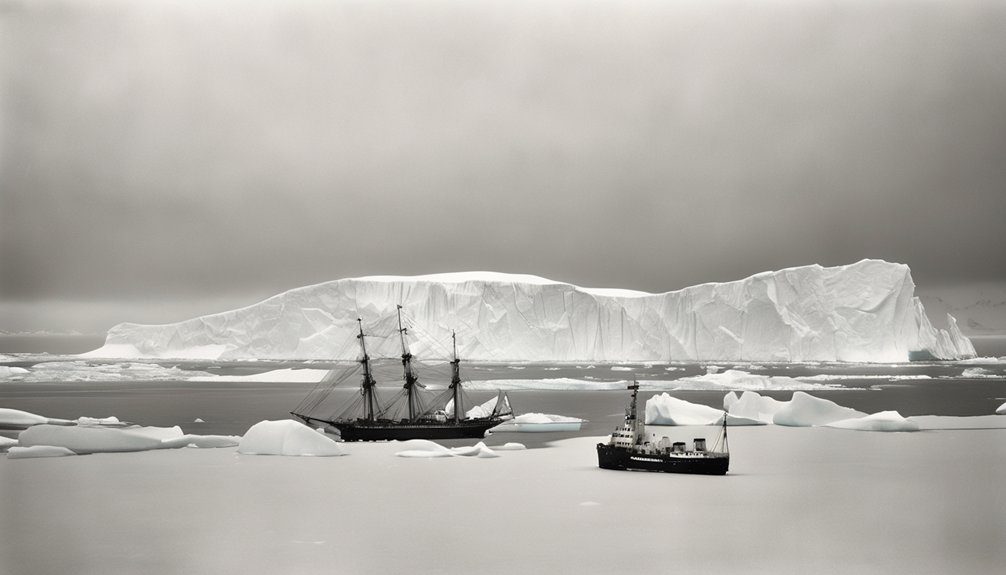
Operation Highjump was a massive 1946-47 U.S. Navy expedition involving over 4,700 personnel and 13 ships, focused on military training and scientific research in Antarctica. It relied on aircraft carriers for logistics and navigated cooperation with international teams. Contrary to popular myths, there’s no credible evidence of secret bases or lost technologies. Instead, you’ll find detailed studies of the Antarctic environment and complex logistical achievements. Exploring further uncovers the true scope and practical outcomes of this historic mission.
The True Scale and Logistics of Operation Highjump
Although Operation Highjump is often remembered for its daring Antarctic exploration, its true scale and logistics reveal an even more impressive undertaking.
You’d face numerous logistical challenges organizing such a massive mission, including transporting thousands of personnel, ships, and aircraft to a remote, icy environment.
Scale considerations were vital, as the operation involved over 4,700 men and 13 ships, demanding precise coordination.
You’d need to manage fuel supplies, weather unpredictability, and communication across vast distances.
Understanding these complexities highlights the extraordinary effort behind Operation Highjump, showing it as a remarkable example of large-scale military and logistical planning.
Scientific Objectives Beyond Military Training
While Operation Highjump primarily served military training purposes, it also pursued significant scientific objectives that extended beyond its defense goals.
You’ll find that the expedition conducted extensive scientific research to better understand Antarctica’s harsh environment. This included ecological studies aimed at documenting local wildlife and evaluating the impact of extreme conditions on ecosystems.
These efforts provided valuable data, contributing to global knowledge of climate patterns and natural habitats. By supporting such scientific research, the operation balanced strategic aims with a commitment to advancing peaceful exploration and environmental awareness, reflecting a broader vision beyond mere military preparedness.
The Role of Aircraft Carriers and Naval Vessels
Scientific research in Operation Highjump relied heavily on the logistical support provided by its fleet, which included multiple aircraft carriers and naval vessels.
You’d notice how the operation’s naval strategy focused on maximizing aircraft capabilities for reconnaissance and transport across vast Antarctic expanses.
These carriers served as mobile bases, enabling rapid deployment of planes and personnel.
Naval vessels guaranteed supply lines remained open, maintaining operational endurance in harsh conditions.
Interaction With International Antarctic Expeditions
Because Operation Highjump took place during a period of growing international interest in Antarctica, its team often encountered other national expeditions operating in the region.
These interactions highlighted the significance of international cooperation despite harsh expedition challenges like extreme weather and limited communication.
You’d notice that while each country pursued its own goals, teams shared crucial information and navigational assistance when possible. This cooperation helped reduce risks and improved overall safety.
Understanding these encounters clarifies that Operation Highjump wasn’t an isolated effort but part of a broader, collaborative presence in Antarctica during that era, shaped by both competition and mutual support.
Debunking Myths About Secret Bases and Lost Technologies
Although Operation Highjump has inspired numerous theories about secret bases and lost technologies, evidence shows these claims lack factual support.
You won’t find credible documentation confirming hidden facilities or advanced, forgotten devices linked to the mission. Official records focus on scientific research and military training, not covert operations.
Secret bases often appeal to imagination but don’t align with the logistical realities of Antarctica. Lost technologies, as described in some stories, lack verification through any reliable source.