

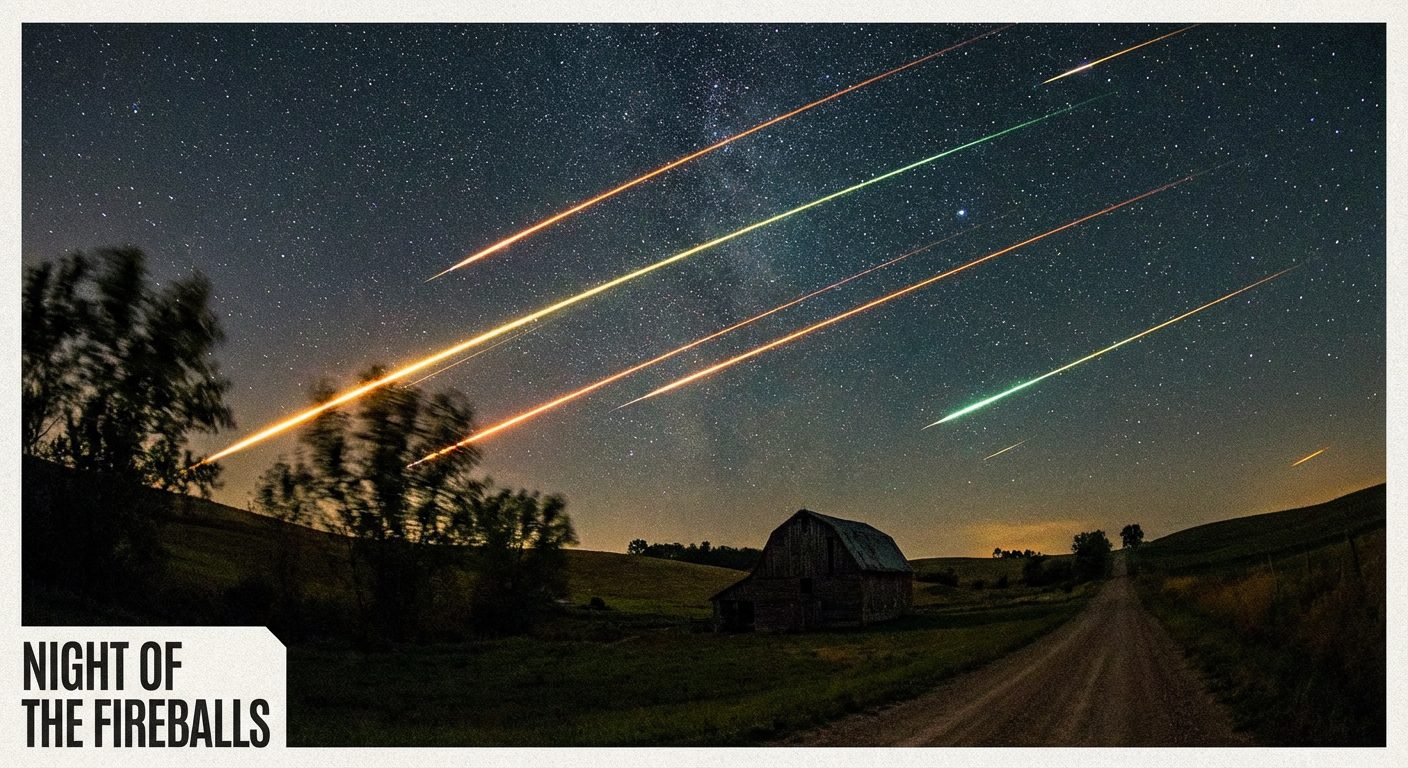
Something is hitting Earth at an unusual rate in 2026, and scientists are not sure why. The American Meteor Society has confirmed a statistically significant surge in large fireball events during the first quarter of the year, with the 50+ witness threshold running at double the historical average. That is not a rounding error. At the most diagnostic measurement level, Q1 2026 sits 3.9 standard deviations above baseline, which translates to odds of roughly 1-in-21,000 by chance alone.
You have probably seen the videos. A slow-burning daytime bolide disintegrating over Germany and France on March 8, watched by 3,229 people. A 7-ton asteroid screaming over Ohio on March 17, rattling windows across northeast Ohio and into Pennsylvania. A meteorite crashing through a roof in north Houston on March 21. Two fireballs on the same day over California on March 23. The events did not feel like coincidence, and the data now confirms they were not.
What is actually driving this is where the scientific debate gets serious.
The Numbers Behind the 2026 Fireball Cluster
The AMS has been tracking fireball events since 2005, with its reporting platform reaching maturity around 2016 to 2018. Their Q1 2026 analysis, published by researcher Mike Hankey on March 25 and updated through March 31, draws on data going back to 2011 to establish a clear baseline.
The headline stat: Q1 2026 recorded 40 fireball events with 50 or more witness reports, against a 2018 to 2025 average of 20. At the 100+ witness threshold, 2026 logged 16 events versus a baseline average of 8. Crucially, the signal gets stronger as the threshold rises, which is exactly what you would expect from physically larger incoming objects, not from more people filing reports. If this were simply a smartphone camera effect, you would see proportional growth across all size categories. That is not what the data shows.
March alone produced five events exceeding 200 reports, more than all prior Marches combined since 2011. The average witness count per March 2026 event was 142.7, nearly three times the next-highest March on record (49.4 in 2021). Even after removing the exceptional March 8 European event, the remaining 41 episodes averaged roughly 67 reports each, still more than double the historical norm.
Thirty of the 40 large events produced confirmed sonic booms, an 82.5% rate. Sonic booms require objects that penetrate deep enough into the atmosphere to create pressure waves reaching the ground. You cannot fake a sonic boom with extra smartphone users.
Where the Fireballs Are Coming From
The AMS computed radiants for 67 trajectory-resolved events in Q1 2026. Two clusters stand out against the 2021 to 2025 baseline.
The first is the Anthelion sporadic source, a broad region of the sky opposite the Sun that produces a steady background of sporadic meteors year-round. In 2026, activity from the tight Anthelion zone registered at 4.1 sigma above baseline under Poisson analysis, with 14 events versus a prior average of 3 to 6. This includes several of the largest individual events: the March 9 East Coast fireball seen by 282 people, the March 10 France fireball with 145 reports, and the March 11 France and Spain event with 236. The density within that sky zone is twice the previous maximum on record.
The second cluster is even more unusual: 12 events in 2026 originated from radiants above 70 degrees declination, compared to a prior-year maximum of 5. High-declination radiants correspond to objects on steeply inclined orbits relative to the ecliptic plane, a population that researchers say is not well understood. This cluster includes the Ohio eucrite fall (Dec +77 degrees) and the California fireball (Dec +81 degrees).
Neither cluster points to a new annual meteor shower. No known shower produces activity from these regions in Q1. Hankey is direct in the AMS report: the enhanced activity is coming from a specific part of the sky at roughly double the normal density. That directional concentration rules out reporting effects entirely. Smartphones do not make fireballs come from one part of the sky.
March 2026 Fireball Events: The Full Sequence
The individual events of March 2026 are worth knowing in full detail, because the clustering over a 16-day window is itself remarkable. All data sourced from the AMS Q1 2026 official analysis, updated March 31, 2026:
- March 8: Daytime bolide over Western Europe (France, Germany, Switzerland, Belgium, Netherlands). 3,229 reports. Average duration 5.5 seconds. Recovered specimens classified as suspected diogenites, a rare achondritic meteorite type from the HED family, originating from differentiated asteroids in the Vesta family.
- March 11: Major fireball over France and Spain. 236 reports. Marked the start of a sustained 13-day wave of large events.
- March 17: Daytime bolide over Ohio. A 7-ton, 2-meter asteroid entered over Lake Erie at 8:57 AM EDT, with energy release estimated at 250 tons of TNT equivalent. 222 reports across 16 states and Ontario. Recovered meteorites confirmed as eucrites from the HED family.
- March 21: Fireball over Houston, Texas. A 1-ton meteoroid airburst 29 miles above the metro area at 4:40 PM CT, producing a 26-ton TNT equivalent energy release. A fragment penetrated the roof of a home in Ponderosa Forest. 181 reports.
- March 23: Two separate fireballs over California on the same day. The first drew 306 reports from San Diego to Willits and east to Carson City, Nevada. The second drew 122 reports across California, Nevada, Oregon, and Washington.
- March 24: Fireballs over Michigan and Georgia. The Michigan event drew 111 reports across five states and Ontario.
Two HED (howardite-eucrite-diogenite) achondrite falls in nine days, from Germany and Ohio respectively, is statistically remarkable on its own. These meteorite types originate from differentiated asteroids, likely in the Vesta family. The two falls are separated by 98.2 degrees of sky, meaning they arrived from entirely different orbital directions and are not part of a common stream.
What Scientists Are Ruling Out
The AMS report works through the candidate explanations methodically. Several can already be dismissed based on the data structure alone.
A new meteor shower is not the explanation. No known showers are active in Q1. The enhanced activity concentrates around existing sporadic sources at elevated density, not a new radiant position.
Increased reporting from smartphones or social media amplification cannot explain the pattern. That would boost counts proportionally across all size categories. The anomaly exists only at the top of the distribution, the signature of genuinely larger incoming objects.
Seasonal quirks, time-of-day bias, and geographic sampling effects have all been examined and do not account for the signal.
What Hankey cannot rule out yet is AI-driven reporting amplification. Since 2023, a person who witnesses a fireball might ask a chatbot where to report it and get directed to the AMS website. This could inflate witness counts per event without changing the actual number of fireballs. This pattern, notably, matches exactly what is observed: normal total event counts but elevated reports per event at the high end. It would not, however, explain the elevated sonic boom rates or the confirmed meteorite recoveries. Those require physical mass arriving from space.
The most scientifically defensible current explanation is an enhancement in the sporadic fireball background from known orbital zones, possibly reflecting an uncharacterized population of debris. As Hankey wrote in the official AMS report: the most honest answer to why this is happening is that we do not fully know.
Researchers are calling for expanded all-sky camera coverage, systematic cross-correlation with NASA’s All-Sky Fireball Network, NOAA GOES satellite data, infrasound arrays, and Doppler radar records. At the time of the Ohio fireball, there was only one AMS-affiliated camera station in the entire state of Ohio, and it was offline. The monitoring gap is real and consequential.
Is This a Threat?
The AMS is direct on this question. None of the Q1 2026 events posed any broad danger. The objects range from pebble-sized to roughly 2 meters across, which is the normal continuum of material Earth encounters continuously. The Houston roof strike was alarming locally but caused no injuries. These are not precursors to an extinction-level impact event.
The AMS also addressed the alien origin question directly in its published report: there is no evidence of anomalous trajectory behavior, controlled flight, or non-natural composition. The recovered HED meteorites from Ohio and Germany have mineral compositions that formed over billions of years on differentiated asteroids. Their chemistry is well-understood and entirely natural.
What this is, is a measurable change in the near-Earth meteoroid environment that researchers do not yet fully understand. The signal is consistent across multiple independent metrics. For the kind of scientific debates that emerge when evidence outpaces explanation, this one is near the top of the 2026 list.
If you witnessed any of these events, the AMS asks you to file a report at amsmeteors.org. Every observation strengthens the dataset and helps narrow down orbital origins.
Will the Surge Continue Into April 2026?
The AMS updated its Q1 analysis through March 31, 2026, and noted the wave was still ongoing at the time of publication. The next known meteor shower, the Lyrids, peaks around April 22 to 23 each year from the debris trail of Comet Thatcher. The Lyrids are a separate, well-understood annual shower and are not connected to the 2026 sporadic surge.
What researchers are watching is whether the elevated Anthelion and high-declination activity persists into Q2. If it does, that adds weight to the hypothesis that something in those orbital zones has genuinely changed. If it does not, Q1 2026 may represent an unusual but bounded statistical outlier at the high end of normal variance.
Either outcome answers something. This kind of clustering is exactly what happens when evidence forces a field to reassess what it thought it knew. Scientists in meteor astronomy are paying close attention to April, and the monitoring infrastructure has not caught up yet.
For broader context on how scientists investigate phenomena that exceed their current models, the methodology being applied here, cross-referencing witness data, recovered specimens, and multi-sensor correlation, is exactly the kind of multi-disciplinary approach that moves a mystery toward an answer.
Frequently Asked Questions
What caused the fireball cluster in early 2026?
The American Meteor Society confirmed a genuine statistical surge in large fireball events during Q1 2026, sitting 3.9 standard deviations above the 2018 to 2025 baseline at the 50+ witness threshold. Enhanced activity from the Anthelion sporadic source and a high-declination orbital population are the best current explanations, though researchers have not identified a definitive single cause.
Were any of the 2026 fireballs dangerous?
None of the Q1 2026 events posed a broad public danger. Objects ranged from pebble-sized to roughly 2 meters in diameter. A fragment from the March 21 Houston fireball pierced a residential roof but caused no injuries. The AMS explicitly states the activity is not evidence of an impact threat.
Could the 2026 fireballs be space debris rather than natural meteors?
For the events with recovered specimens, the mineralogical evidence is definitive: the Ohio and Germany falls are HED achondrites formed on natural asteroids over billions of years. For events without recovered material, full characterization requires instrumental tracking data not available at the time. The AMS found no evidence of anomalous trajectory behavior or controlled flight in any analyzed case.
Is the 2026 fireball surge connected to a new meteor shower?
No. The AMS analysis ruled out a new shower because enhanced activity originates from existing sporadic sky regions at elevated density, not from a new radiant position. No parent comet or asteroid has been identified for the 2026 cluster.
How does the 2026 fireball activity compare to previous years?
At the 50+ witness threshold, Q1 2026 recorded 40 events against a baseline average of 20. Q1 2026 at 3.9 sigma is a substantially larger departure than any prior year. March 2026 produced more events exceeding 200 witness reports than all prior Marches combined since 2011.
What is the Anthelion sporadic source?
The Anthelion sporadic source is a broad region of the sky opposite the Sun that produces a steady, year-round background of sporadic meteors from objects on orbits heading toward the inner solar system. In Q1 2026, activity from this region approximately doubled versus baseline, reaching 4.1 sigma above normal in statistical analysis.
