

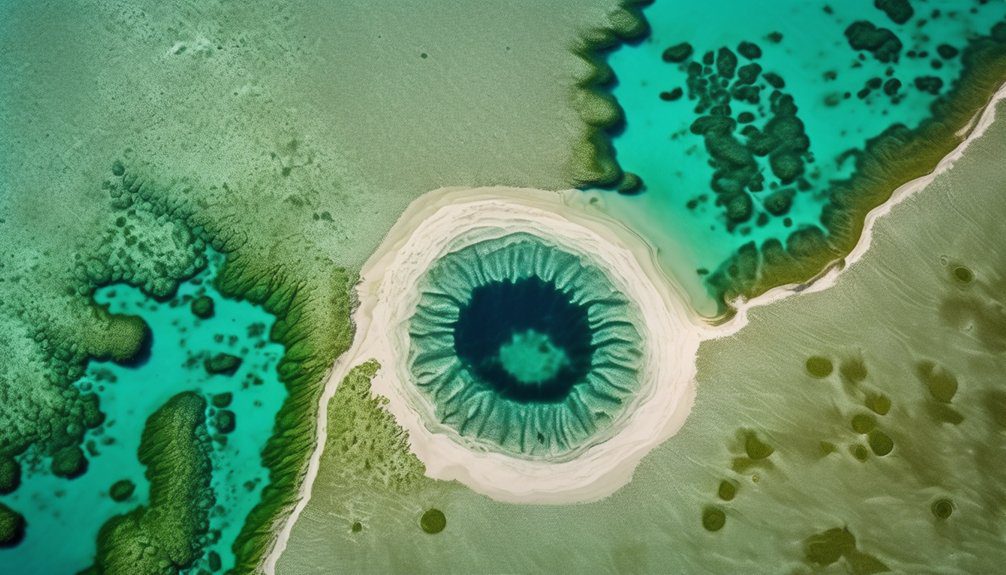
You’ll find the 2025 update on the Baltic Sea Anomaly integrates advanced sonar mapping and underwater imaging, revealing a mostly natural geological formation shaped by erosion and sediment. Recent expeditions used autonomous vehicles to capture detailed data, improving our understanding of the anomaly’s environment. While theories about ancient structures remain, analysis leans toward natural causes. This ongoing research highlights the value of multidisciplinary studies and emerging technology, offering deeper insight into this mysterious underwater feature worth further exploration.
Discovery and Initial Investigations
Although the Baltic Sea Anomaly first gained widespread attention in 2011, its discovery occurred during a routine underwater survey conducted by the Ocean X Team, a Swedish treasure hunting group.
The discovery timeline shows that initial findings revealed an unusual, large object resting on the sea floor. These unusual shapes and formations caught the team’s attention, sparking curiosity about its origin and composition.
As you explore this anomaly, you’ll see how early investigations laid the foundational questions. This initial phase focused on gathering visual data and sonar images, setting the stage for further analysis without jumping to conclusions.
Recent Expeditions and Technological Advances
Several recent expeditions have leveraged advanced technology to explore the Baltic Sea Anomaly in greater detail.
You can now access clearer insights thanks to advanced imaging and enhanced sonar technology. These tools allow a more precise examination of the anomaly’s shape and composition, supporting your quest for understanding without constraints.
Key technological advances include:
- High-resolution sonar mapping for accurate underwater topography.
- Advanced imaging systems capturing detailed visual data.
- Autonomous underwater vehicles enabling extended exploration.
- Real-time data transmission to surface teams.
Geological and Environmental Assessments
When you examine the Baltic Sea Anomaly from a geological and environmental perspective, you gain essential insights into its formation and current state.
The anomaly’s unique geological formations suggest a combination of natural rock structures altered by erosion and sediment deposition over time. Understanding these formations helps clarify the environmental impact of the anomaly on surrounding marine ecosystems.
Analyzing Theories and Hypotheses
Building on the geological and environmental information, you can examine various theories and hypotheses that attempt to explain the Baltic Sea Anomaly’s origin and nature.
These anomaly theories range widely, reflecting diverse interpretations. You should consider:
- Natural geological formations shaped by underwater erosion.
- Remnants of ancient human structures submerged over millennia.
- Unusual underwater archaeological artifacts linked to lost civilizations.
- Geological phenomena yet to be fully understood by science.
Implications for Future Research and Exploration
Although the Baltic Sea Anomaly has sparked numerous theories, its ambiguous nature presents unique challenges and opportunities for future research and exploration.
You’ll find that future implications include developing advanced imaging technologies and conducting multidisciplinary studies to uncover its origin.
Research directions should focus on precise mapping, material analysis, and environmental impact assessment to provide clearer insights.
By embracing open collaboration and innovative methods, you can help navigate the uncertainty surrounding the anomaly.
This approach guarantees that exploration remains grounded in evidence, guiding you toward meaningful discoveries while respecting scientific rigor and the freedom to question established ideas.
