

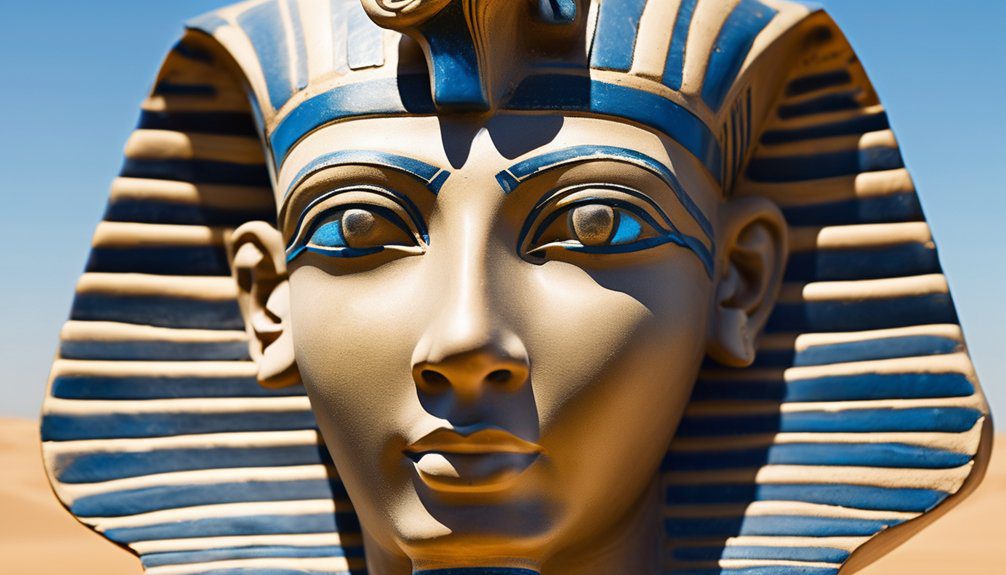
You might wonder if ancient Egyptians were Black, but genetic studies show their ancestry was diverse. Their DNA reveals connections to populations in Africa, the Near East, and the Mediterranean, reflecting a complex mix rather than a single racial group. This diversity resulted from Egypt’s location as a cultural crossroads influencing language, customs, and genetics. Understanding their identity requires looking beyond modern racial categories to see a rich, intertwined history. More details explain this complexity further.
Historical Context of Ancient Egyptian Population
Although the ancient Egyptian population lived thousands of years ago, understanding their historical context is essential to grasp their identity.
You should consider how geographical influences shaped their society, as Egypt’s location bridged Africa and the Near East, creating a unique environment. This position encouraged cultural exchanges with neighboring regions, affecting language, art, and customs.
These interactions contributed to a diverse and dynamic population, blending various traits over time. By examining these factors, you can better appreciate the complexity of ancient Egyptians beyond simplistic racial categories, recognizing their identity as a product of both environment and intercultural connections.
Overview of Genetic Research on Ancient Egyptians
As genetic research techniques have advanced, scientists have been able to analyze ancient Egyptian DNA to gain insights into their ancestral origins and population dynamics.
By examining genetic markers, researchers trace connections to various groups involved in ancient migrations across Africa and the Near East. These markers reveal a complex genetic landscape shaped by interactions over millennia, rather than a single, uniform identity.
Understanding this diversity helps you appreciate how ancient Egyptians were influenced by multiple populations. This research provides a clearer picture of their genetic heritage, highlighting the importance of migration and gene flow in shaping their unique genetic profile.
Findings From Recent DNA Analysis of Mummies
When researchers have conducted DNA analysis on ancient Egyptian mummies, they’ve uncovered valuable information about the population’s genetic makeup.
Mummy genetics reveal a complex picture of ancient ancestry, showing connections across regions. These findings include:
- Genetic links to populations in the Near East and northeastern Africa
- Evidence of genetic continuity over several millennia within Egypt
- Variations indicating diverse backgrounds among individuals
- Limited sub-Saharan African genetic markers in some samples
Interpretation of Genetic Diversity in Ancient Egypt
Since ancient Egypt was located at a crossroads between Africa, the Near East, and the Mediterranean, its genetic diversity reflects a mixture of influences from these regions.
When you examine genetic markers from ancient Egyptian remains, you see evidence of varied ancestral origins, indicating a complex population history.
This diversity shows that Egyptians shared genetic traits with neighboring populations rather than belonging to a single, homogeneous group.
Understanding these genetic markers helps you appreciate how migration, trade, and interaction shaped Egypt’s gene pool, providing a nuanced picture of its people’s biological heritage without oversimplifying their identity.
Implications for Understanding Ancient Egyptian Identity
Although genetic evidence reveals a diverse ancestry, it doesn’t define ancient Egyptian identity on its own. You must consider cultural identity beyond genetic markers, as racial classification often oversimplifies history.
Understanding ancient Egyptians involves appreciating:
- Their shared language, religion, and customs that shaped social cohesion.
- The fluidity of identity in a crossroads region bridging Africa and the Near East.
- How modern racial categories don’t fit ancient contexts.
- The importance of archaeological and textual evidence alongside genetics.
Frequently Asked Questions
How Did Ancient Egyptian Art Depict Skin Color Variations?
In ancient art, you’ll see skin tones varying by gender and role—men often depicted with reddish-brown hues, women with lighter tones. These choices weren’t just aesthetics; they reflected cultural symbols and social identities of the time.
What Languages Did Ancient Egyptians Speak and How Do They Relate to Identity?
You’ll find ancient Egyptians spoke hieroglyphic and later Coptic languages, shaping identity through linguistic evolution. These languages connected culture, beliefs, and power, helping you understand how language freedom influenced identity formation across time.
Were There Significant Migrations Into Egypt During Ancient Times?
Yes, you’ll find significant migration patterns into Egypt, fueled by ancient trade routes. These movements shaped Egypt’s rich culture, showing how freedom of movement and exchange influenced its diverse identity over time.
How Do Modern Egyptians Relate Culturally to Their Ancient Ancestors?
You embrace a rich cultural heritage that shapes your modern identity, blending ancient traditions with contemporary values. This connection empowers you to celebrate freedom while honoring the legacy of Egypt’s enduring civilization.
Did Ancient Egyptians Have Diverse Physical Features Beyond Skin Color?
Yes, ancient Egyptians had diverse facial features and hair textures, reflecting their geographic crossroads. You’ll see a variety of appearances, showing they weren’t confined to one look, embracing a broader human freedom in identity.