

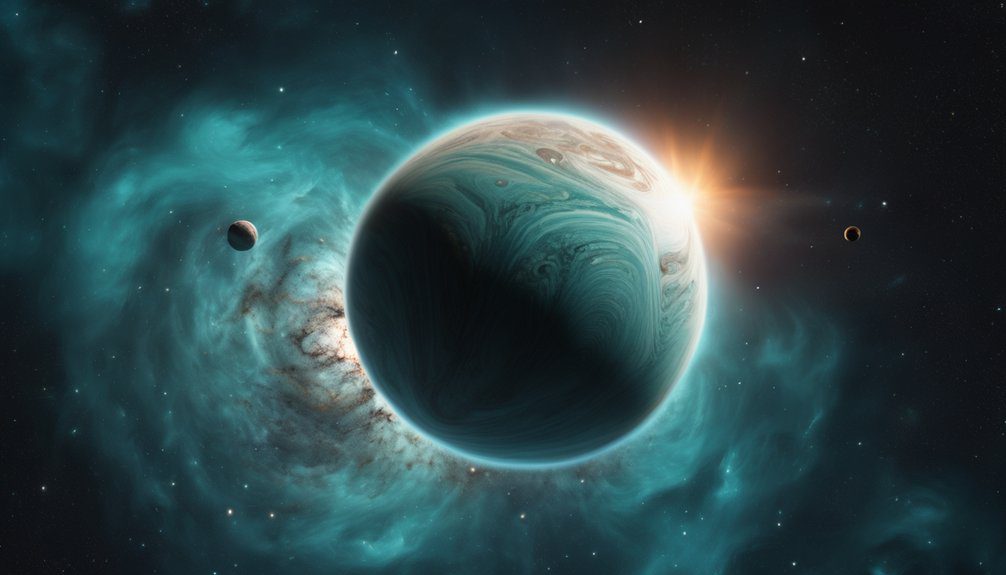
TOI-1452b is an exoplanet identified by TESS, known for its vast, global oceans hidden beneath a thick icy crust. Its dense atmosphere and possible ice layers set it apart from other ocean worlds like Europa. These conditions might support life similar to Earth’s deep-sea vents. Scientists study its unique environment to better understand planetary habitability. Exploring TOI-1452b opens new insights into how water-rich planets form and sustain potential life.
Discovery and Observation of TOI-1452b
Although exoplanet discoveries have become more common in recent years, the identification of TOI-1452b stands out due to its unique characteristics.
You’ll find that the TOI 1452b discovery resulted from careful analysis of data collected by the Transiting Exoplanet Survey Satellite (TESS). During TOI 1452b observation, astronomers monitored periodic dips in light from its host star, indicating the planet’s presence.
This method allowed precise measurements of the planet’s size and orbit. By focusing on these signals, you can appreciate how the discovery and observation of TOI-1452b contribute to our understanding of potentially habitable exoplanets.
Characteristics of the Water World Planet
When you examine the characteristics of a water world planet like TOI-1452b, you’ll find that its composition and structure differ greatly from rocky planets like Earth.
This planet is dominated by vast oceanic features beneath a dense, possibly icy crust. Its atmospheric composition likely includes gases that create a thick, insulating layer, protecting the liquid water below.
You can appreciate how this environment challenges traditional ideas of planetary make-up.
- Expansive global oceans, unlike Earth’s scattered seas
- Thick atmosphere with unique gaseous blends
- Possible ice layers separating ocean from rocky core
- Structure supporting freedom from dry land constraints
Potential for Life on TOI-1452b
Since TOI-1452b features extensive global oceans beneath a thick atmosphere, it presents intriguing conditions for potential life.
You’ll want to take into account key habitability factors such as temperature stability, chemical composition, and energy sources that might support biological processes.
The planet’s deep oceans could foster potential ecosystems similar to Earth’s hydrothermal vent communities, where life thrives without sunlight.
However, the thick atmosphere might influence surface conditions and nutrient cycling.
While direct evidence is lacking, these habitability factors suggest TOI-1452b holds promise as a candidate for hosting life, warranting further exploration and study.
Comparison With Other Ocean Worlds
Understanding TOI-1452b’s potential for life sets a foundation for comparing it with other known ocean worlds in our solar system and beyond.
When you explore ocean worlds through exoplanet comparisons, you notice unique traits that distinguish TOI-1452b. Unlike Europa or Enceladus, it boasts a thicker ice shell and possibly deeper oceans. These differences matter when considering habitability and exploration.
As you reflect on ocean worlds, keep in mind:
- Vast hidden oceans beneath icy crusts
- Varied potential for life-supporting conditions
- Differences in atmospheric composition and pressure
- Their role in expanding your understanding of habitable zones
Future Missions and Research Directions
As research into ocean worlds like TOI-1452b advances, space agencies and scientists are planning targeted missions to gather more detailed data on their environments.
Future exploration will likely rely on potential technologies such as advanced telescopes, spectrometers, and possibly robotic probes designed to analyze atmospheric and surface compositions remotely.
These tools will help you better understand the planet’s water-rich characteristics and assess its habitability.
Continued study aims to refine models of ocean worlds, guiding the development of missions that explore similar exoplanets.
This research will expand your knowledge of planetary systems and the possibilities for life beyond Earth.
Frequently Asked Questions
How Was TOI-1452B Named and Who Discovered It?
You’ll find TOI-1452b’s name came from the naming process tied to the TESS mission’s catalog. The discovery team, using TESS data, actively identified and confirmed this intriguing exoplanet beyond our solar system.
What Technology Was Used to Detect TOI-1452B?
You’ll detect TOI-1452b using the transit method, watching its star dim as the planet crosses. Then, spectral analysis helps you study its atmosphere, revealing secrets while giving you the freedom to explore beyond Earth’s limits.
How Far Is TOI-1452B From Earth?
You’ll find TOI-1452b about 100 light-years away from Earth. Distance measurements like this fuel planetary exploration, giving you the freedom to dream about traveling beyond our solar system and exploring new, watery worlds.
What Challenges Exist in Studying Water Worlds Like TOI-1452B?
You’ll face challenges like deciphering atmospheric composition through faint signals and understanding tidal forces that shape the planet’s environment. These hurdles make exploring water worlds tricky but thrilling if you crave cosmic freedom.
Could TOI-1452B Have Moons or Rings?
Yes, TOI-1452b could have moons or ring systems, since moon formation often happens around such planets. You’ll want to explore further, as these features could reveal much about its history and environment.