

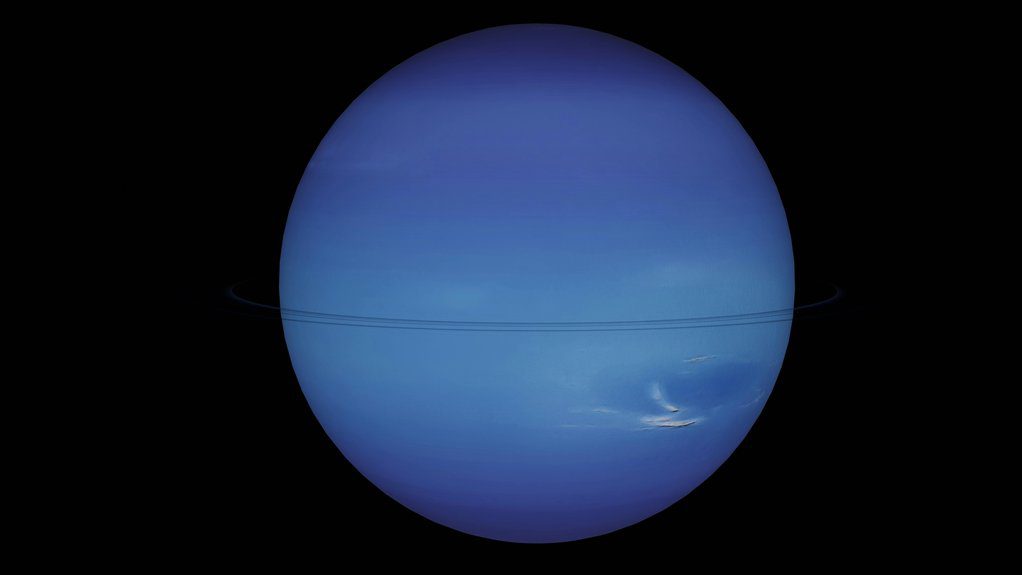
You’ve discovered a planet with rings larger than Saturn’s, but it orbits closer to the sun than expected. Unlike Saturn’s icy rings, this planet’s bands mix rock and ice, showing diverse ring compositions. Its rings move chaotically due to stronger gravitational forces, challenging our ideas about where ring systems can form and how planetary systems develop. Understanding this planet reveals new details about celestial dynamics and planetary formation. Exploring further uncovers more on these surprising rings.
The Unexpected Location of the Ringed Giant
Although planets with prominent ring systems are often found in the outer regions of our solar system, this particular ringed giant defies expectations by occupying an unusual location.
You might assume that such a planet would be far from the sun, where colder temperatures favor ring formation. However, this planet resides closer in, challenging traditional views on celestial dynamics.
The processes that led to its extensive rings involve complex interactions between gravitational forces and orbital debris, showing that ring systems can develop under a wider range of conditions than previously thought.
Comparing the New Planet’s Rings to Saturn’s
Ring systems offer valuable clues about a planet’s formation and environment, so comparing the new planet’s rings to Saturn’s helps you understand their similarities and differences.
Unlike Saturn’s rings, which are primarily made of water ice, the new planet’s ring composition includes a mix of rock and ice, suggesting a different origin.
You’ll also notice that the ring dynamics vary; Saturn’s rings exhibit stable, well-defined structures, while the new planet’s rings show more chaotic movements, likely influenced by stronger gravitational interactions.
These differences in ring composition and dynamics reveal how environmental factors and planetary characteristics shape ring systems.
Implications for Our Understanding of Planetary Systems
Since this newly discovered planet has rings larger and compositionally different from Saturn’s, it challenges some of the assumptions we hold about how planetary systems develop.
You’ll find that planet formation theories must now account for a wider range of ring structures and materials. This discovery suggests that celestial dynamics can produce diverse ring systems even in unexpected locations, altering the way you think about planetary evolution.
It also prompts a reevaluation of how gravitational forces and particle interactions shape these rings over time. By studying this planet, you’ll gain new insights into the processes that govern system stability and ring longevity.
Ultimately, this expands your understanding of planetary system diversity and encourages more flexible models in future research.
Frequently Asked Questions
What Is the Name of the Newly Discovered Ringed Planet?
The newly discovered ringed exoplanet is called J1407b. You’ll find its exoplanet characteristics fascinating, especially its massive ring formation, which surpasses Saturn’s rings, offering unique insights into planetary ring dynamics and evolution.
How Far Is This Planet From Earth?
The planet’s distance from Earth measures roughly 300 light-years, using astronomical measurements. So, when you think about planet distance, it’s incredibly vast—making this ringed world a distant marvel you can only observe through powerful telescopes.
What Methods Were Used to Detect the Planet’s Rings?
You’ll find the planet’s rings through ring detection using astronomical techniques like transit photometry and direct imaging. These methods let you observe light dimming and capture visuals, revealing the massive ring system clearly from afar.
Could This Planet Support Life?
You probably shouldn’t expect habitable conditions there since the planet’s extreme environment likely prevents life as it is understood. Still, the search for extraterrestrial life keeps pushing boundaries, so don’t rule anything out completely.
When Was This Planet Discovered?
You’ll find the planet discovery happened in recent years, marking a huge astronomical significance. It’s impressive how this finding expands our understanding of planetary rings, showing you there’s still so much to learn beyond our solar system.