

NVIDIA DLSS 5 was supposed to be the company’s biggest visual leap in years. Instead, it has become one of the most divisive GPU announcements in recent memory, with thousands of gamers accusing it of destroying the art direction of the games they love.
Since the technology was unveiled at GTC 2026 in March, social media has been flooded with side-by-side screenshots showing characters that look less like carefully designed game art and more like AI-generated stock imagery. The backlash is loud, specific, and not going away. And when Jensen Huang responded by telling gamers they were “completely wrong,” he turned a product controversy into a trust problem.
Here is what is actually happening with DLSS 5, what gamers are objecting to, and whether their complaints hold up under scrutiny.
What DLSS 5 Actually Does
Unlike previous versions of Deep Learning Super Sampling, DLSS 5 does not simply upscale a lower-resolution image to a higher one. It takes a game’s color and motion vectors as input and uses an AI model to regenerate the scene from scratch, infusing it with what NVIDIA describes as “photoreal lighting and materials anchored to source 3D content.”
The AI model is trained to understand scene semantics including characters, hair, fabric, and skin. It then generates its own interpretation of how those elements should look under the detected lighting conditions, overwriting what the game’s original renderer produced. DLSS 5 runs in real time at up to 4K resolution and requires an RTX 50 series GPU (Blackwell architecture), making it exclusive hardware from the outset.
NVIDIA showed the technology running on Resident Evil Requiem, Starfield, Hogwarts Legacy, Assassin’s Creed Shadows, and The Elder Scrolls IV: Oblivion Remastered among others, with a full commercial rollout planned for Fall 2026.
The demo hardware was a dual RTX 5090 setup, though NVIDIA confirmed the feature will work on a single RTX 50 GPU.
The Visual Artifacts and Ghosting Complaints
The specific problems gamers are describing fall into a few recurring categories.
The most frequently cited issue is what people are calling “over-smoothing.” Characters that were designed with deliberate roughness, grime, texture, or stylized detail come out the other side of DLSS 5 looking airbrushed. Skin that was meant to look weathered, scarred, or gaunt ends up with the plastic sheen of a beauty filter. The AI model is essentially deciding what “photorealistic” means and applying its interpretation regardless of what the original artists intended.
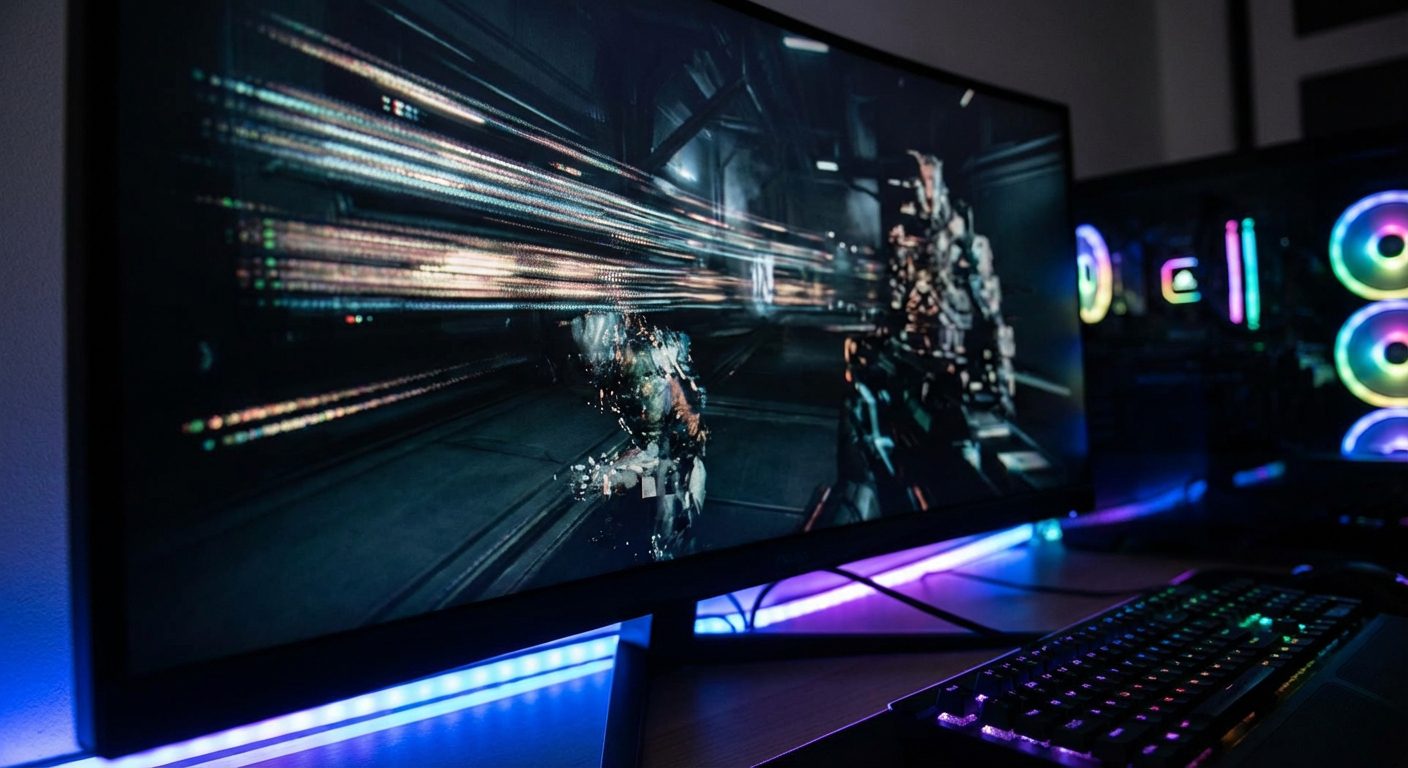
Ghosting is a separate complaint, particularly on fast-moving objects and hair. Because DLSS 5 generates frames using motion vectors and a single-frame analysis rather than traditional rendering, rapid movement can produce trailing artifacts where the AI has misjudged where elements should be. This is most visible at the edges of character models.
The third issue is more philosophical than technical: the feeling that the original art direction has been overridden. When gamers posted before-and-after screenshots of Grace Ashcroft and Leon Kennedy from Resident Evil Requiem with DLSS 5 enabled, the reaction was immediate. The characters looked different, not just better-lit. The faces had been subtly regenerated rather than simply enhanced. One commenter on Reddit described it as “AI vandalism.”
TechRadar published a headline capturing the community’s tone almost exactly: gamers were calling DLSS 5 a “yassification machine” that had turned carefully designed characters into “looks-maxed freaks.”
Jensen Huang’s “Completely Wrong” Response
The controversy would likely have remained a niche GPU discussion if not for what happened next. When asked about the backlash at a press Q&A session, Jensen Huang did not acknowledge the concerns. He said, simply: “Well, first of all, they are completely wrong.”
He followed that by stating artistic control remains with developers, and that NVIDIA DLSS 5 provides game studios with “detailed controls for intensity, color grading and masking” so artists can determine where and how enhancements are applied.
The response landed badly. As Huang has positioned NVIDIA as a company transforming every creative industry through AI, many gamers read his dismissal as confirmation of their fear: that NVIDIA genuinely believes its AI knows better than the artists who made the games. The Medium analysis of the incident put it plainly: “What started as a technology debate became something far more personal.”
The Gamers Nexus community thread on Reddit, titled “NVIDIA Says You’re Completely Wrong About DLSS 5 Being Slop,” received thousands of comments. The sentiment was not that the technology was bad by default. It was that gamers did not want it applied without meaningful player-side controls, and that being told they were wrong for noticing visible changes felt condescending.
Are the Complaints Technically Justified?
Partially. The over-smoothing and character alteration complaints appear to be real based on the demonstration footage. DLSS 5 is not a filter applied on top of a game’s renderer; it partially replaces the rendered output with AI-generated imagery. When that AI generates something that does not match the original artistic intent, the difference is visible.
The ghosting complaints are harder to assess at this stage since DLSS 5 has not reached consumers yet. The GTC demonstrations were controlled environments running on dual RTX 5090 hardware. Performance under real-world conditions on a single RTX 5080 or RTX 5070, at varying frame rates, may produce different artifact profiles.
What NVIDIA’s defense gets right is that developer control is built into the framework. Studios can mask specific regions, adjust intensity, and opt in or out of specific enhancements. Whether those controls will be exposed to players as in-game settings is a separate question, and one NVIDIA has not clearly answered.
For context, upscaling controversies are not new. Sony’s PS5 Pro upscaling drew similar early criticism about over-processing, and earlier GPU visual enhancements like ray tracing have faced their own adoption friction. What separates the DLSS 5 situation is the degree of image regeneration involved. Previous upscaling filled in missing pixels. DLSS 5 generates new visual data using a probabilistic AI model, which is a fundamentally different intervention.
What Happens When DLSS 5 Ships in Fall 2026
The technology is scheduled to release this fall, and a significant number of major titles have already committed to supporting it. Publishers including Bethesda, Capcom, Ubisoft, and Warner Bros. Games are on the confirmed list.
The practical question for you as a player will be simple: can you turn it off? If DLSS 5 ships as an opt-in feature with per-game toggles and visible before/after comparisons, the backlash will mostly dissolve. Players who want the AI-enhanced look can use it; those who prefer the original renderer can disable it.
If it ships as a default-on setting with limited player control, or if developers are pressured to enable it as a performance feature without matching quality controls, the complaints will intensify significantly.
NVIDIA has the technology to make DLSS 5 work well. The question is whether it will give players enough control to make it work for them. Jensen Huang’s response suggests the company believes it already has the answer. The gaming community’s reaction suggests it is not that simple.
Frequently Asked Questions
What is causing DLSS 5 visual artifacts and ghosting?
DLSS 5 uses an AI model to regenerate frame imagery rather than simply upscaling existing pixel data. Ghosting occurs when the AI misinterprets fast-moving objects or edges based on motion vectors, while over-smoothing happens when the model applies its own photorealistic interpretation over deliberately stylized character designs.
Can you disable DLSS 5 in games?
NVIDIA has confirmed that developers have controls for where and how DLSS 5 is applied, including masking and intensity settings. Whether players will have an in-game toggle to disable it entirely will depend on each studio’s implementation. This has not been standardized yet as of the GTC 2026 announcement.
Which games are most affected by the DLSS 5 controversy?
The most discussed examples involve Resident Evil Requiem, where characters Grace Ashcroft and Leon Kennedy showed noticeably altered facial details with DLSS 5 enabled. Starfield and Hogwarts Legacy were also featured in early demos where the AI-enhanced output differed visibly from the original art style.
Does DLSS 5 only work on RTX 50 series GPUs?
Yes. Unlike DLSS 4 and earlier versions which were gradually extended to older RTX hardware, DLSS 5 is designed specifically for Blackwell architecture (RTX 50 series). The GTC 2026 demo ran on dual RTX 5090 GPUs, though NVIDIA confirmed it will function on a single RTX 50 GPU at launch.
Is Jensen Huang right that gamers are “completely wrong” about DLSS 5?
The technical complaints about character alteration and ghosting are grounded in observable output from the demo footage. Whether that constitutes a problem depends on implementation and player control. Huang’s position is that developers retain artistic control through the DLSS 5 toolset, which is technically accurate but does not address whether players will have the ability to opt out.
