

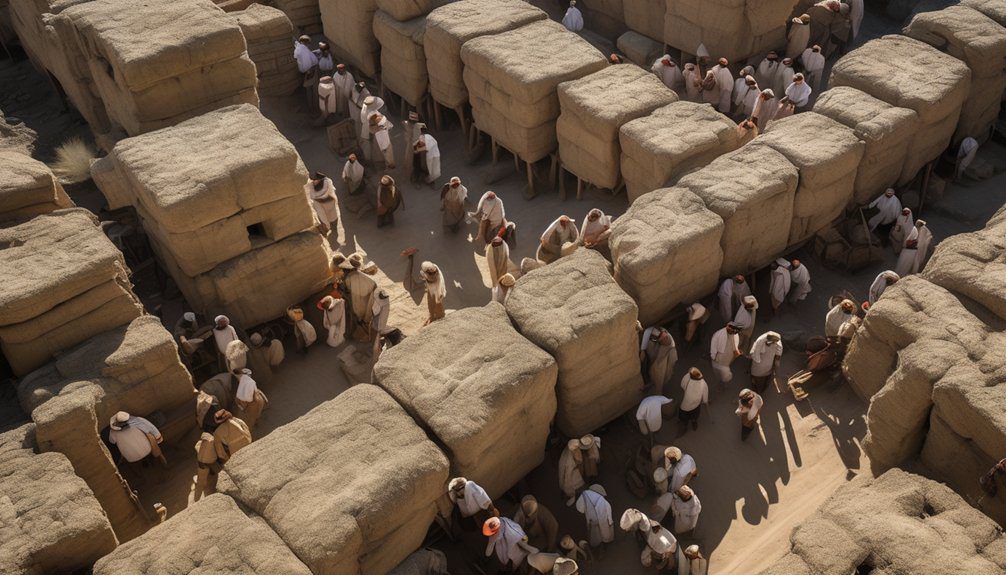
You lifted 1000-ton stones by using wooden sledges and plant-fiber ropes to move them over lubricated surfaces, often placed on logs or prepared paths. Carefully built ramps reduced the effort needed to raise these massive stones, while levers helped shift them incrementally. Human and animal labor worked together, coordinating strength and endurance. Early civilizations combined these tools with precise engineering to manage such feats. Exploring further reveals the innovative methods behind these impressive constructions.
Ancient Tools and Materials Used for Moving Megaliths
Ancient builders relied on a combination of simple but effective tools and natural materials to move massive megaliths.
You’d find that ancient lifting techniques often involved wooden sledges, ropes made from plant fibers, and lubricated surfaces to reduce friction during stone transportation. These materials were readily available, durable, and adaptable for different terrains.
Workers coordinated efforts to slide or roll stones over logs or prepared paths, maximizing mechanical advantage without modern machinery.
The Role of Ramps and Levers in Lifting Heavy Stones
Although moving massive stones posed significant challenges, builders effectively used ramps and levers to lift and position them with precision.
You’d rely on carefully engineered ramp designs, which provided gradual inclines to reduce the force needed to raise stones. Lever systems amplified your strength, allowing you to shift heavy loads incrementally.
Combining these methods, you could maneuver 1000-ton stones without modern machinery. The ramps served as stable pathways, while levers helped adjust the stone’s position at critical points.
Understanding these techniques shows how ancient builders exercised ingenuity, applying basic physics principles to achieve freedom in construction.
Evidence of Human and Animal Labor in Stone Transportation
When you examine the transportation of massive stones, you find clear evidence that both human and animal labor played essential roles in the process.
Human labor provided the coordinated effort needed to pull, push, and guide these heavy stones over long distances.
Meanwhile, animal power, such as oxen or horses, supplemented this effort by adding strength and endurance, especially on difficult terrain.
Archaeological findings, like wear marks on tools and animal harnesses, support this combined approach.
Understanding this collaboration helps you appreciate the resourcefulness of ancient builders who maximized available forces without modern machinery.
Innovative Engineering Techniques of Early Civilizations
Since moving massive stones required more than just brute strength, early civilizations developed innovative engineering techniques to solve complex construction challenges.
You’d notice they carefully planned stone alignment to guarantee stability and precise positioning, reflecting not only practical needs but also cultural significance.
They used ramps, levers, and rolling logs to maneuver heavy blocks, demonstrating a deep understanding of physics.
This approach allowed them to lift and place stones with remarkable accuracy, preserving sacred traditions.
Modern Experiments Recreating Megalith Lifting Methods
Understanding the techniques early builders used to move massive stones has inspired modern researchers to replicate these methods through practical experiments.
You can observe how modern experiments test ancient techniques like levering, rolling, and using inclined planes to lift heavy megaliths. By recreating these processes, researchers identify the physical principles and human effort involved, offering insights into ancient engineering.
These controlled trials help you appreciate the ingenuity and resourcefulness of early civilizations without relying on modern machinery. Such experiments bridge the past and present, revealing how freedom in problem-solving led to impressive construction feats.