

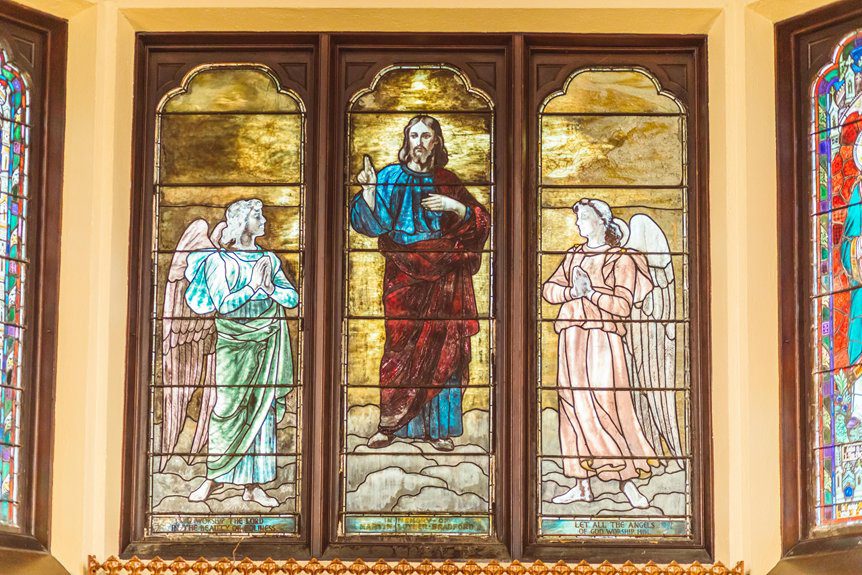
You might expect angels to look gentle and human-like, but biblically accurate angels are quite different. They often have multiple faces, eyes, and wings, like the fiery Seraphim with six wings or the guardian Cherubim with four faces and bodies covered in eyes. These awe-inspiring beings serve divine roles such as delivering judgment and protecting sacred spaces. Their complex forms inspire both fear and reverence, disclosing the deeper, more terrifying truth behind familiar holy imagery. Exploring their nature reveals even more fascinating details.
The Diverse Forms of Angels in Scripture
Although many people picture angels as uniform beings with wings and halos, the Bible presents a variety of angelic forms that differ markedly in appearance and function.
You’ll find that angelic hierarchies include distinct classes, each with unique roles and celestial appearances. Some angels appear as dazzling beings with multiple faces or eyes, while others resemble human figures or even wheels covered in eyes.
Understanding these diverse forms helps you appreciate the complexity of biblical descriptions, moving beyond simple stereotypes to recognize angels as multifaceted messengers serving different purposes within divine order and freedom.
The Seraphim: Fiery Beings With Six Wings
Among the various angelic beings described in the Bible, the Seraphim stand out for their distinctive and striking appearance. You’ll notice their fiery appearance, symbolizing purification and intense devotion.
Each Seraphim has six wings, used in specific ways:
- Two wings cover their faces, showing reverence.
- Two wings cover their feet, expressing humility.
- Two wings enable flight, representing swiftness.
These features emphasize their role as divine attendants, continuously praising and serving God.
Understanding their form helps you appreciate the symbolic depth behind biblical descriptions, offering insight into the spiritual freedom and order they embody in sacred texts.
The Cherubim: Guardians With Multiple Faces and Eyes
The Cherubim serve as powerful guardians in biblical descriptions, distinguished by their multiple faces and eyes.
These cherubim characteristics include four distinct faces—human, lion, ox, and eagle—each symbolizing different aspects of creation and divine authority. Their bodies are covered with eyes, emphasizing their vigilance and awareness.
In their guardian roles, cherubim protect sacred spaces, such as the Garden of Eden and the Ark of the Covenant, preventing unauthorized access. Their terrifying and complex appearance reflects their serious responsibility.
Understanding these features helps you grasp how the Bible portrays cherubim as uniquely equipped protectors within the spiritual domain.
The Role of Angels in Delivering Divine Judgment
When divine judgment is required, angels often act as God’s messengers and enforcers, carrying out specific tasks to bring about justice.
You’ll find that these divine messengers execute angelic retribution with precision and authority. They don’t act on personal will but follow divine commands strictly.
Their role includes:
- Delivering warnings or messages to individuals or nations.
- Executing punishments as decreed by higher powers.
- Guarding sacred boundaries to uphold divine law.
Understanding their function helps you see angels not just as symbols but as active agents ensuring freedom through order and accountability.
Why Biblical Angels Inspire Both Fear and Reverence
Although angels often appear as protectors and guides, their biblical descriptions reveal why they inspire both fear and reverence.
You encounter divine messengers who embody a presence beyond human understanding, evoking a sense of fearful awe. Their appearances often include multiple wings, eyes, and radiant light, which symbolize their closeness to the divine and their immense power.
This combination of otherworldly features and their role as enforcers of God’s will commands respect and caution.
Frequently Asked Questions
Do Angels Have Free Will in Biblical Texts?
Yes, angels in biblical texts possess free will, which is evident through the angelic rebellion led by Lucifer. This event shows angels could choose to obey or defy God, highlighting their capacity for decision-making.
However, they exist within a strict divine hierarchy where obedience is expected. You’ll find that their free will operates within these boundaries, balancing autonomy and submission to God’s supreme authority.
How Do Biblical Angels Differ From Popular Culture Depictions?
You’ll find biblical angels differ greatly from popular culture depictions. Instead of the gentle, human-like figures often shown, biblical angels belong to a complex angelic hierarchy with varied roles.
These celestial beings appear awe-inspiring and sometimes terrifying, reflecting divine authority rather than friendliness. Their descriptions emphasize power and mystery, often involving multiple wings or eyes, which contrasts sharply with the simplified, approachable images common in media and art today.
Are Angels Considered Genderless Beings in the Bible?
Angels in the biblical angelic hierarchy are generally considered genderless celestial beings.
The Bible doesn’t assign them a specific gender, as their purpose transcends human traits like gender identity.
While they sometimes appear in masculine form for communication, their essence is spiritual and not bound by human characteristics.
This understanding helps you see angels as free, divine messengers rather than beings limited by earthly gender distinctions.
What Languages Do Angels Speak According to Scripture?
Angels don’t speak any specific human language according to scripture; instead, they use angelic languages for celestial communication.
These languages are often depicted as divine and beyond human understanding, facilitating direct communication with God and other heavenly beings.
When angels deliver messages to humans, they typically use the local language to guarantee clarity.
Can Humans Become Angels After Death?
You can’t become an angel after death, according to most biblical teachings.
Angelic transformation isn’t part of human posthumous existence; instead, humans are described as entering a spiritual state distinct from angels.
Angels are separate created beings with unique roles, not former humans.
Understanding this distinction helps you grasp spiritual concepts clearly, avoiding confusion between human souls and angelic beings in religious contexts.