

A Rare Visitor From Beyond the Solar System
On July 1, 2025, the Asteroid Terrestrial-impact Last Alert System (ATLAS) flagged what looked like a new asteroid. But follow-up orbital calculations revealed something extraordinary: the object was not bound by the sun’s gravity. Instead, it came from deep interstellar space, making it only the third confirmed interstellar visitor after Oumuamua (2017) and 2I/Borisov (2019).
Named 3I/ATLAS, this comet is streaking through the solar system at 60 kilometers per second, fast enough to escape permanently. According to UCLA astronomer David Jewitt, “It’s the fastest thing we’ve ever seen passing through the solar system.”
A Comet, Not a Spaceship
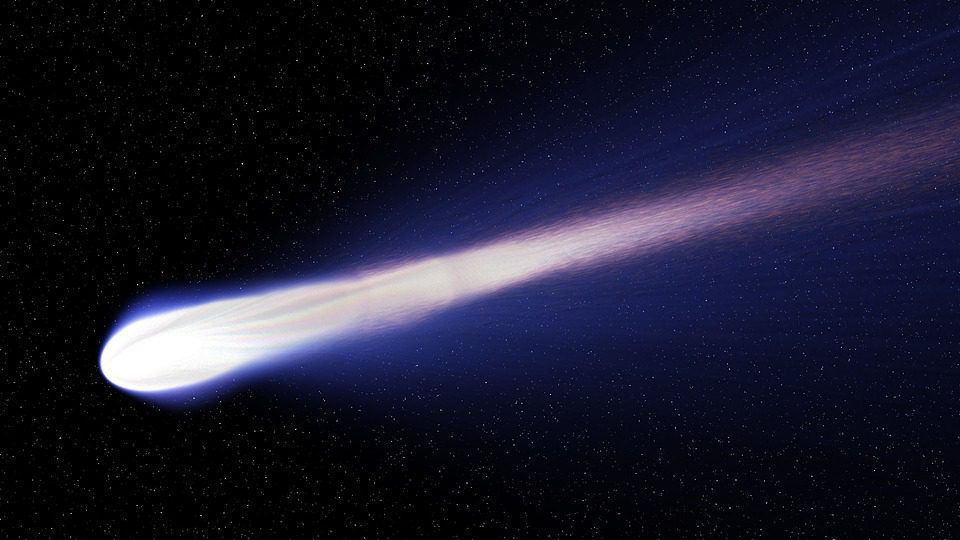
Despite early speculation, astronomers quickly determined 3I/ATLAS is a comet, not alien technology. The James Webb Space Telescope and Hubble both captured images of a coma—a halo of gas and dust surrounding its icy nucleus—and a faint tail pointing away from the sun.
James Wray of Georgia Tech explains: “It looks generally like a comet. But in detail, there are some intriguing differences.”
Strange Polarization and Unusual Chemistry
One key difference is its polarization signature, or the way light scatters from dust particles. Unlike typical solar system comets, 3I/ATLAS emits light polarized in a single direction, hinting at unusual grain size or composition in its dust cloud.
Spectral analysis also shows more carbon dioxide than seen in local comets, alongside carbon monoxide and water ice. At first, scientists thought the comet might be tens of kilometers wide, but new measurements suggest its nucleus is only about 2.8 meters across—hidden beneath its dusty shroud.
How Many More Are Out There?
If three interstellar objects have already been spotted within a decade, there may be thousands more passing through the solar system at any given time. Jewitt estimates around 1,000 such visitors enter and exit per year, though that number could be off by a factor of ten.
The upcoming Vera C. Rubin Observatory in Chile, with its full-sky surveys, could dramatically increase the discovery rate and allow earlier detections for closer study.
In the coming weeks, 3I/ATLAS will slip into the sun’s glare, making it temporarily invisible. It should reappear in December 2025, giving astronomers a fresh chance to study it before it vanishes back into interstellar space.
Meanwhile, on October 3, the comet will pass much closer to Mars than Earth. That timing is ideal for the Mars Reconnaissance Orbiter (MRO), which is expected to capture images with three times the resolution of Hubble.
If the comet survives its solar pass, the best observations may still be ahead.
Each interstellar visitor carries chemical and structural clues from distant planetary systems. With only three confirmed so far, every detail of 3I/ATLAS could help astronomers understand how planets form, how materials move between stars, and whether the building blocks of life are universal.
As Jewitt put it: “This may be the oldest thing we’ve ever seen pass through the solar system.”