

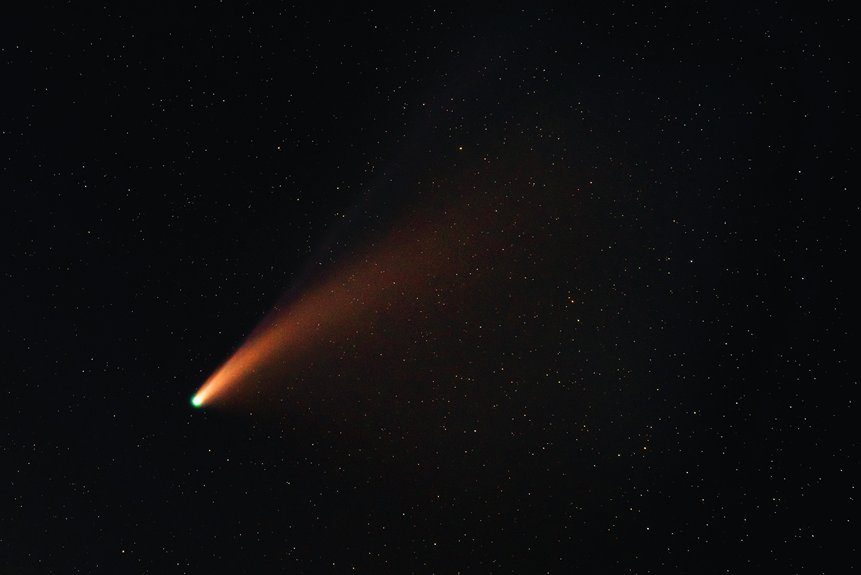
Astronomers have identified 3I/Atlas as an interstellar comet moving rapidly into the inner solar system. You can expect it to brighten as solar heat causes its icy surface to release gases, forming a glowing coma and tail. Studying its unique composition offers insights into distant planetary systems and cosmic origins unlike typical solar system comets. Observing 3I/Atlas’s changes helps scientists understand its behavior and the effects of solar radiation. Further explanations reveal more about this remarkable visitor.
Origins and Journey of 3I/Atlas
Although the exact origins of 3I/Atlas remain under investigation, astronomers have determined that it’s an interstellar comet entering our solar system from beyond.
When you examine the comet discovery, you’ll find it was identified due to its unusual speed and direction, which differ from typical solar system comets.
By tracking its orbital trajectory, scientists can confirm that 3I/Atlas isn’t bound by the Sun’s gravity in the same way as local objects.
This trajectory shows it came from outside our solar system, traveling through space before approaching the inner planets.
Understanding this path helps you appreciate how 3I/Atlas’s journey differs from familiar comets, offering a glimpse into the dynamic movements of objects beyond our solar neighborhood.
Scientific Significance of Interstellar Comets
Because interstellar comets like 3I/Atlas originate outside our solar system, they provide unique scientific opportunities to study material from distant regions of space.
By analyzing their composition, you gain insights into the building blocks of other planetary systems, advancing interstellar exploration. These objects carry pristine material that predates our solar system, helping you understand cosmic origins beyond the familiar environment.
Studying 3I/Atlas allows you to compare its characteristics with those of native comets, revealing differences in chemical makeup and formation processes. This comparison deepens your knowledge of how various star systems evolve.
Fundamentally, interstellar comets act as messengers from afar, offering tangible samples to investigate the broader universe. Your observations contribute to refining models of planetary formation and the distribution of organic compounds across space.
What to Expect as 3I/Atlas Approaches the Sun
As 3I/Atlas moves closer to the Sun, you can expect changes in its brightness and behavior that provide valuable observational opportunities.
The comet’s visibility will increase due to the solar influence heating its surface, causing volatile materials to sublimate and create a glowing coma and tail. This process enhances the comet’s brightness, making it easier to observe with telescopes and, potentially, binoculars.
However, the solar influence also affects the comet’s trajectory and activity, which astronomers will monitor closely. You should anticipate fluctuations in brightness as the comet reacts to varying solar radiation levels.
Tracking these changes will help scientists understand 3I/Atlas’s composition and interaction with solar forces, offering insights into its origin and the nature of interstellar objects entering our solar system.
Frequently Asked Questions
How Was 3i/Atlas First Discovered?
You’ll find 3I/Atlas was first discovered through a careful discovery process using advanced astronomical tools like telescopes and imaging technology, allowing astronomers to spot its unique trajectory and identify it as an interstellar comet.
What Does the Name 3i/Atlas Mean?
You’ll find 3I/Atlas follows comet nomenclature where “3I” means it’s the third identified interstellar object, and “Atlas” is the survey that discovered it. Astronomical designations help you track and classify comets effectively.
Can 3i/Atlas Be Seen With the Naked Eye?
You probably won’t see 3I/Atlas with the naked eye right now, since comet visibility depends on brightness and position. Keep an eye on updates, though—comets can surprise you when they get closer and brighter.
Are Interstellar Comets Dangerous to Earth?
You don’t need to worry much; interstellar threats like cometary impacts are extremely rare. Scientists constantly monitor space, so if an interstellar comet posed danger, you’d hear about it well in advance to stay safe.
How Long Will 3i/Atlas Be Visible From Earth?
You’ll enjoy comet visibility for several weeks as 3I/Atlas approaches. For the best observing tips, use a telescope during clear, dark nights away from city lights to catch its faint, fast-moving glow.