

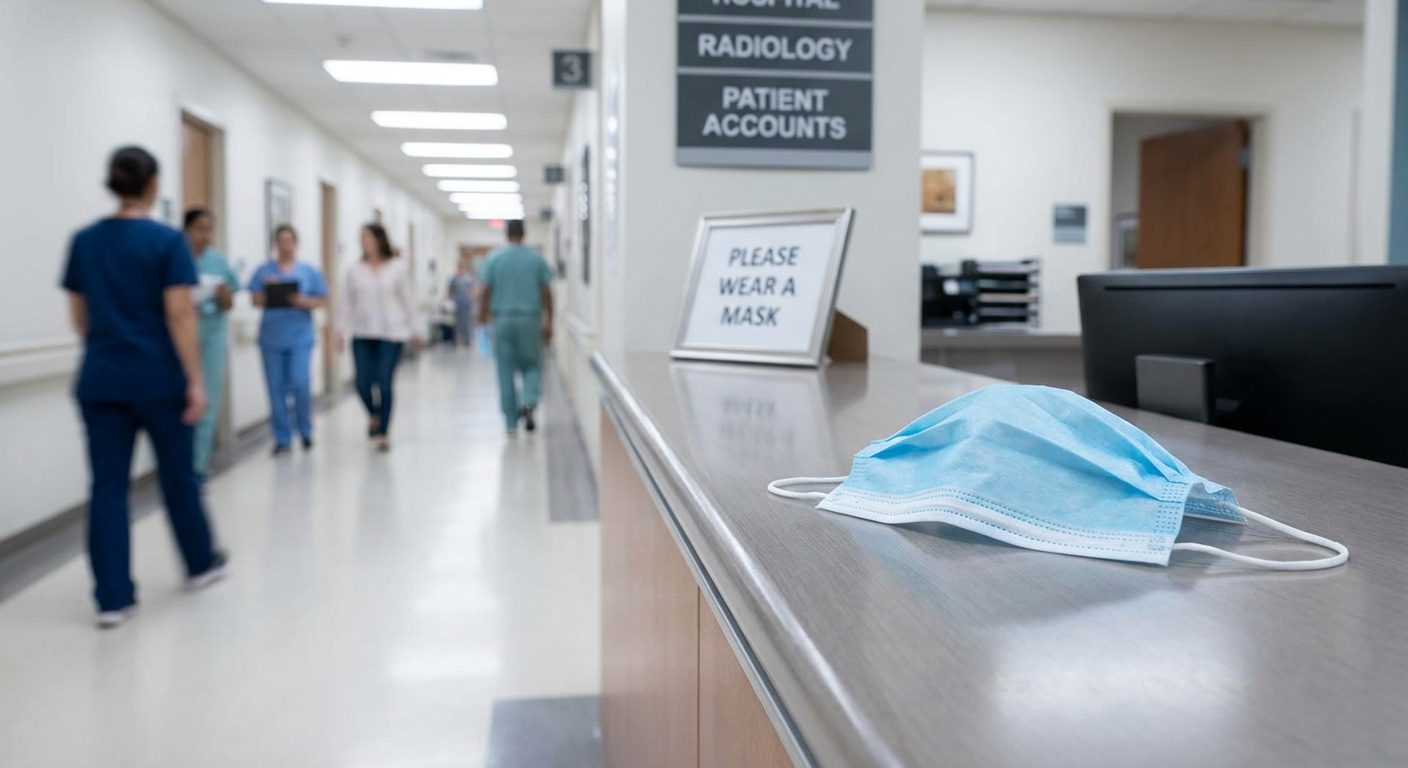
Hospital mask mandates are back in 2026, and this time the push is coming from individual health systems rather than governments. Fenway Health in Boston, the Edward Hines Jr. VA Hospital in Illinois, Novant Health across the Carolinas, and facilities under San Mateo County’s Health Officer Order F25-1 in California all reinstated mask requirements between November 2025 and January 2026. The trigger: a simultaneous surge in influenza A and new COVID-19 variants filling emergency departments faster than staff can handle.
This is not pandemic-era politics. These are targeted, time-limited policies with defined exit criteria. Whether you are a patient, a visitor, or a healthcare worker, the rules have changed at hundreds of facilities across the country, and understanding exactly which hospitals, why, and for how long gives you the clearest picture of what to expect at your next appointment.
Which Hospitals Have Reinstated Mask Requirements in 2026
The most transparent example is Fenway Health in Boston. On January 6, 2026, the organization posted a public announcement stating that, effective January 7, 2026, universal masking in all patient care areas would be mandatory for staff. The policy was issued directly in response to updated guidance from the Massachusetts Department of Public Health, which flagged influenza A emergency room visits escalating from moderate to high across the state. The rule covers waiting rooms, hallways near exam rooms, elevators, and all exam spaces, and applies to everyone regardless of vaccination status.
Fenway Health also published its exit condition: universal masking will end when ER visits for both influenza and COVID-19 return to low levels for two consecutive weeks. That metric-based off-ramp is notable because it removes the politics from the decision and ties the policy directly to surveillance data.
In Illinois, the Edward Hines Jr. VA Hospital announced mandatory mask requirements for all staff providing patient care, effective January 6, 2026. The announcement specified that hospital-provided face masks covering the nose and mouth were required during any patient care activity.
Novant Health, the major nonprofit system operating more than 800 facilities across North Carolina, South Carolina, and Georgia, published updated masking guidance for the 2025-26 virus season in November 2025. Their guidance advises staff and visitors to follow facility-specific masking recommendations, with higher-risk areas such as oncology wards and transplant units maintaining stricter requirements throughout the season.
In California, San Mateo County Health Officer Order F25-1, issued October 15, 2025, mandated face masks for all persons (excluding patients) in patient-care areas of skilled nursing facilities from November 1, 2025 through March 31, 2026. The order covers a county serving more than 750,000 residents and applies to the full winter respiratory virus period as defined by the Health Officer.
Why Mask Policies Are Coming Back Now
Three factors converged to push facilities back toward mandatory masking. First, influenza A activity surged to high levels across multiple U.S. regions in late December 2025 and early January 2026, overwhelming emergency departments in Massachusetts, Illinois, and California. Second, the BA.3.2 subvariant of SARS-CoV-2, nicknamed the Cicada variant, has been detected in wastewater surveillance in 25 U.S. states and confirmed in 23 countries as of early 2026. If you want a full breakdown of what BA.3.2 looks like clinically, the BA.3.2 Cicada variant guide covers its 70-plus spike protein mutations and what that means for prior immunity. Third, RSV (respiratory syncytial virus) activity remained elevated throughout the winter, adding pressure on pediatric and geriatric wards already near capacity.
Hospital administrators are making a clear calculation: when three respiratory viruses circulate simultaneously and beds are filling up, the cost of a nosocomial outbreak that forces ward closures is far higher than the friction of mask requirements. These policies are not a signal of pandemic-level alarm. They are operational risk management, and most facilities have built in automatic sunset clauses tied to surveillance metrics.
What the Science Actually Says About Masks in Hospitals
The evidence base for masking in clinical environments is more nuanced than either side of the debate acknowledges. The 2024 Cochrane Library systematic review on physical interventions to interrupt or reduce the spread of respiratory viruses found that current evidence does not conclusively confirm or deny whether masks slow viral spread in community settings, based on limitations in available randomized trials. That finding was widely misreported as proof that masks do not work when the actual conclusion was closer to: we are uncertain, given the quality of the studies we assessed.
Healthcare settings are meaningfully different from general community settings. A 2024 review published by the National Institutes of Health concluded that masks were effective at stemming SARS-CoV-2 spread in clinical environments, particularly when combined with other infection prevention protocols such as hand hygiene and improved ventilation. A properly fitted N95 respirator worn consistently by trained clinical staff performs very differently from a loosely worn surgical mask worn intermittently by a casual visitor, and that distinction matters enormously when interpreting the research.
The current hospital policies reflect this reality. Most facilities are requiring surgical masks for visitors and general staff, while recommending or requiring N95 respirators for staff in high-risk clinical areas. That tiered approach is consistent with CDC healthcare infection control guidance, which recommends masking during periods of elevated respiratory virus activity in healthcare settings.
If you have been experiencing shortness of breath while sitting or other respiratory symptoms, health systems with active mask requirements will ask you to mask up at check-in and may route you to a separate intake area before you see any clinical staff.
How Patients and Staff Are Responding
Reactions from healthcare workers split largely along generational and specialty lines. Nurses and physicians who worked through 2020 and 2021 at busy urban hospitals generally support the return of seasonal masking without much resistance. The prevailing attitude in that cohort is that the mask protects in both directions: it protects the immunocompromised patients who cannot afford to catch influenza, and it protects the clinician from missing a week of work with a preventable illness.
Pushback tends to come from two directions. Some frontline staff in outpatient and administrative roles report mask fatigue and frustration that requirements feel like a step backward rather than a seasonal norm. A smaller group of patients has expressed discomfort with requirements, citing physical discomfort and, in some cases, political objections. Hospitals are managing this by keeping communication clear and impersonal: the requirement is tied to surveillance metrics, not ideology, and it ends automatically when the epidemiological threshold is met.
Visitor compliance varies significantly by region. In Boston and the Bay Area, where public health messaging has historically been well-received, compliance at facilities with active requirements has been high, according to staff accounts. Some visitors across the Southeast and Midwest have pushed back verbally, though actual non-compliance is rare once masks are available at the entrance and staff ask once, clearly.
Patients managing post-viral symptoms, including brain fog after COVID, or those with chronic respiratory conditions may find prolonged masking uncomfortable. Most facilities with active requirements accommodate these patients by offering telehealth alternatives or designating lower-traffic waiting areas where clinical safety allows.
What to Do Before Your Next Hospital Appointment
Mask policies vary by facility, department, and sometimes by individual floor or unit. The most useful thing you can do before an appointment is check the hospital website for a current infection control notice or call the facility directly. Do not assume that because a nearby hospital is not masking, yours is not either.
If you are visiting a loved one in a skilled nursing facility in California, the San Mateo County Health Officer Order and similar orders in other Bay Area counties require masks through March 31, 2026, for all visitors and staff in patient care areas.
For outpatient visits at large health systems like Novant Health, the masking guidance may be advisory rather than mandatory in low-risk departments. For visits to VA medical centers, check the specific facility directly, as policies are being set at the facility level rather than systemwide.
Bringing your own N95 respirator is always an acceptable alternative to a facility-provided surgical mask. If you are immunocompromised, visiting an immunocompromised patient, or going into an oncology or transplant ward, an N95 offers meaningfully better protection than a surgical mask regardless of what the facility requires.
Frequently Asked Questions
Are hospitals across the U.S. requiring masks in 2026?
Not universally. Several major health systems, including Fenway Health in Boston, Edward Hines Jr. VA Hospital in Illinois, Novant Health in the Carolinas, and facilities under California county health orders, reinstated mandatory masking for staff and visitors in late 2025 and early 2026. These are facility-level decisions tied to local respiratory virus surveillance data, not a national mandate. Check directly with your hospital before visiting.
When will hospital mask requirements end in 2026?
Fenway Health has published a specific exit condition: masks will no longer be required once emergency room visits for both influenza and COVID-19 stay at low levels for two consecutive weeks. San Mateo County Health Officer Order F25-1 runs through March 31, 2026. Other facilities are monitoring respiratory virus activity week by week and have not published fixed end dates.
Do surgical masks actually prevent COVID-19 spread in hospitals?
The evidence is stronger in healthcare settings than in community settings. A 2024 NIH-published review found masks effective at stemming SARS-CoV-2 spread in clinical environments when combined with other infection control measures. The 2024 Cochrane systematic review expressed uncertainty about community-setting effectiveness but did not conclude masks are ineffective. In hospitals, consistent use by trained staff is the critical variable.
What is the BA.3.2 variant and why does it matter for hospital mask policies?
The BA.3.2 subvariant of SARS-CoV-2, nicknamed the Cicada variant, carries 70 to 75 mutations in its spike protein, more than any dominant variant since Omicron. As of February 2026, it had been detected in wastewater surveillance across 25 U.S. states. While it has not caused a dramatic increase in severe illness, its immune escape characteristics and simultaneous circulation with influenza A create heightened risk in clinical settings, contributing to the wave of precautionary masking policies.
Can a hospital turn you away for not wearing a mask?
Hospitals are private medical facilities and can set entry conditions as part of their infection prevention policies. In practice, most facilities provide masks at the entrance and ask visitors to comply. Those who refuse may be directed to a designated waiting area, offered a telehealth alternative, or asked to reschedule a non-urgent visit. Emergency care cannot legally be withheld on this basis under EMTALA.
Is an N95 better than a surgical mask for hospital visits?
Yes, meaningfully so. An N95 respirator that fits properly filters at least 95% of airborne particles, while a standard surgical mask is primarily designed to catch larger droplets. If you are immunocompromised, visiting a high-risk ward, or in a region with active COVID-19 or influenza outbreaks, bringing your own N95 is a practical step regardless of what the facility requires.
