

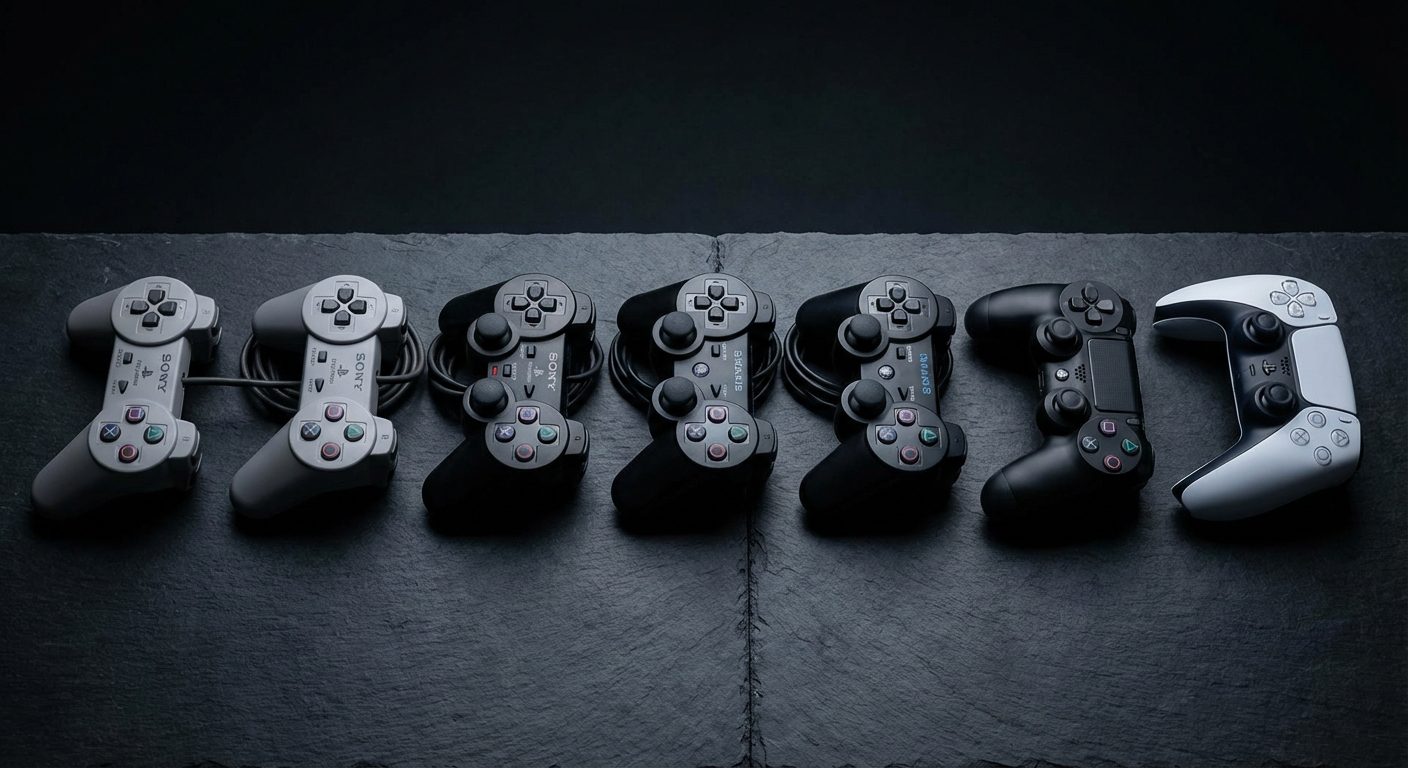
Thirty years of PlayStation hardware, and the controller barely changed shape. That is the point. Sony spent three decades perfecting the same basic form, adding one revolution at a time, until the DualSense arrived and finally broke the mold in ways nobody expected from a gamepad.
The PlayStation controller is one of the most recognizable objects in consumer electronics. Ask anyone who grew up in the 1990s to close their eyes and draw a controller from memory, and they will sketch something that looks almost identical to what ships with a PlayStation 5 today. That continuity was intentional, but the engineering underneath it changed dramatically with each generation.
Here is the full story, generation by generation, of how Sony took a simple digital pad and turned it into one of the most sophisticated haptic input devices ever put in a consumer product.
The Original PlayStation Controller (1994): Where It All Started
When Sony launched the original PlayStation in Japan on December 3, 1994, the controller that came with it was deceptively simple. No analog sticks. No rumble. Just a directional pad, four face buttons arranged in a diamond, two shoulder buttons on each side, and Start and Select in the middle.
The face button icons, the triangle, circle, cross, and square, were not chosen at random. Sony designer Teiyu Goto assigned each shape a meaning: triangle represented point of view (first-person perspective), circle meant “yes” or confirm, cross meant “no” or cancel, and square represented a menu or document. Japanese game studios defaulted to circle for confirm and cross for cancel, while Western developers flipped this convention, which is why PlayStation users in Europe and North America grew up pressing X to confirm rather than O. That asymmetry still causes confusion today.
The 1994 pad weighed 150 grams and used a wire length of 2 meters. It was minimal, but it worked. The symmetric grip handles, the concave shoulder buttons, the precise clickiness of the face buttons: all of it was engineered by studying how hands actually rest during extended play sessions.
The Dual Analog Controller and DualShock (1997-1998): The Rumble Years
In April 1997, Sony introduced the PlayStation Analog Controller, giving PlayStation owners their first taste of twin analog sticks. It was a significant addition, but the execution had problems: the handles were longer than players expected, and critically, there was no rumble feedback. Sony had avoided vibration motors due to a patent dispute with Immersion Corporation, which had been aggressively licensing rumble technology. Litigation was in progress, and the cost of resolving it was weighing on product decisions.
The solution arrived in November 1997. The DualShock combined dual analog sticks with two vibration motors embedded in the grips, producing the now-iconic low-frequency rumble that became synonymous with PlayStation gaming. The DualShock also introduced a revised button layout with analog sticks positioned symmetrically, a placement Sony has maintained across every controller since.
Within a year, the DualShock replaced the standard pad entirely. It shipped with every PS1 console sold from 1998 onward. For an entire generation of players, the DualShock was not just a controller, it was the controller.
DualShock 2 (2000): Pressure-Sensitive Everything
The DualShock 2 launched alongside the PlayStation 2 in March 2000 and looked almost identical to its predecessor. Same shape, same weight, same layout. The differences were nearly invisible until you actually played with it.
Every single button on the DualShock 2, including the face buttons, the d-pad, and all four shoulder buttons, became pressure-sensitive. Press the X button halfway and a character walks; press it fully and they run. In Gran Turismo 3, you could modulate the accelerator by how hard you pressed the trigger rather than treating it as an on/off switch. Racing games, fighting games, and action titles all found ways to use this nuance, and it created a level of analog control that no directional button had previously offered.
Millions of PS2 owners still rank the DualShock 2 as the finest controller Sony ever produced, citing the pressure-sensitive inputs, the near-perfect weight distribution, and a build quality that held up across thousands of hours of play. That reputation persists more than two decades later.
Sixaxis and DualShock 3 (2006-2008): Motion Comes and Goes
The PlayStation 3 reveal in 2005 introduced one of the most ridiculed controller prototypes in gaming history. The “boomerang” concept, a wildly curved asymmetric design that looked more like a kitchen appliance than a gamepad, was shown at E3 and promptly destroyed by the internet. Sony walked it back before launch.
What shipped in November 2006 was the Sixaxis, a wireless controller that retained the familiar DualShock shape but removed the vibration motors entirely. The Immersion lawsuit had not been resolved at launch. In their place, Sony added six-axis motion sensing: the controller could detect tilt, pitch, and roll. A handful of games used it. Lair, a dragon-flight game from Factor 5, made motion controls mandatory and was savaged by critics and players alike. Most developers treated the motion feature as optional, and players largely ignored it.
By 2008, Sony had settled with Immersion and the DualShock 3 arrived with rumble restored. Bluetooth connectivity allowed up to four controllers to pair simultaneously, eliminating the multitap accessory that PS2 players had needed for multiplayer. The pressure-sensitive buttons from the DualShock 2 were dropped: they had proven too expensive to maintain at scale for that generation.
DualShock 4 (2013): The Biggest Redesign Before DualSense
The DualShock 4 launched with the PlayStation 4 on November 15, 2013, and it was the most substantial hardware redesign since the original DualShock. Sony had been fielding complaints for years, particularly from North American and European players who found the controller’s grip too small compared to the Xbox 360 controller. The DS4 was wider, thicker, and heavier at 210 grams (versus the DualShock 3’s 192 grams), with a more pronounced grip contour and improved analog stick texture to prevent thumb slippage.
Three features defined the DualShock 4. First, the Start and Select buttons disappeared, replaced by Options and Share. The Share button was a genuine shift in how Sony thought about its audience: players could now broadcast, record, and screenshot gameplay directly from the controller without a capture card or a PC. Second, a capacitive touchpad sat in the center of the controller face, enabling swipe gestures and acting as an additional input button. Third, a light bar on the back glowed in player-assigned colors, originally designed to work with the PlayStation Camera for positional tracking.
If you want context on how long Sony has been managing its PlayStation back catalogue as a living product, the 1994 PlayStation library now arriving on PlayStation Plus shows exactly how deep those roots go.
DualSense (2020): When a Controller Becomes a Sensory Device
The DualSense launched with the PlayStation 5 on November 12, 2020, and it immediately made every previous PlayStation controller feel like a rough draft. Sony had spent the PS4 generation watching haptic technology mature in mobile devices and wearables. The DualSense was the result of applying those advances to a gamepad with a full development team and a serious hardware budget behind it.
Two technologies define the DualSense. The first is haptic feedback via HD rumble, replacing the traditional rotating-mass vibration motors with linear actuators that produce precise, localized sensations. Rain sounds different from gravel. A bowstring has a different tension than a car engine vibration. The feedback has texture and directionality that older rumble motors simply could not simulate.
The second is adaptive triggers. The L2 and R2 triggers contain small motors and mechanical resistance mechanisms that games can program dynamically. In Returnal, pulling the trigger halfway fires one mode; pulling it fully past the resistance point fires another. In Astro’s Playroom, which ships with every PS5 and is essentially a DualSense showcase, you feel the difference between walking on sand, bouncing on springs, and swimming through water. It is not a gimmick. Developers who integrated it well reported that players spent longer in-game because the physical feedback added a sensory layer that pure visuals and audio alone could not deliver.
The DualSense also added a built-in microphone with a dedicated mute button, USB-C charging to replace Micro-USB, and a reworked speaker. The controller weighs 280 grams, making it the heaviest PlayStation controller ever shipped, though the weight is balanced well enough that extended sessions do not cause noticeable fatigue.
Sony followed with the DualSense Edge in January 2023, a customizable pro variant with swappable stick caps, back paddles, adjustable trigger travel distances, and replaceable stick modules to address the drift problem that plagued earlier DualSense units. It retails at $199.99. With Sony confirming the PS6 release window, the question is now what the next controller generation adds to what the DualSense already does.
Why Players Keep Going Back to the Old Controllers
Ask PlayStation fans which controller they remember most fondly and the answers split sharply by when they started playing. PS2 veterans frequently pick the DualShock 2: the pressure-sensitive inputs worked exceptionally well in the games that defined that era, the build quality outlasted the console itself in many cases, and the controller felt neutral in the hand without trying to impress you with features. There was nothing to learn.
PS4-era players tend to call the DualShock 4 the most refined version of the traditional design. Its ergonomic adjustments were the most accommodating for large hands that Sony had ever managed before the DualSense, and the Share button permanently changed how gaming content gets created and shared online.
The nostalgia is not really about the hardware. It is about the hours logged and the games that defined specific periods of life. Picking up a DualShock 2 as an adult triggers the physical memory of Shadow of the Colossus or late-night Pro Evolution Soccer sessions in a way that few other objects can replicate. The controller is not just a tool: it is a sensory bookmark. Sony understood this implicitly, which is why they resisted changing the fundamental silhouette for three decades, and why the DualSense’s departure from that tradition was such a deliberate, well-prepared move.
For the longer view on where Sony’s hardware is heading next, the breakdown of PlayStation 6 release date expectations and next-gen console features covers what the industry is anticipating from Sony’s next platform.
PlayStation Controller Generation Timeline
- 1994: Original PlayStation Controller (digital only, no sticks, no rumble)
- 1997 (April): Dual Analog Controller (first twin analog sticks, no rumble)
- 1997 (November): DualShock (analog sticks plus dual vibration motors)
- 2000: DualShock 2 (pressure-sensitive buttons across all inputs, PS2 launch)
- 2006: Sixaxis (wireless, six-axis motion sensing, vibration removed)
- 2008: DualShock 3 (vibration restored, Bluetooth multi-controller support)
- 2013: DualShock 4 (touchpad, Share button, light bar, major ergonomic overhaul)
- 2020: DualSense (haptic feedback, adaptive triggers, USB-C, built-in mic)
- 2023: DualSense Edge (pro customizable version, replaceable stick modules)
Frequently Asked Questions
What was the first PlayStation controller with analog sticks?
The first PlayStation controller with analog sticks was the Dual Analog Controller, released in Japan in April 1997. It featured twin analog sticks but no vibration. The DualShock, released in November 1997, was the first to combine analog sticks with rumble feedback and became the standard controller from 1998 onward.
Why did the PS3 launch without rumble?
The PlayStation 3 launched with the Sixaxis controller, which had no vibration motors because Sony was in the middle of a patent dispute with Immersion Corporation over rumble technology. Sony settled the lawsuit in 2007 and released the DualShock 3 in 2008 with vibration fully restored.
What makes the DualSense different from all previous PlayStation controllers?
The DualSense introduced haptic feedback via linear actuators (producing nuanced, directional sensations with texture, not just vibration intensity) and adaptive triggers with programmable mechanical resistance in L2 and R2. It also added a built-in microphone, USB-C charging, and a significantly upgraded speaker. No previous PlayStation controller had any of these features.
Which PlayStation controller do fans consider the best?
Opinions split by gaming generation. The DualShock 2 is the most frequently cited by PS2-era players for its pressure-sensitive inputs and build quality. The DualShock 4 earns consistent praise for ergonomics and the Share button. The DualSense scores highest on technical innovation, with its haptic and adaptive trigger systems rated as the largest single leap in PlayStation controller design since the original DualShock introduced rumble in 1997.
How much does the DualSense Edge cost and what does it add?
The DualSense Edge retails at $199.99. It adds swappable stick caps (three sizes), two programmable back paddles, adjustable trigger travel (standard, short, or locked), and replaceable stick modules designed to address stick drift. The profile system lets players save and switch between custom button layouts and trigger settings for different games.
