

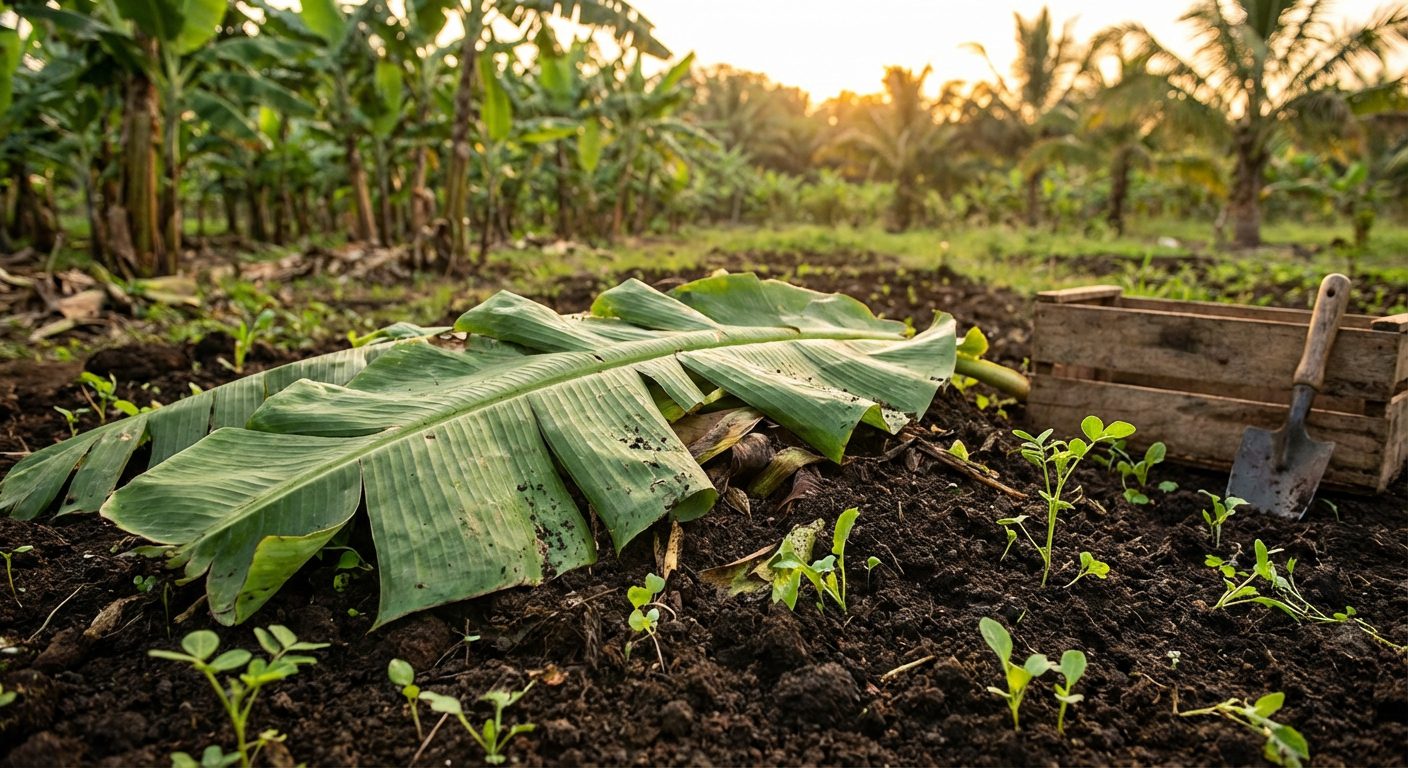
Banana waste generates roughly 29 million tons of discarded plant material every year, and most of it ends up burned or dumped. A cluster of agrotech startups and academic researchers is now turning that waste stream into organic fertilizer, closing a loop that synthetic chemistry has kept open and expensive for decades.
The science behind this shift is not speculative. A 2025 review published in the peer-reviewed journal Agriculture analyzed results from over 120 independent studies and found that fertilizers derived from banana peels consistently improved germination rates, leaf size, and plant height compared to untreated soil, sometimes outperforming commercial synthetic blends in controlled conditions. The research was led by Nokuthula Khanyile at the University of Mpumalanga in South Africa.
For farmers watching fertilizer costs eat into margins, and for soil scientists watching nitrogen runoff degrade waterways, the timing matters. Global production of bananas sits at approximately 116 million metric tons per year. Peels account for roughly one quarter of that total weight, meaning the raw input for this fertilizer category already exists at industrial scale, for free, as agricultural waste.
What Banana Waste Actually Contains
The nutritional profile of banana plant material explains why researchers keep returning to it. Peels, stems, and leaves are dense in potassium, nitrogen, phosphorus, calcium, and magnesium. These are the same macronutrients listed on every bag of commercial fertilizer, except here they come pre-packaged in organic matter that also feeds soil microbes.
Banana stems carry high water content alongside these nutrients. When processed into compost or liquid extract, that moisture becomes a delivery mechanism for nutrients that release slowly into the root zone. The slow-release profile matters because it reduces the nitrogen runoff problem that has made synthetic fertilizers a documented environmental liability.
According to a 2022 study published in Nature Scientific Reports, nitrogen fertilizers manufactured in fossil-fuel-dependent factories are responsible for approximately two percent of all human-caused greenhouse gas emissions globally. Biofertilizers made from organic waste sidestep that production chain entirely. The emissions are not generated in the first place.
If you want to understand more about how soil chemistry connects to broader environmental outcomes, the OpticFlux coverage of ancient agricultural engineering feats gives useful context on how human civilizations manipulated soil nutrition for millennia without synthetic inputs.
How the Conversion Process Works
Processing methods range from low-tech to highly engineered, depending on the target market and output volume.
At the simple end: peels are sun-dried, ground into coarse powder, and mixed directly into soil before planting. Multiple trials reviewed by Khanyile found this approach produced measurable improvements in root length and leaf area. A blend of dried banana and orange peels appeared repeatedly across the reviewed studies as a particularly effective combination for early-stage plant growth.
The more advanced approach involves fermentation. Banana peels are combined with other organic waste, including coffee grounds in some documented trials, and allowed to ferment under controlled conditions. Microbial activity breaks down the plant matter and releases nutrients into a liquid concentrate that can be diluted and applied directly to soil. Early-stage trials on leafy vegetables showed accelerated growth rates with this method.
Factory-scale operations take a different route. The Banana Fabric startup in Qena, Egypt, launched on January 20, 2025, with backing from the Food and Agriculture Organization of the United Nations (FAO). The company uses an industrial squeezing process to extract nutrient-dense liquid from banana waste collected directly from local farms. That liquid is packaged as biofertilizer and sold back to farmers as a cost-effective replacement for chemical inputs. FAO provided both technical support and machinery for the operation, which currently employs six people.
The founder, engineer Hagar Mohamed Mahmoud, described the problem she was solving directly: banana waste in Qena was being burned in fields, polluting air and contributing to greenhouse gas emissions, or dumped into waterways where it damaged local ecosystems. Her operation intercepts that waste before it becomes a liability.
What the Crop Trials Show
The 2025 meta-analysis covers multiple crop types, and the results are specific enough to be practically useful for growers.
In pea plant trials, banana peel decomposition time proved critical. The optimal window for soil-incorporated peels was approximately two months before planting. That timing produced the best germination and growth outcomes. When peels were decomposed in water rather than soil, the optimal period extended to six months, after which benefits began to diminish.
In fenugreek studies, liquid banana peel extract outperformed powdered peel. Plants grown with the liquid version were taller and produced more vigorous foliage.
The most striking results came from okra trials. When researchers applied a blend of banana peel powder combined with other fruit-based organic materials, split between a pre-planting soil treatment and a mid-growth application, the treated plants outperformed those given standard chemical fertilizer on three metrics: foliage density, pod weight, and color vibrancy.
Not every method worked equally well. Banana peel biochar, a charcoal-like substance produced by heating organic material in low-oxygen conditions, showed limited benefit for plant height across trials. This is a useful boundary condition for manufacturers considering biochar-focused product lines.
The Business Model Behind Banana Biofertilizer
The economic logic of banana biofertilizer production works from both sides of the supply chain.
On the input side, banana waste is currently a cost for farmers, not a revenue source. In the Qena model, farmers currently donate their waste to Banana Fabric, with paid collection planned for the second phase of operations. That transition turns a disposal problem into an income stream, creating a commercial incentive for farmers to sort and preserve waste rather than burn it.
On the output side, synthetic fertilizer prices have been volatile since 2021, driven by energy costs and supply chain disruptions. Farmers in price-sensitive markets, especially smallholders in tropical regions where bananas grow abundantly, face acute pressure from input costs. A locally produced organic alternative that costs less to manufacture and distribute represents genuine pricing power for biofertilizer producers.
The IMARC Group’s manufacturing plant feasibility analysis for banana stem and leaf-based organic fertilizer identifies potassium and phosphorus content as the primary commercial value drivers. Industry analysts point to South and Southeast Asia as the highest-growth opportunity, given that bananas rank among the most cultivated crops across those regions.
India and the Philippines are already cited by FAO as international leaders in banana fiber and organic byproduct trade. Both countries have established supply chains that could integrate biofertilizer production without requiring new agricultural infrastructure.
Environmental Impact: What the Numbers Actually Say
Three distinct environmental benefits flow from redirecting banana waste into fertilizer rather than landfills or open burning.
First, avoided emissions from decomposition. Organic matter breaking down in landfills produces methane, a greenhouse gas with roughly 80 times the short-term warming potential of carbon dioxide. Diverting banana waste into aerobic composting or liquid fermentation processes eliminates that methane pathway.
Second, avoided emissions from synthetic fertilizer production. Nitrogen-based fertilizers are made via the Haber-Bosch process, which requires natural gas as both feedstock and fuel. Every ton of organic nitrogen substituted reduces that demand.
Third, avoided water pollution. Nitrogen runoff from synthetic fertilizers is the primary driver of agricultural water contamination in major farming regions. According to the US Environmental Protection Agency, nitrogen and phosphorus runoff contribute to hypoxic dead zones in coastal waters, including the Gulf of Mexico dead zone that exceeds 6,000 square miles seasonally. Slow-release organic amendments reduce the runoff risk significantly compared to soluble synthetic fertilizers applied in bulk.
For readers tracking broader environmental technology trends, our coverage of ancient high-technology tools offers perspective on how low-tech and high-tech approaches to resource management have always coexisted. And if you are curious about the intersection of nutrition and soil health, our piece on what causes sudden fatigue traces how nutrient deficiencies in food connect back to depleted farmland.
Where the Science Still Has Gaps
The 2025 Khanyile review is explicit about what current research does not yet show. Most trials in the 120-study dataset focused on early growth metrics: germination rate, seedling height, leaf size. Very few tracked crops through to final harvest yield, post-harvest storage life, or nutritional density of the produce.
Banana peel chemistry is also not uniform. Nutrient concentration varies by banana variety, growing region, climate, and how long after harvest the peel is processed. A peel processed within 24 hours in a tropical facility produces a different product than one collected three days later in a cooler climate. Standardizing inputs remains the manufacturing challenge that separates laboratory results from scalable production.
Long-term effects on soil microbial communities are largely unmeasured. Some biofertilizer trials suggest that repeated banana-based amendments build beneficial microbial populations that improve nutrient cycling over multiple growing seasons. That compounding soil benefit, if confirmed at scale, would change the economic calculation considerably. A farmer who improves soil structure over three years does not need to keep increasing fertilizer application rates to maintain yield.
The research gap is not an argument against the technology. It is an argument for the second wave of trials that will determine whether banana biofertilizer becomes a mainstream agricultural input or remains a niche organic supplement.
Frequently Asked Questions
What nutrients are in banana leaf and stem fertilizer?
Banana plant waste, including peels, stems, and leaves, contains potassium, nitrogen, phosphorus, calcium, and magnesium. These are the primary macronutrients required for plant growth and match the compounds found in commercial NPK fertilizers. Potassium and phosphorus concentrations are particularly high relative to other organic waste streams, which makes banana-based biofertilizer commercially competitive on a nutrient-per-kilogram basis.
How is banana waste converted into organic fertilizer?
Three methods are in documented use. Dried and powdered peels can be mixed directly into soil. Liquid extract is produced by blending fresh peels or by fermenting banana waste with other organic material, then filtering and concentrating the nutrient-rich liquid. Industrial operations, such as the FAO-supported Banana Fabric facility in Qena, Egypt, use a mechanical squeezing process to extract biofertilizer liquid at scale from collected farm waste.
Is banana peel fertilizer better than synthetic fertilizer?
In specific crop trials reviewed by researchers at the University of Mpumalanga, banana peel biofertilizer matched or outperformed synthetic fertilizers on growth metrics for okra, fenugreek, and peas. Synthetic fertilizers deliver nutrients faster and more predictably at high doses. Organic banana-based amendments release nutrients more slowly, which reduces runoff risk and feeds soil microbes. The practical answer depends on crop type, soil condition, and application method.
What is the environmental benefit of banana waste fertilizer?
Three documented benefits: avoided methane emissions from landfill decomposition, reduced demand for fossil-fuel-intensive synthetic fertilizer production, and lower nitrogen runoff risk compared to soluble NPK fertilizers. Banana biofertilizer production also creates a commercial incentive for farmers to collect and process waste rather than burn it in fields, eliminating particulate emissions from open combustion.
Which countries are leading in banana biofertilizer production?
Egypt launched a FAO-backed commercial operation in January 2025. India and the Philippines have established banana fiber and organic byproduct trade infrastructure that positions them to scale biofertilizer production. South Africa is contributing primary research through the University of Mpumalanga. Brazil and Indonesia, as major banana-producing nations, are identified in industry feasibility analyses as high-potential markets for banana stem and leaf-based fertilizer manufacturing.
