

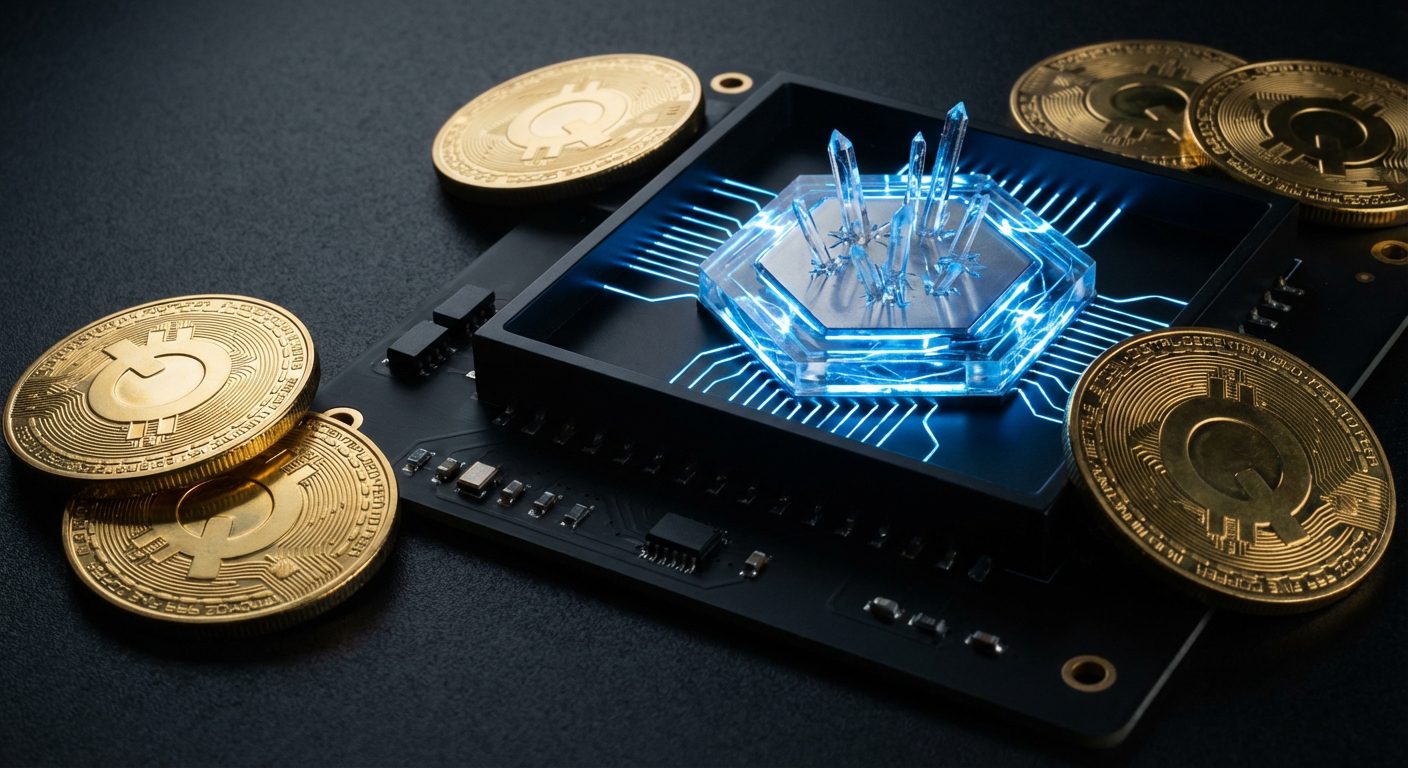
Google quantum computing poses a concrete, dated threat to Ethereum and the broader crypto market. In March 2026, Google published a formal timeline to migrate all its systems to post-quantum cryptography by 2029, and explicitly warned that waiting any longer risks exposing data encrypted today to future decryption attacks. The crypto industry, which dismissed Google’s Willow chip announcement in December 2024 as a distant concern, is now scrambling to catch up.
The shift in tone is significant. When Willow launched, most blockchain developers called the quantum threat “decades away.” Four months later, Google is issuing a public deadline and urging every company to follow. The window between when Willow-class machines become cryptographically dangerous and when blockchain networks can realistically complete a migration is narrowing fast.
What Google’s Willow Chip Actually Does to Ethereum
The Google Willow quantum chip, unveiled in December 2024, reduced computation errors as it scaled, a property quantum systems historically struggle with. That breakthrough matters for crypto because breaking the elliptic curve cryptography (ECC) protecting Ethereum wallets requires a stable, error-corrected quantum machine, not just raw qubit counts.
Ethereum, like Bitcoin and Solana, uses the secp256k1 curve for signing transactions. Researchers estimate that breaking secp256k1 requires roughly 4,000 logical, error-corrected qubits running Shor’s algorithm. Willow operates at 105 physical qubits with improved error correction, which puts that milestone somewhere between 2028 and 2033 based on current scaling trajectories, not 2050 as many assumed when Willow debuted.
According to analysis published by BlockEden.xyz in March 2026, 24 of the top 26 blockchain protocols by market capitalization rely exclusively on quantum-vulnerable signature schemes. That includes every major DeFi protocol in production today.
The “Harvest Now, Decrypt Later” Attack That’s Already Happening
You don’t need a working quantum computer to begin exploiting crypto networks today. The attack model known as “harvest now, decrypt later” (HNDL) is already active: adversaries intercept and store encrypted blockchain data now, then decrypt it once quantum hardware scales to capability.
A February 2025 Federal Reserve research paper flagged HNDL as a systemic risk to financial infrastructure, including on-chain settlement systems. Google’s March 2026 warning specifically cites this as the reason urgency precedes capability: “action is needed before a future quantum computer can break current encryption.” The data being signed and broadcast on Ethereum today will still be recoverable in 2030.
This means Ethereum users with wallets that have exposed their public keys, which covers every wallet that has ever sent a transaction, are generating material that could eventually be used to reconstruct private keys. Cold wallets that have never broadcast a transaction remain safer, but only for as long as they stay dormant.
Ethereum’s Response: EIP-8141 and the 2030 Deadline
Vitalik Buterin published Ethereum’s post-quantum strategy in February 2026, shortly after the Ethereum Foundation established a dedicated PQC research team. The core proposal is EIP-8141, which enables accounts to switch signature types, including quantum-resistant schemes, without requiring new wallet addresses. This is critical: the billions of dollars locked in smart contracts reference existing address formats and cannot simply migrate to new keypairs without either voluntary user action or a protocol-level forced migration.
The gas cost problem is severe. Current ECDSA signature verification costs approximately 3,000 gas on Ethereum. Quantum-resistant alternatives under the NIST standards could require around 200,000 gas, a 66x increase. Buterin’s roadmap addresses this through “validation frames” within EIP-8141, bundling multiple post-quantum signatures into a single combined proof to spread the overhead. Full quantum resistance is targeted before 2030 across the Ethereum Foundation’s development plan, which charts roughly seven hard forks through 2029.
The signature size challenge compounds the gas issue. CRYSTALS-Dilithium signatures, the primary NIST-standard quantum-resistant alternative, run approximately 2.4 KB per signature compared to ECDSA’s 64 bytes. That’s a 37x increase in block space consumption for every transaction. If you’re holding crypto in a wallet that interacts regularly with DeFi, this transition will eventually affect your transaction fees and confirmation times.
What NIST Finalized in August 2024
The cryptographic foundation for migration already exists. The National Institute of Standards and Technology (NIST) finalized three Federal Information Processing Standards in August 2024. FIPS 203 (ML-KEM), based on CRYSTALS-Kyber, serves as the primary standard for key encapsulation and general encryption. FIPS 204 (ML-DSA), based on CRYSTALS-Dilithium, replaces classical signature schemes and is explicitly designed for blockchain transaction signing. FIPS 205 (SLH-DSA), based on SPHINCS+, offers a conservative hash-based alternative that relies on no lattice assumptions.
In March 2025, NIST added HQC (Hamming Quasi-Cyclic) as a fourth algorithm for key encapsulation, providing code-based diversity that does not depend entirely on the security of lattice mathematics. These standards give blockchain developers a concrete, peer-reviewed toolkit. The open question is speed of adoption, not availability of solutions.
The UK, France, Germany, the Netherlands, and the United States have all published strategies or guidelines on quantum migration timelines. The European Commission’s EuroQCI initiative aims to have operational pan-European quantum communication infrastructure in place by 2027.
Solana Is Moving Faster Than Ethereum
Solana has emerged as the most aggressive major blockchain in post-quantum migration. In December 2025, the Solana Foundation partnered with security firm Project Eleven to launch a public testnet replacing every Ed25519 signature with CRYSTALS-Dilithium. The testnet sustained roughly 3,000 transactions per second, matching mainnet throughput despite the significantly larger signature sizes.
Phantom and Ledger developer builds now support dual keypairs: Ed25519 plus Dilithium for high-value wallets. Firedancer, Jump Crypto’s alternative validator client shipping in 2026, already supports multiple signature backends, making it quantum-migration-ready before Ethereum’s EIP-8141 is finalized.
Solana also deployed its Winternitz Vault in January 2025, an optional wallet feature using hash-based one-time signatures for high-value cold storage. It is a stopgap rather than a permanent solution, but it shows that Solana’s developer community treats this as a present engineering problem rather than a future policy debate.
The speed difference between Solana and Ethereum on this issue reflects structural differences: Solana’s smaller validator set makes coordinating hard forks easier, while Ethereum’s decentralized governance and the volume of locked capital make forced migrations politically difficult. If you’re tracking major crypto market developments for investment purposes, the pace of each protocol’s quantum migration is now a legitimate risk factor to monitor.
The Real Risk Timeline for Crypto Holders
The crypto community’s initial reaction to Willow, that quantum computers are decades from breaking real encryption, was based on counting physical qubits while ignoring error correction progress. Google’s 2029 deadline announcement signals that its own engineers no longer believe that framing.
The realistic window looks like this: fault-tolerant quantum computers capable of breaking secp256k1 could arrive between 2028 and 2033. Ethereum’s migration to quantum-resistant signatures, if EIP-8141 proceeds on schedule, would not be complete before 2030. That leaves a potential overlap window where quantum-capable machines exist before all wallets and smart contracts have migrated. Ethereum addresses that have broadcast transactions are the primary exposure point during that window.
For most retail holders with hardware wallets that have never sent a transaction, the immediate risk is low. For DeFi protocols, institutional custodians, and any smart contract managing significant capital, the calculus is different. The Federal Reserve’s HNDL warning makes clear that adversaries are not waiting for Q-Day to begin collecting. Builders working with on-chain trading platforms should be tracking PQC roadmap milestones as part of their security posture today.
Frequently Asked Questions
Does the Google Willow chip threaten Ethereum right now?
No. The Google Willow chip operates at 105 physical qubits and is not capable of running Shor’s algorithm at the scale needed to break elliptic curve cryptography. Ethereum’s secp256k1 encryption requires roughly 4,000 logical, error-corrected qubits to crack. The risk is forward-looking, with most researchers placing a credible threat window between 2028 and 2033 based on current quantum hardware scaling rates.
What is the “harvest now, decrypt later” attack and why does it matter for crypto?
The harvest now, decrypt later (HNDL) attack involves collecting and storing encrypted blockchain data today, then decrypting it once quantum computers become capable of breaking ECC. A February 2025 Federal Reserve research paper flagged HNDL as a systemic risk to financial infrastructure. Every signed Ethereum transaction ever broadcast to the network is potentially recoverable data under this attack model.
What is post-quantum cryptography and which standards apply to blockchain?
Post-quantum cryptography (PQC) refers to cryptographic algorithms designed to resist attacks from quantum computers. NIST finalized three standards in August 2024: FIPS 203 (ML-KEM based on CRYSTALS-Kyber), FIPS 204 (ML-DSA based on CRYSTALS-Dilithium), and FIPS 205 (SLH-DSA based on SPHINCS+). FIPS 204 is the most directly applicable to blockchain transaction signing, offering signatures in the 2 to 5 KB range with rapid verification.
How is Ethereum planning to become quantum resistant?
Ethereum’s plan centers on EIP-8141, proposed by Vitalik Buterin in February 2026. It allows accounts to migrate signature types without changing addresses, essential for preserving compatibility with existing smart contracts. The Ethereum Foundation’s roadmap targets full quantum resistance before 2030. The main engineering challenge is that quantum-resistant signatures cost up to 66 times more gas than the ECDSA signatures used today, requiring batching solutions to remain economically viable.
Which cryptocurrency is closest to being quantum resistant?
Solana is currently the most advanced major blockchain in post-quantum migration. Its December 2025 CRYSTALS-Dilithium testnet, run with security firm Project Eleven, sustained 3,000 transactions per second with post-quantum signatures. The Firedancer validator client, shipping in 2026, supports multiple signature backends by default. Ethereum’s EIP-8141 remains in proposal stage as of early 2026.
What should crypto holders do right now about the quantum threat?
Cold wallets that have never broadcast a transaction expose less risk because the public key has never been revealed on-chain. Wallets that have sent transactions have exposed public keys, making them theoretically vulnerable once quantum hardware scales. Monitoring your blockchain’s PQC migration progress, using hardware wallets from vendors supporting dual-signature schemes, and avoiding concentrating large holdings in wallets with long transaction histories are practical steps for 2026.
