

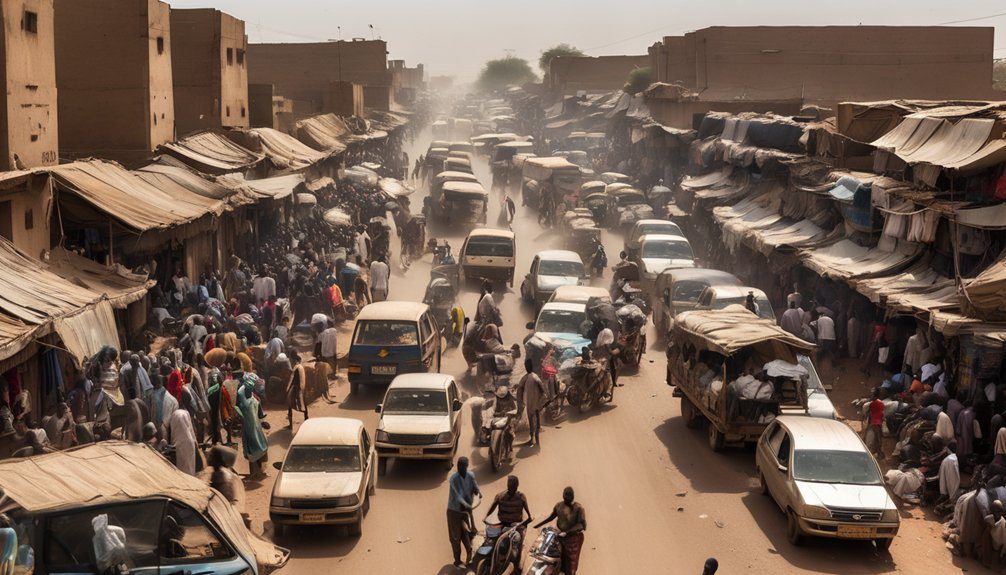
You’re facing persistent congestion in Sudan mainly because of administrative inefficiencies that delay traffic monitoring and response. Policy gaps weaken enforcement and create oversight challenges, while economic constraints limit funding for infrastructure repairs and expansion. Socioeconomic factors like rapid urban growth and uneven access to transit lead to heavy reliance on private vehicles. These combined issues prevent congestion from clearing effectively. Exploring these hidden causes can offer a clearer understanding of the ongoing traffic problems.
Administrative Inefficiencies Hampering Traffic Management
Administrative inefficiencies play a significant role in hampering traffic management in Sudan.
When traffic monitoring systems lack coordination, you face delays in identifying congestion points and responding effectively. Limited resource allocation further restricts your ability to maintain roads and deploy traffic control measures.
Without streamlined administrative processes, decision-making slows down, causing gaps in managing traffic flow. These inefficiencies prevent you from implementing timely solutions and optimizing available resources.
Improving administrative coordination and ensuring proper distribution of funds and personnel are essential steps. Doing so enhances traffic monitoring capabilities and helps you regain control over Sudan’s growing congestion challenges.
Policy Gaps and Regulatory Challenges
Although regulations exist to manage traffic, significant policy gaps and regulatory challenges continue to undermine effective congestion control in Sudan.
You’ll find that weak policy implementation and inconsistent regulatory oversight create loopholes allowing congestion to persist. These issues limit your ability to experience smoother traffic flow and freedom on the roads.
Key concerns include:
- Lack of coordinated policy frameworks
- Inadequate enforcement mechanisms
- Overlapping jurisdictional authority
- Insufficient transparency in regulatory processes
- Limited stakeholder engagement in policy development
Addressing these challenges is essential for improving traffic management and restoring your mobility rights.
Economic Constraints Impacting Infrastructure Development
Because funding for infrastructure projects remains limited, economic constraints greatly hinder the development and maintenance of Sudan’s transportation network.
You’ll find that funding shortages directly stall essential repairs and expansions, leaving roads and transit systems inadequate. Investment barriers also discourage private and foreign investors, restricting the capital needed to modernize infrastructure.
These economic challenges create a cycle where congestion worsens due to aging facilities and insufficient alternatives. Without overcoming these financial obstacles, it’s difficult for Sudan to build the free-flowing transport system its people need.
Addressing funding shortages and investment barriers is critical for lasting improvements.
Socioeconomic Factors Contributing to Urban Congestion
When urban populations grow rapidly, socioeconomic factors play a significant role in worsening congestion. You often see limited access to affordable housing pushing more people into crowded areas, straining existing infrastructure.
Inadequate urban planning fails to integrate effective transportation alternatives, increasing reliance on private vehicles. Additionally, uneven income distribution restricts many from using efficient transit options. Job locations concentrated in specific zones create peak-hour bottlenecks.
Consider these factors:
- Insufficient affordable housing near workplaces
- Lack of diverse transportation alternatives
- Poor urban planning coordination
- Income disparities affecting mobility
- Concentrated employment centers causing traffic surges
Understanding these helps you grasp congestion’s complex roots.
Frequently Asked Questions
How Does Seasonal Weather Affect Traffic Congestion in Sudan?
You’ll find that during Sudan’s rainy season, roads flood and slow traffic, while heat waves degrade pavement, causing delays. Both extremes trap you in congestion, restricting your freedom to move swiftly and freely around the city.
What Role Does Public Transportation Availability Play in Congestion?
Public transit shapes your commute patterns directly; when it’s scarce or unreliable, you end up stuck in traffic. Improving public transit gives you freedom, letting you choose faster, smoother routes instead of gridlocked roads.
Are There Any Technological Solutions Being Implemented to Ease Traffic?
Yes, you can benefit from smart traffic systems using data analytics to optimize flow and reduce jams. These technologies give you freedom by minimizing delays and enhancing your daily commute experience.
How Does Urban Planning Influence Traffic Flow in Sudan?
Urban design directly shapes traffic patterns, so when you embrace smart urban planning, you’ll release smoother flow and less congestion. You’ll gain freedom to move efficiently, reducing frustration and reclaiming control over your daily commute.
What Impact Does Cross-Border Trade Have on Local Traffic Congestion?
You’ll notice cross-border trade intensifies local traffic congestion by overloading trade routes. While it boosts the economic impact, you’ll feel the strain on freedom of movement, urging smarter planning to ease the flow.
