

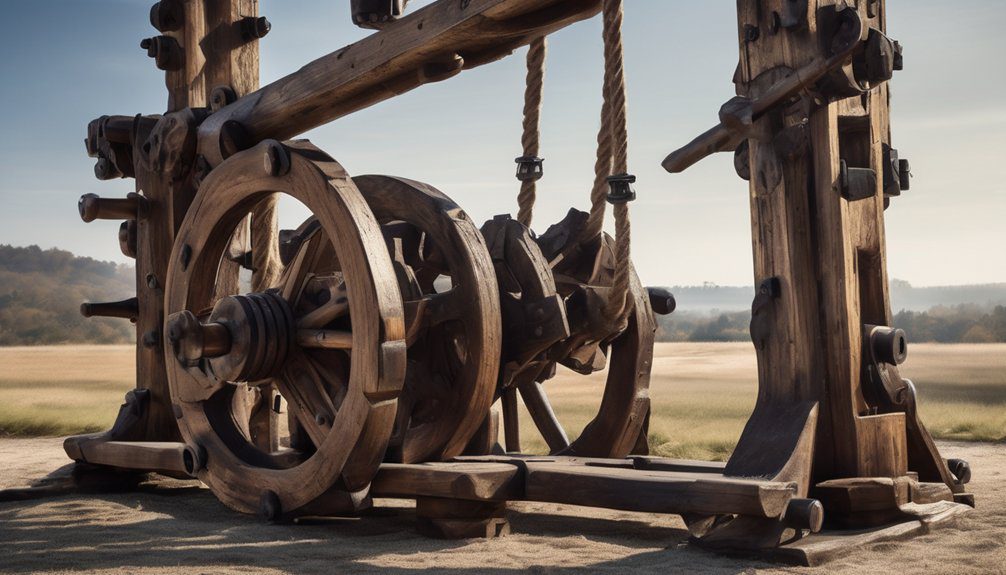
You use the ballista by pulling back its arms twisted with sinew or ropes, storing torsion energy. When released, this energy shoots large bolts with great force and accuracy. Its sturdy wooden frame and metal fittings guarantee durability and stability during firing. The ballista was deadly because it combined powerful mechanical tension with precise targeting, allowing soldiers to disrupt enemy ranks or siege walls effectively. Understanding its design reveals why it remained essential across centuries.
The Engineering Behind the Ballista
The engineering behind the ballista involves a careful combination of mechanical principles and materials designed to maximize power and accuracy.
You’ll notice that its design principles rely on tension and torsion, using twisted ropes or sinew to store energy. Construction materials such as sturdy wood frames and durable metal components guarantee stability and longevity.
These elements work together to create a precise and reliable weapon. Understanding these basics lets you appreciate how engineers balanced strength and flexibility, crafting a tool that delivered formidable force while maintaining control.
This foundational knowledge sets the stage for exploring how projectiles were launched.
Mechanism of Launching Projectiles
Although it may seem complex at first, the ballista launches projectiles through a carefully coordinated release of stored mechanical energy.
You’ll notice its launching mechanics rely on torsion springs made from twisted ropes, which store tension when drawn back. This tension releases suddenly, propelling the projectile forward with great force.
The projectile design itself, often long bolts or large arrows, is streamlined for stability and accuracy in flight.
Tactical Advantages in Ancient Warfare
When you consider battlefield dynamics, the ballista offers several tactical advantages that ancient commanders could exploit effectively. Its ability to launch large projectiles with precision allowed forces to disrupt enemy formations from a distance.
In siege tactics, the ballista could breach walls or target defenders, reducing risks for attackers. On open fields, it provided a psychological edge, forcing opponents to adjust their battlefield strategy to avoid deadly volleys.
You could deploy it to control key positions, supporting infantry or cavalry with sustained firepower. Overall, the ballista enhanced operational flexibility, making it a valuable asset in ancient warfare.
Evolution and Legacy of the Ballista
As military technology advanced, the ballista underwent significant changes that reflected evolving tactical needs and engineering capabilities.
You’ll notice design improvements such as enhanced tension mechanisms and more durable materials, which increased its range and accuracy.
Historical influences from Greek and Roman innovations shaped these developments, allowing the ballista to remain relevant over centuries.
Understanding this evolution helps you appreciate how the ballista’s legacy influenced later siege weapons and early firearms.
Frequently Asked Questions
Who Invented the Ballista and When Was It First Used?
You’ll find the ballista was invented by ancient Greeks around 400 BCE as a powerful siege engine. It changed ancient warfare, giving armies freedom to attack fortified positions from a distance with deadly precision.
What Materials Were Used to Construct the Ballista?
You’ll find the ballista built with a sturdy wooden frame and reinforced with metal components for strength and durability. This combination gave it the freedom to launch projectiles powerfully and accurately across great distances.
How Many Soldiers Were Required to Operate a Ballista?
You’ll need a crew of about five to seven soldiers to operate the ballista efficiently. This crew requirement guarantees operational efficiency, letting you control the weapon swiftly while maintaining freedom on the battlefield.
What Types of Projectiles Did the Ballista Fire?
You’ll find ancient warfare used ballistae to fire various projectile types like large bolts, stones, and incendiary missiles. These powerful weapons helped armies maintain freedom by breaking enemy lines and fortifications from a distance.
Were Ballistas Used in Naval Battles?
Yes, you’ll find ballistas played a key role in naval warfare as ancient artillery. They gave freedom to fleets, letting you strike enemies from afar, controlling seas without surrendering to close combat.
