

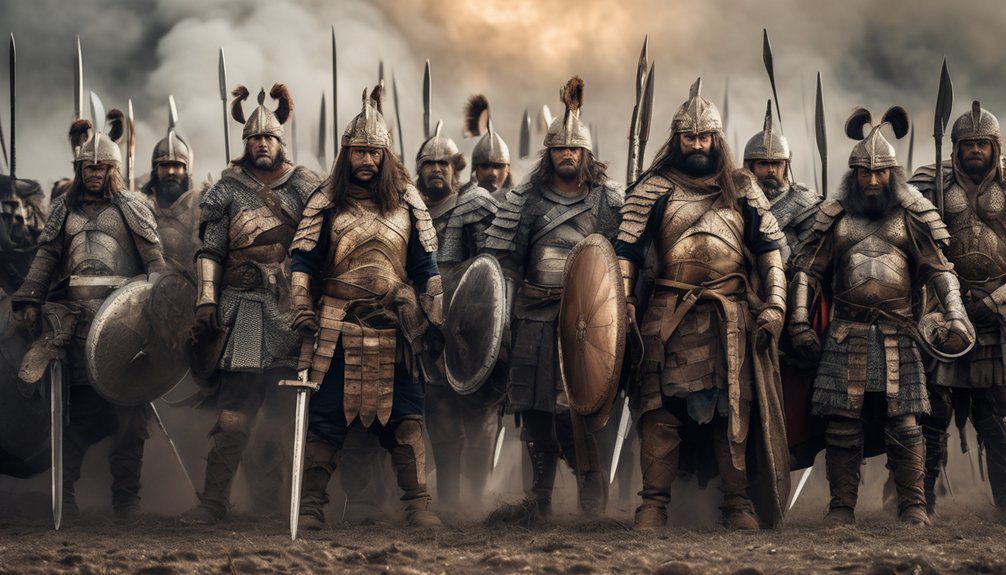
You’ll find the greatest warriors ranked by their military skills, leadership, and lasting impact on history. Alexander the Great innovated battle tactics and expanded his empire across continents. Genghis Khan combined cavalry mastery with strategic alliances. Warriors like Joan of Arc and Spartacus inspired resistance and resilience. Others, such as Hannibal and William Wallace, used terrain and surprise brilliantly. Ching Shih led vast pirate fleets with strict discipline. Each shaped warfare uniquely—exploring their stories reveals how warfare evolved globally.
Alexander the Great
Alexander the Great led one of the most remarkable military campaigns in history, conquering vast territories across three continents.
You can learn from his innovative battle tactics, which combined speed, flexibility, and coordination to overwhelm larger forces. His use of phalanx formations alongside cavalry charges changed warfare strategies.
Beyond the battlefield, Alexander’s cultural impact reshaped societies by spreading Greek ideas, language, and governance, promoting a blend of Eastern and Western traditions.
If you value freedom, you’ll appreciate how his conquests facilitated the exchange of knowledge and encouraged diverse cultures to interact, setting foundations for future civilizations to flourish.
Genghis Khan
You’ll find Genghis Khan’s military innovations reshaped warfare with new tactics and organization.
His strategies for expanding the empire relied on both swift mobility and psychological warfare.
Understanding these methods reveals how he built one of history’s largest continuous empires.
Military Innovations
Although the Mongol Empire is often remembered for its vast territorial conquests, Genghis Khan’s military innovations played an essential role in achieving this success.
You’d notice his tactical advancements, such as highly disciplined, fast-moving cavalry units that communicated with signal flags and coordinated precise maneuvers. These tactics allowed his forces to outsmart larger armies.
Additionally, Genghis Khan introduced weapon innovations, including composite bows with superior range and power, which gave his warriors a significant edge.
Empire Expansion Strategies
When expanding his empire, Genghis Khan relied on a combination of strategic planning and psychological warfare to achieve rapid and extensive territorial gains.
You can learn from his use of empire expansion techniques that combined swift military action with careful diplomacy. He formed strategic alliances to secure borders and recruit skilled warriors, which strengthened his forces without prolonged conflict.
This approach allowed him to maintain momentum while minimizing resistance. By balancing force with calculated partnerships, Genghis Khan created a vast, unified domain.
Understanding these methods highlights how deliberate strategy and alliances are essential for effective empire expansion.
Miyamoto Musashi
Miyamoto Musashi remains one of the most renowned samurai warriors in Japanese history, known for his unmatched skill in swordsmanship and his strategic mind.
You can learn from his samurai philosophy, which emphasizes adaptability, mental discipline, and understanding opponents beyond mere physical combat.
His innovative sword techniques, including the use of two swords simultaneously, broke traditional boundaries and allowed greater freedom in battle strategy.
By studying Musashi’s approach, you gain insight into balancing technique with mindset, a lesson valuable for anyone seeking personal freedom and mastery over challenges.
His legacy endures as a model of skill and strategic thought.
Joan of Arc
You’ll find Joan of Arc’s story begins with her early life marked by strong visions that shaped her purpose.
She quickly rose to military leadership, guiding French forces during a critical phase of the Hundred Years’ War.
Understanding her impact helps you appreciate how her legacy continues to influence both history and culture.
Early Life and Vision
Although Joan of Arc lived during a turbulent period in 15th-century France, her early life was relatively ordinary.
You’d find her raised in a modest farming family, shaped by childhood influences like faith and local traditions. These factors sparked a visionary mindset that distinguished her from others.
You can see how this mindset formed the foundation for her later actions, driven by a strong sense of purpose and freedom.
Understanding her early years helps you appreciate the roots of her unusual determination and the clarity of vision that guided her through immense challenges ahead.
Military Leadership and Legacy
When Joan of Arc took command during the Hundred Years’ War, she demonstrated exceptional military leadership despite her young age and lack of formal training.
You witness her keen understanding of military tactics, which allowed her to inspire troops and secure vital victories. Her leadership qualities included courage, decisiveness, and the ability to unite diverse forces under a common cause.
Joan’s legacy endures as a symbol of determination and the fight for freedom. By studying her approach, you learn how innovative tactics combined with strong leadership can change the course of history and inspire generations seeking liberty.
Spartacus
Spartacus is one of the most renowned warriors in history, known primarily for leading a major slave revolt against the Roman Republic between 73 and 71 BCE.
You recognize the Spartacus rebellion as a powerful symbol of resistance and the fight for freedom.
As a gladiator, Spartacus’s legacy goes beyond combat skills; he inspired enslaved people to challenge oppression.
His leadership transformed a group of gladiators and slaves into a formidable force, demonstrating strategic prowess against Rome’s armies.
You see Spartacus not just as a warrior but as a catalyst for change, embodying the enduring struggle for liberty.
Saladin
Saladin stands out as a key figure in medieval history, known for his leadership during the Crusades and his role in uniting Muslim forces against the Crusader states.
You’ll find that Saladin’s diplomacy played an essential role in forging alliances and maintaining order among diverse groups. His ability to negotiate peace while preparing for conflict shows a strategic mind focused on long-term freedom and stability.
Saladin’s tactics combined mobility with effective use of terrain, allowing him to outmaneuver opponents consistently.
Understanding his methods offers insight into how leadership and strategy can achieve both military success and political cohesion.
Richard the Lionheart
Richard the Lionheart earned his reputation through his military skill and leadership during the Third Crusade. As a Crusader King, he demonstrated strategic brilliance and courage, often leading charges personally.
You’d recognize him as the Lionheart Legend, symbolizing fierce determination and a relentless fight for freedom. His ability to unite soldiers and inspire loyalty played a key role in several victories, despite challenging circumstances.
While his reign was brief, his impact on medieval warfare and chivalry remains significant. Understanding Richard’s legacy helps you appreciate how leadership and valor shaped history during a time when freedom was fiercely contested.
Hannibal Barca
Hannibal Barca stands out as one of history’s most skilled military commanders, known primarily for his role in the Second Punic War against Rome.
You can learn a lot from Hannibal’s tactics, which challenged the dominant Roman forces during the Punic Wars. His strategies emphasized mobility and surprise, helping him overcome larger armies.
Consider these key elements:
- Crossing the Alps with war elephants
- Using ambushes to disrupt enemy formations
- Exploiting terrain advantages
- Coordinating diverse troops effectively
- Maintaining high morale among his soldiers
William Wallace
Although William Wallace is often remembered as a symbol of Scottish resistance, his impact as a military leader goes beyond legend.
You can study his innovative battle tactics, particularly during the Battle of Stirling Bridge, where he used the terrain to outmaneuver a larger English force.
Wallace’s commitment to Scottish freedom was evident in his ability to unite clans and inspire troops despite limited resources.
Understanding his strategic choices helps you appreciate how he challenged a powerful enemy with limited means.
His legacy teaches that determined leadership and tactical ingenuity can greatly influence the fight for freedom.
Ching Shih
Ching Shih commanded one of the largest and most powerful pirate fleets in history during the early 19th century. You’ll find her mastery of pirate tactics and naval warfare vital in understanding her success.
She established strict codes that maintained order and discipline across her fleet. Her leadership guaranteed freedom for her crew while dominating the South China Sea.
Key aspects of her command include:
- Organized fleet structure with clear hierarchy
- Effective use of pirate tactics for surprise attacks
- Control over vast maritime territories
- Enforcement of strict laws to prevent chaos
- Strategic alliances enhancing naval warfare strength
Her legacy defines strategic freedom at sea.
Frequently Asked Questions
What Criteria Were Used to Rank These Warriors?
You consider warrior attributes like skill, bravery, and leadership, combined with historical context such as their impact and era challenges. This way, you honor those who fought fiercely, inspiring freedom and resilience throughout history.
Are There Any Female Warriors Besides Joan of Arc Included?
Yes, you’ll find other female warriors included who made significant historical impact. These fearless women fought for freedom and broke barriers, proving courage and strength aren’t limited by gender, inspiring those who value liberty and justice.
How Did These Warriors Influence Modern Military Tactics?
You’ll see how their strategic innovations sparked tactical evolution, shaping modern military methods. Their fearless pursuit of freedom inspired adaptable, bold tactics that empower forces today to defend liberty with precision and resilience on the battlefield.
Were Any of These Warriors Also Political Leaders?
Yes, many were warrior statesmen and military rulers who fought fiercely for freedom and justice. You’ll see how their leadership combined battlefield skill with political vision, inspiring movements that still value liberty and self-determination today.
Did Any of These Warriors Have Significant Non-Combat Achievements?
Yes, you’ll find many warriors had significant non-combat achievements, like influencing culture and showcasing leadership qualities that inspired freedom movements. Their impact went beyond battle, shaping societies and empowering people to pursue liberty and justice.
