

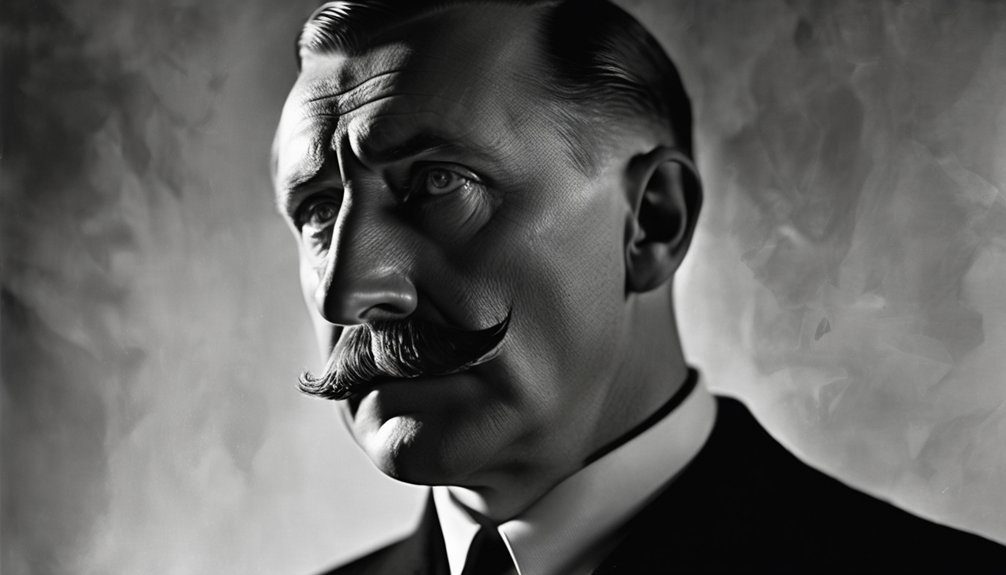
You should understand Hitler’s religious beliefs because they were complex and shaped how he used faith to serve his political goals. Though raised Catholic, he rejected core Christian doctrines and emphasized nationalism and racial ideology instead. His regime manipulated religious themes in propaganda to legitimize authority and control society, pressuring churches to conform. This blending of faith and state impacted religious freedom and institutions deeply. Exploring these beliefs reveals why they mattered for Nazi policies and society.
Hitler’s Personal Religious Views and Statements
Although Adolf Hitler was raised in a Roman Catholic environment, his personal religious views evolved over time and often contradicted traditional Christian beliefs.
You’ll notice that Hitler’s spirituality was complex, shaped by his early religious upbringing but later marked by skepticism and selective acceptance.
He frequently expressed admiration for certain Christian morals yet rejected key doctrines, emphasizing a nationalist and racial ideology over faith.
Understanding this shift is essential if you want to grasp how his beliefs influenced his actions without relying on conventional religious frameworks.
This perspective highlights the tension between personal conviction and public expression in his life.
The Use of Religion in Nazi Propaganda and Policy
When examining Nazi propaganda and policy, you’ll find that the regime strategically manipulated religious themes to support its goals.
They employed religious manipulation by blending Nazi symbolism with Christian imagery, aiming to legitimize their authority and unify the public under a controlled spiritual narrative.
This approach distorted traditional beliefs to promote obedience and nationalism, aligning faith with state ideology.
You’ll see how this tactic helped suppress dissent by presenting the regime as divinely sanctioned.
Understanding this use of religion reveals how propaganda can undermine genuine freedom, emphasizing the need to recognize and resist such manipulative strategies in any society.
The Impact of Hitler’s Beliefs on Religious Institutions and Society
Since Hitler’s personal beliefs heavily influenced his policies, religious institutions and society experienced significant changes under his regime.
You’ll see that Hitler’s influence extended into religious manipulation, as he sought to control churches and suppress dissenting beliefs. He pressured religious leaders to conform to Nazi ideology, weakening independent religious authority.
Society, in turn, faced restrictions on religious expression and moral autonomy, as the regime prioritized loyalty to the state over spiritual freedom.
Frequently Asked Questions
How Did Hitler’s Religious Beliefs Influence His Foreign Policy Decisions?
You’ll see Hitler’s religious motivations shaped his foreign alliances, pushing aggressive expansion to promote his twisted worldview. Understanding this helps you recognize how faith can be misused to justify oppression and threaten freedom worldwide.
What Role Did Occultism Play in Nazi Ideology?
You’ll see occult symbolism and mystical rituals subtly shaped Nazi ideology, fueling their manipulation of power. Recognizing this helps you guard freedom against hidden forces exploiting belief for control and oppression.
Were Hitler’s Views on Religion Consistent Throughout His Life?
You’ll see Hitler’s early beliefs were somewhat traditional, but Hitler’s later views shifted toward manipulation of religion for control. His inconsistency shows how he twisted faith to suppress freedom and enforce his ideology.
How Did Hitler’s Religious Stance Compare to Other Totalitarian Leaders?
You’ll see Hitler’s religious stance was opportunistic, unlike Stalin’s atheism or Mussolini’s Catholicism. He manipulated faith to control people, threatening freedom, while Stalin rejected religion outright, and Mussolini used it to legitimize his rule.
Did Hitler’s Family Share His Religious Beliefs?
Hitler’s family beliefs were rooted in Catholicism, shaping his childhood influence. But you’ll see he diverged sharply, rejecting traditional faith to push his own ideology, showing how personal freedom clashed with imposed dogma.
