

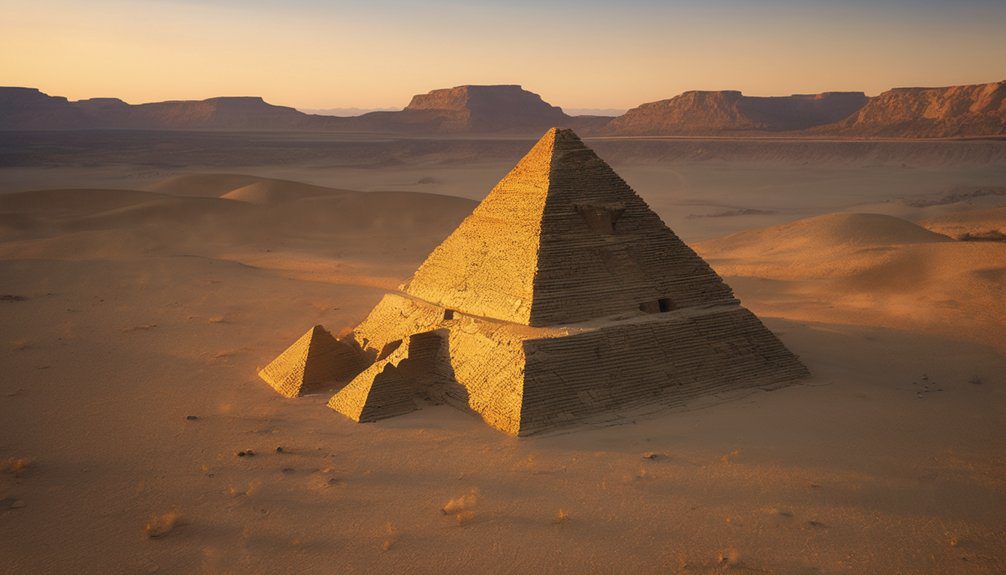
You might hear claims that pyramids are 10,000 years old, but this idea lacks solid evidence. Archaeologists date pyramids using scientific methods like radiocarbon dating and stratigraphic analysis, which consistently place their construction around 2700–2500 BCE. These techniques link pyramids closely with ancient Egyptian civilizations. The myth persists due to cultural fascination and sensational stories, yet the true timeline highlights impressive human achievement within known history. Exploring this further reveals how these dates are firmly established.
Origins of the 10,000-Year Pyramid Theory
Although the idea of pyramids dating back 10,000 years has gained some attention, it originated primarily from alternative historians and fringe researchers rather than mainstream archaeology.
You’ll find these theories often link ancient civilizations with lost knowledge, emphasizing pyramid symbolism as a key to understanding human history.
This perspective suggests pyramids represent more than tombs or monuments; they symbolize universal principles or cosmic connections.
While intriguing, these ideas lack solid evidence and often overlook established archaeological methods.
If you seek freedom in thought, it’s essential to explore such claims critically, distinguishing imaginative interpretations from well-supported historical facts.
Archaeological Evidence for Pyramid Dating
When archaeologists date pyramids, they rely on a combination of scientific techniques and contextual analysis to establish accurate timelines.
You’ll find that pyramid construction techniques, such as the use of specific stone types and tool marks, align closely with the known methods of the ancient Egyptian civilization.
By examining artifacts, burial sites, and inscriptions found nearby, researchers connect the pyramids to particular historical periods.
This evidence consistently points to construction dates within a few thousand years ago, not 10,000.
Understanding these details helps you see the pyramids as products of their time, grounded in documented ancient Egyptian culture.
Scientific Methods Used to Date the Pyramids
Building on the archaeological evidence that links pyramids to specific historical periods, scientists use a range of dating methods to establish more precise timelines.
Radiocarbon dating measures the decay of carbon isotopes in organic materials found near pyramid sites, providing age estimates within a few centuries.
Stratigraphic analysis examines the layers of soil and artifacts around the pyramids, revealing the sequence of construction and use.
Together, these scientific methods help confirm that the pyramids belong to the well-documented civilizations of ancient Egypt, rather than being thousands of years older as some myths suggest.
Why the Myth Continues to Persist
Since the pyramids have long captured public imagination, myths about their origins continue to thrive despite scientific evidence. You often encounter cultural misconceptions that blend mystery with speculation, leading people to doubt established facts.
These myths persist partly because ancient technologies still fascinate you, making it tempting to believe in lost knowledge beyond current understanding. Additionally, popular media and sensational stories reinforce these ideas, overshadowing academic research.
When you seek freedom from misinformation, it’s important to recognize how these factors contribute to the myth’s endurance. Understanding this helps you appreciate the real history without being swayed by unfounded claims.
The True Historical Timeline of Pyramid Construction
Understanding why myths about the pyramids continue to persist helps set the stage for a clear examination of their actual construction history.
Pyramid construction began around 2700 BCE with the Step Pyramid of Djoser in ancient Egypt, marking a significant advancement by ancient civilizations. Over centuries, techniques evolved, leading to the Great Pyramid of Giza around 2560 BCE.
These structures reflect human ingenuity within a known historical timeline, not mysterious ancient origins. By recognizing the documented phases of pyramid construction, you can appreciate the achievements of ancient civilizations without relying on unfounded myths.
This clarity supports a more accurate understanding of human history.
