

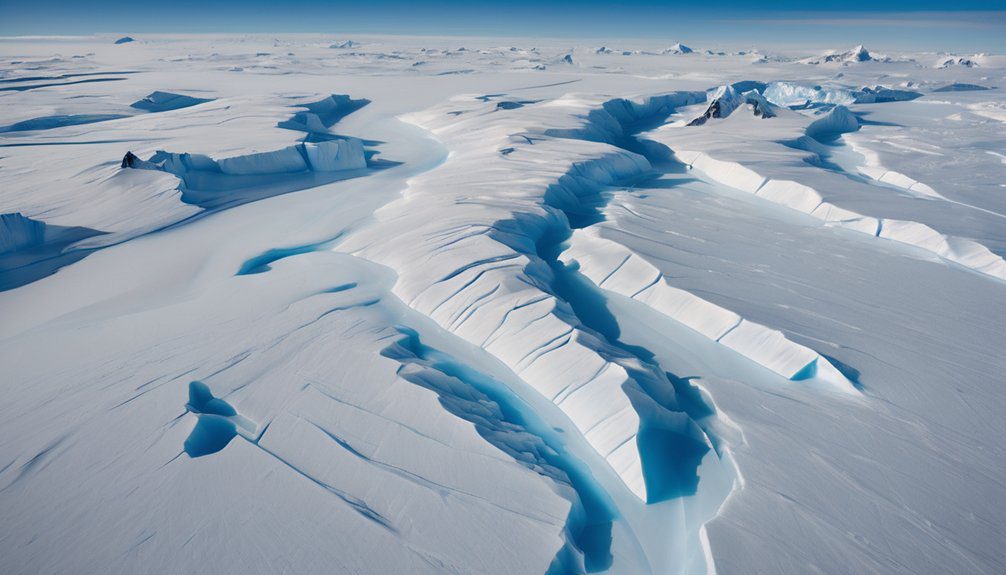
Radar technology has revealed Antarctica’s hidden mountain ranges, valleys, and extensive networks of subglacial lakes beneath its thick ice sheets. These radar surveys send radio waves through ice, capturing reflections from bedrock and water systems, uncovering complex features you can’t see from the surface. Understanding these subglacial structures is essential because they influence ice movement and stability, affecting sea level rise and climate models. Exploring further uncovers how this hidden world shapes Antarctica’s environmental future.
Mapping Hidden Mountain Ranges and Valleys
Although Antarctica is mostly covered by thick ice sheets, scientists have been able to map hidden mountain ranges and valleys beneath the surface.
You can explore this hidden topography thanks to advanced radar technology, which penetrates the ice and reveals detailed images of the land beneath. This technology sends radio waves through the ice, capturing reflections from the bedrock below.
Discovery of Subglacial Lakes and Water Systems
The hidden mountain ranges and valleys beneath Antarctica’s ice reveal more than just solid rock formations; they also harbor vast networks of subglacial lakes and water systems.
Using advanced radar technology, scientists have mapped these hidden bodies of water, uncovering complex subglacial hydrology beneath the ice sheet.
These lakes, trapped under immense pressure, remain liquid due to geothermal heat and friction from ice movement.
Radar surveys detect variations in ice reflectivity, indicating water presence.
Implications for Ice Sheet Dynamics and Climate Change
Since subglacial water affects how ice sheets move, understanding these hidden systems is essential for predicting changes in Antarctica’s ice dynamics.
You’ll find that subglacial lakes and water channels influence ice flow by lubricating the base, allowing the ice to slide faster. This process alters ice sheet stability and can accelerate melting.
Furthermore, these changes impact climate feedback loops by affecting sea level rise and global temperatures. Recognizing these interactions helps you grasp how Antarctica’s ice sheet responds to warming.
This knowledge empowers better climate models and informs strategies for managing future environmental shifts.
