

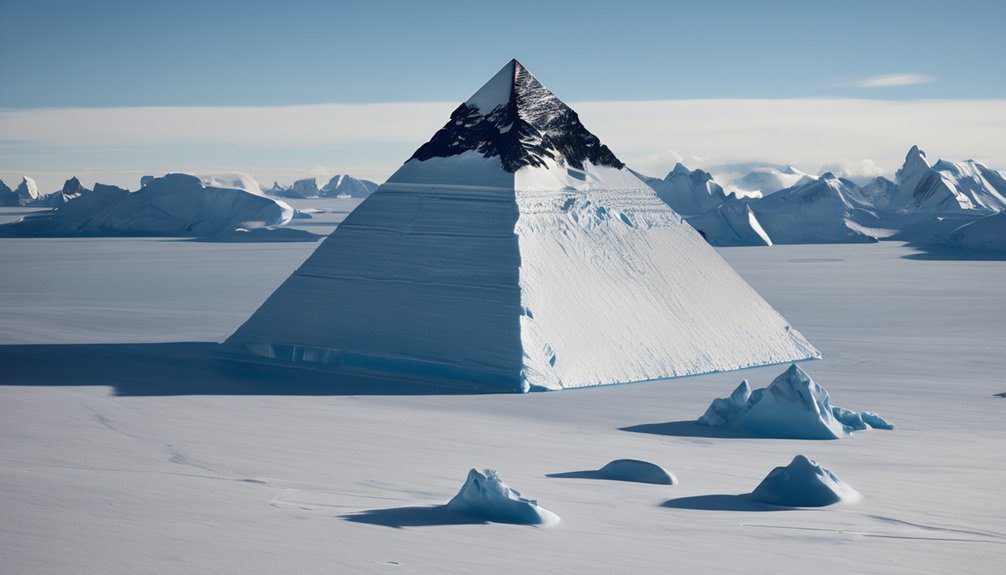
You likely came across the Antarctica pyramid myth after early satellite images showed pyramid-like formations there. Initially, these unusual shapes sparked theories about ancient civilizations. Social media accelerated the spread, sharing viral posts with spectacular claims. However, scientists studied these structures using geology and remote sensing, concluding they are natural formations shaped by erosion and tectonic activity. Despite this, the myth persists due to cultural fascination with mysteries. Understanding these details will reveal how facts and fiction intertwine around this myth.
Early Satellite Images and Initial Speculations
When early satellite images of Antarctica were first released, they captured unusual shapes that sparked curiosity and speculation among researchers and enthusiasts alike.
You might notice these formations appeared pyramid-like, prompting initial theories about their origin. Satellite analysis quickly became essential, as experts examined the shapes to determine if they were natural or man-made.
These early interpretations varied widely, with some suggesting geological processes while others considered more extraordinary explanations.
Understanding these initial theories helps you grasp how the myth began, rooted in the interpretation of satellite data that, at first glance, seemed to defy conventional geological understanding.
The Role of Social Media in Popularizing the Myth
Although the Antarctica pyramid myth originated from satellite imagery interpretations, social media has played a significant role in spreading and amplifying these ideas.
Platforms like YouTube, Twitter, and Facebook have enabled users to share images and videos rapidly, fueling viral trends around mysterious pyramids. You, as a participant in these digital spaces, encounter posts that invite curiosity and speculation, often without scientific verification.
Social media’s structure encourages quick sharing, which helps myths gain momentum and reach wide audiences. This environment supports the free exchange of ideas, but it also allows unverified claims to flourish alongside factual information.
Debunking the Pyramid: Scientific Perspectives
Since satellite images sparked curiosity about pyramid-like shapes in Antarctica, scientists have thoroughly examined these claims using geological and remote sensing data.
You’ll find that the pyramid origins are natural, formed by unique geological formations shaped over millions of years. These formations result from erosion, tectonic activity, and ice movement, creating sharp peaks resembling pyramids.
Researchers use advanced tools to differentiate natural landforms from artificial structures, confirming no evidence of human construction exists. Understanding these processes helps you appreciate Antarctica’s landscape without myths, emphasizing science’s role in explaining intriguing shapes without resorting to unfounded theories.
The Appeal of Antarctica Mysteries in Popular Culture
Scientific evidence has clarified that Antarctica’s pyramid-like formations are natural, yet the idea of mysterious structures continues to captivate many.
You might wonder why these formations hold such mysterious allure in popular culture. This cultural fascination stems from a human desire to explore the unknown and imagine hidden histories.
Stories of ancient civilizations or secret bases spark curiosity and invite speculation. While science provides clear explanations, the appeal of Antarctica mysteries offers a sense of freedom to question and dream beyond established facts.
Understanding this helps you appreciate how myths persist alongside scientific knowledge.
