

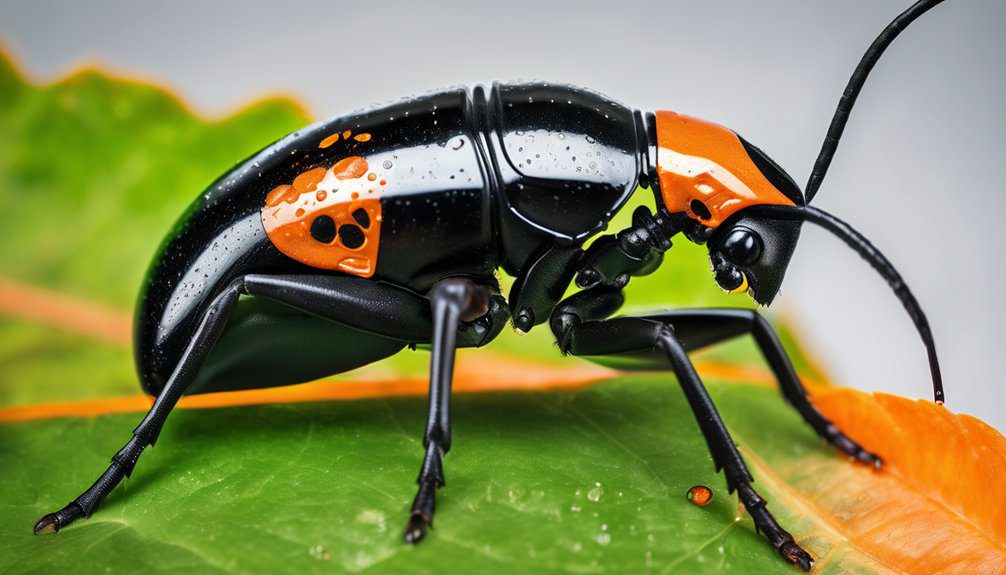
You’ll find the bombardier beetle shoots a hot, explosive spray by mixing two separate chemicals—hydroquinone and hydrogen peroxide—stored in its abdomen. When threatened, enzymes trigger a rapid reaction, creating oxygen, heat, and toxic quinones that blast from its rear in pulses. This powerful defense deters predators effectively and evolved to boost the beetle’s survival. Understanding this mechanism reveals remarkable natural chemistry and evolutionary adaptation, providing deeper insight into how this insect protects itself.
Anatomy of the Bombardier Beetle’s Chemical System
Although the bombardier beetle is small, its chemical defense system is remarkably complex and highly specialized.
You’ll find two main chemical glands inside its abdomen, each storing different reactants separately. When threatened, these chemicals are released into a reaction chamber, where they mix and rapidly generate heat and gas.
This process creates a powerful, pulsating spray that the beetle can aim precisely at predators. Understanding this anatomy reveals how the beetle maintains control over this volatile reaction, allowing it to defend itself effectively without harm.
This system exemplifies a finely tuned natural mechanism designed for survival and freedom from threat.
The Chemistry Behind the Explosive Spray
When the bombardier beetle feels threatened, it triggers a rapid chemical reaction between two compounds stored separately within its abdomen: hydroquinone and hydrogen peroxide.
These chemical compounds combine in a specialized reaction chamber, where enzymes catalyze the reaction mechanisms, breaking down hydrogen peroxide into oxygen and water while oxidizing hydroquinone into quinones.
This process generates heat and produces a boiling, toxic spray expelled through the beetle’s abdomen.
The precise control of this reaction allows the beetle to release bursts of hot, noxious liquid as a defense.
Understanding these reaction mechanisms reveals how nature designs effective chemical defenses.
Defensive Advantages and Evolutionary Significance
The bombardier beetle’s ability to produce and control its explosive chemical spray offers significant defensive benefits that have shaped its survival over time.
This evolutionary adaptation serves as an effective predator deterrence mechanism, allowing the beetle to escape threats swiftly and safely. By releasing a precise, high-temperature chemical blast, it discourages attacks without physical confrontation.
Over generations, this trait enhanced the beetle’s chances of survival and reproduction, demonstrating how natural selection favors functional defense strategies.
Understanding this adaptation reveals the intricate balance between predator and prey, emphasizing freedom through survival in a competitive environment.
Frequently Asked Questions
Where Is the Bombardier Beetle Commonly Found?
You’ll find bombardier beetles across diverse habitats worldwide, especially in forests and grasslands. Their habitat distribution highlights their adaptability, and by controlling pest populations, you’ll see their essential ecological role in maintaining balance.
How Fast Can the Bombardier Beetle Shoot Its Spray?
You’ll be amazed that the bombardier beetle’s spray speed can reach up to 6 meters per second. This quick defensive mechanism lets it protect itself fiercely, giving it the freedom to escape threats and survive.
What Predators Are Deterred by the Beetle’s Acid Spray?
You’ll find that ants, spiders, and frogs back off thanks to the beetle’s chemical composition. Its powerful acid spray offers effective predator avoidance, letting the beetle roam freely without fear of attack or capture.
Can the Bombardier Beetle Spray Multiple Times in a Row?
Yes, you’ll find the bombardier beetle can spray multiple times in a row. Its spray frequency supports its defensive behavior, giving it freedom to defend itself relentlessly against threats without running out of acid quickly.
How Do Researchers Study the Beetle’s Explosive Mechanism?
You’ll use experimental techniques and chemical analysis to reveal the beetle’s secret. By observing reactions and measuring compounds, you can freely explore how this tiny creature controls explosive bursts with precision and power.
