

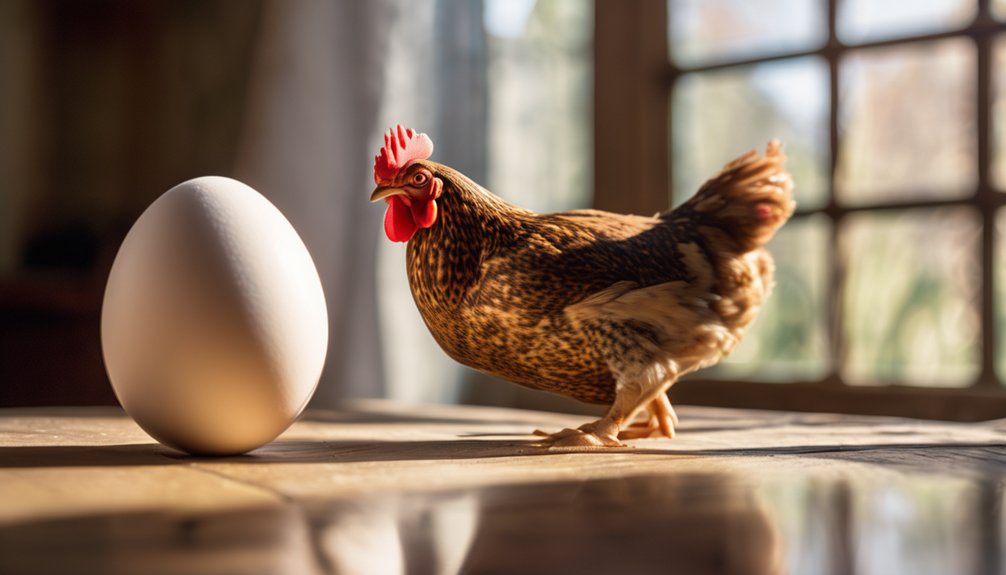
You might wonder what came first, the chicken or the egg. Scientifically, eggs existed long before chickens because species evolved gradually. Genetic mutations caused changes in ancestral birds, and at some point, a bird that was not quite a chicken laid an egg containing the first true chicken. This reflects gradual evolutionary steps, not a sudden origin. Understanding this offers insight into nature’s slow transformation, and exploring further reveals how this puzzle ties into broader biological and philosophical ideas.
The Origins of the Question
The question of which came first, the chicken or the egg, has intrigued thinkers for centuries. You’ll find its origins rooted deeply in philosophical implications, where it symbolizes endless cycles and causality dilemmas.
Exploring the historical context reveals that ancient philosophers like Aristotle pondered this paradox in order to understand existence and creation. This question doesn’t just challenge your curiosity; it invites you to reflect on cause and effect in life’s processes.
Understanding Evolutionary Biology
Philosophical questions about origins often lead us to examine scientific explanations, especially those provided by evolutionary biology.
You’ll find that evolutionary mechanisms, such as natural selection and adaptation, drive species differentiation over time. These processes gradually alter populations, allowing new species to emerge from ancestral ones.
The Role of Genetic Mutations
Genetic mutations play an essential role in driving evolutionary change by introducing new variations within a population’s DNA.
These genetic variations act as the raw material for evolutionary changes, allowing species to adapt over time. When a mutation benefits survival or reproduction, it may be passed on and become more common.
You can think of the process like this:
- Mutations create genetic variations.
- Natural selection favors beneficial mutations.
- Beneficial mutations accumulate, leading to evolutionary changes.
Scientific Perspectives on the Chicken-Egg Puzzle
Although the chicken-and-egg question has puzzled people for centuries, scientists have approached it by examining evolutionary biology and developmental processes.
You’ll find that egg classification plays a key role, as eggs existed long before chickens. By studying genetic lineage, researchers trace how mutations gradually transformed ancestral birds into modern chickens.
This means the first true chicken egg came from a bird that wasn’t quite a chicken yet. Understanding these scientific perspectives helps you see that the egg, in a broad biological sense, preceded the chicken, highlighting nature’s gradual evolutionary steps rather than a sudden origin.
Implications Beyond Biology
The scientific findings about the chicken and the egg extend their influence beyond biology, touching areas such as philosophy, logic, and even everyday decision-making.
You’ll find that exploring this puzzle offers valuable philosophical implications and diverse cultural interpretations.
Consider how the dilemma:
- Challenges ideas of causality and existence in philosophical debates
- Reflects cultural narratives about origins and creation myths
- Influences logical approaches to problem-solving and decision-making
Frequently Asked Questions
Can Chickens Lay Eggs Without Fertilization?
Yes, you can see chickens lay eggs without fertilization through chicken reproduction. Those eggs still undergo egg development, but they won’t hatch into chicks, giving you freedom to collect eggs without worrying about baby chickens.
How Long Does It Take for a Chicken Egg to Hatch?
It takes about 21 days for the hatching process during egg incubation. You’ll see life emerge with patience and care—embracing nature’s timing lets you experience the freedom of new beginnings firsthand.
Are There Eggs That Don’T Come From Chickens?
Yes, you’ll find egg varieties beyond chicken eggs, like duck eggs, quail eggs, and even massive ostrich eggs. Exploring these options lets you enjoy diverse flavors and embrace freedom in your culinary choices.
What Is the Nutritional Difference Between Chicken Eggs and Other Eggs?
You’ll find egg nutrition varies across egg varieties—duck eggs pack more fat and protein, while quail eggs offer richer vitamins. Exploring different eggs lets you embrace diverse flavors and nutrients freely, enhancing your diet uniquely.
How Do Farmers Incubate Chicken Eggs Artificially?
You’ll use artificial incubation by controlling egg temperature precisely, usually around 99.5°F, and turning eggs regularly to mimic nature. This method frees you from relying on hens, giving you full control over hatching success.
