

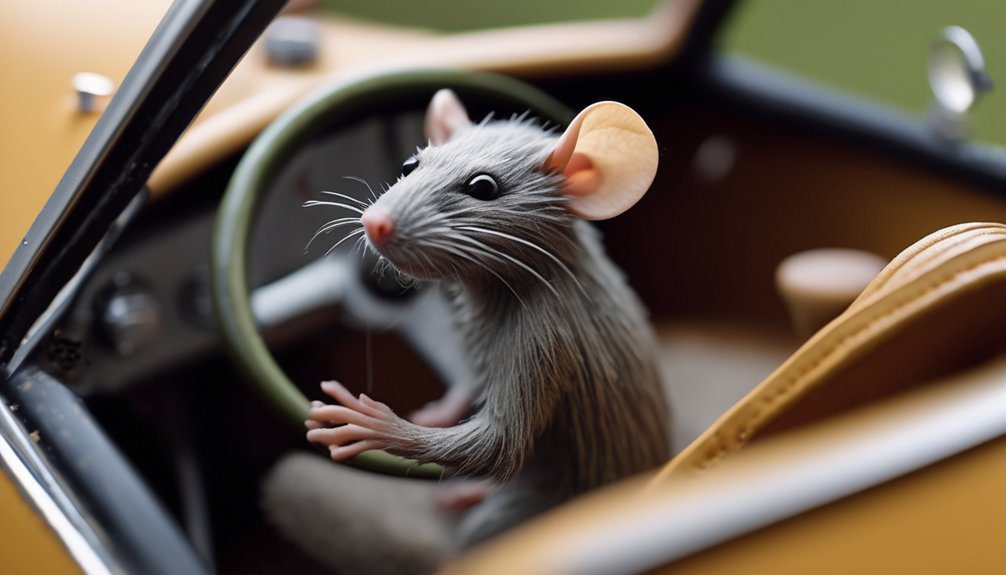
In this experiment, you’ll see how rats learn to steer and accelerate tiny cars using positive reinforcement and repeated practice. The setup involves miniature vehicles equipped with sensors that respond to rat movements, encouraging skill development through gradual, more complex tasks. This process showcases rats’ cognitive flexibility and problem-solving ability. Beyond examining behavior, this research offers insights into learning, memory, and neural function. Exploring further reveals the broader implications and future directions of this innovative work.
How Rats Learn to Control Miniature Vehicles
Although rats aren’t natural drivers, they quickly learn to control miniature vehicles through a combination of training techniques and positive reinforcement.
You’ll observe that rat navigation skills improve as they associate specific movements with rewards. By guiding you through vehicle manipulation, rats develop the ability to steer and accelerate within a controlled environment.
This learning process involves repeated practice, allowing the rats to adapt their behavior for effective control. The training taps into their natural exploratory instincts, transforming these into purposeful actions.
Understanding this method reveals how targeted conditioning fosters the rat’s mastery over driving tasks.
Insights Into Rat Cognition and Behavior
When you examine the behavior of rats driving miniature vehicles, you gain valuable insights into their cognitive abilities and problem-solving skills.
These experiments reveal that rats can process complex tasks, make decisions, and adjust their actions based on feedback. Their ability to navigate and control a vehicle shows flexibility in thinking and learning, traits once thought to be exclusive to higher mammals.
Observing this behavior helps you understand how their brains approach challenges and solve problems, demonstrating a level of intelligence that supports broader studies on animal cognition and the mechanisms underlying adaptive behavior in dynamic environments.
The Experimental Setup and Training Process
Understanding how rats develop the skills to operate miniature vehicles requires examining the experimental setup and training process in detail.
The experimental design involves a controlled environment where rats interact with a tiny car equipped with sensors responding to their movements.
Training techniques start with rewarding rats for simple actions like pushing pedals, gradually increasing complexity as they learn steering and acceleration.
Positive reinforcement encourages consistent behavior, allowing rats to connect their actions with vehicle responses.
This methodical approach guarantees rats acquire driving skills through repetition and motivation, highlighting the careful planning behind this unique behavioral study.
Potential Applications and Future Research
Since rats can learn to control miniature vehicles, researchers have identified several potential applications for this ability, ranging from neuroscience studies to robotics development.
You could see this technique advancing behavioral therapy by helping understand decision-making processes and motor control. It also holds promise for cognitive enhancement studies, offering insights into learning and memory mechanisms.
Future research may explore more complex tasks or integrate neural interfaces to deepen control precision. Additionally, this work could inspire innovative robotic systems that mimic biological adaptability.
Frequently Asked Questions
Are the Rats Rewarded for Driving the Cars?
Yes, you’ll find the rats receive reward mechanisms like treats, which fuel their driving motivation. These rewards encourage their freedom to explore and control, making the experiment about empowerment and voluntary action.
How Long Do the Rats Typically Drive During Experiments?
You’ll find the driving duration varies but usually lasts around 30 minutes within the experiment timeline. This balance lets the rats explore freely without fatigue, ensuring they stay engaged and curious throughout the session.
What Types of Cars Are Used in These Experiments?
You’ll find miniature vehicles specially crafted for experimental designs, letting rats navigate freely. These tiny cars offer you a glimpse into uncharted freedom, blending science and exploration in a way that’s both strange and fascinating.
Do the Rats Show Any Signs of Stress While Driving?
You won’t see typical stress indicators in their behavioral responses; rats adapt quickly and seem curious rather than stressed. Their freedom to explore controls reduces anxiety, letting them engage confidently without obvious signs of distress.
How Do Researchers Ensure the Rats’ Safety in the Cars?
Researchers use rat harnesses and other safety measures to keep you secure while driving. They guarantee you can explore freely without harm, letting you enjoy the experiment with maximum safety and minimal restriction.
