

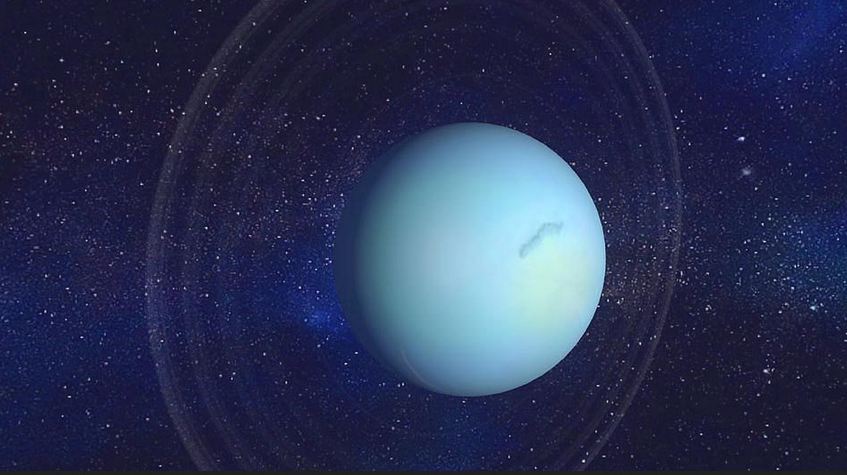
Uranus Has a Stable Cosmic Partner – And It’s Been There for Thousands of Years
In a rare orbital configuration, Uranus isn’t alone in its journey around the Sun. New research confirms the planet is gravitationally locked in a 3:4 orbital resonance with an icy Centaur object named 2015 OU194. For every 4 trips Uranus makes around the Sun, OU194 completes exactly 3. This is not coincidence. It’s celestial choreography—and it’s been stable for millennia.
What Is 2015 OU194?
2015 OU194 is a Centaur—a class of small solar system bodies orbiting between Jupiter and Neptune. Most Centaurs have erratic, short-lived orbits. Not this one. According to the new study led by Daniel Bamberger of the Northolt Branch Observatories in Germany, this asteroid’s trajectory is unusually circular and remarkably stable.
By analyzing extended observation data (spanning 3.5 years from previous 2017–2018 scans), Bamberger’s team verified that this Centaur’s path isn’t just stable—it’s resonant.
Why a 3:4 Resonance Matters
Orbital resonances like this don’t happen randomly. They’re the result of deep gravitational mechanics. In this case, Uranus and 2015 OU194 are in what’s known as a mean motion resonance. Every time Uranus finishes 4 orbits, the asteroid completes exactly 3. This prevents collisions, stabilizes the system, and locks both bodies in a long-term gravitational rhythm.
This type of coordination has only been seen a handful of times in the outer solar system. A few Centaurs, like 2013 RG98, show similar behavior. But OU194 stands out due to its clean orbital path and long-lasting resonance. Simulations suggest it’s been dancing with Uranus for over 100,000 years and may continue for another half a million.
Implications for Planetary Science
This isn’t just a fun astronomical oddity. It shifts how scientists think about the dynamical architecture of the outer solar system. Stable resonances like this one:
-
Suggest unseen gravitational scaffolding beyond Neptune
-
Offer clues about how planets and minor bodies avoid chaotic collisions
-
Support the idea that many Centaurs might be locked in hidden orbital harmonies
Researchers are already investigating other objects with similar behaviors. Bodies like 2014 NX65 also show signs of being influenced by Neptune’s gravity, hinting at more complex patterns than previously recognized.
Uranus and 2015 OU194 aren’t just neighbors—they’re locked in a precise, long-term orbital relationship that could reveal deeper truths about gravitational mechanics and the evolution of our solar system.
If you’re tracking outer solar system dynamics, planetary formation models, or resonant orbital systems, this study delivers one message: look again—there’s structure in the chaos.