

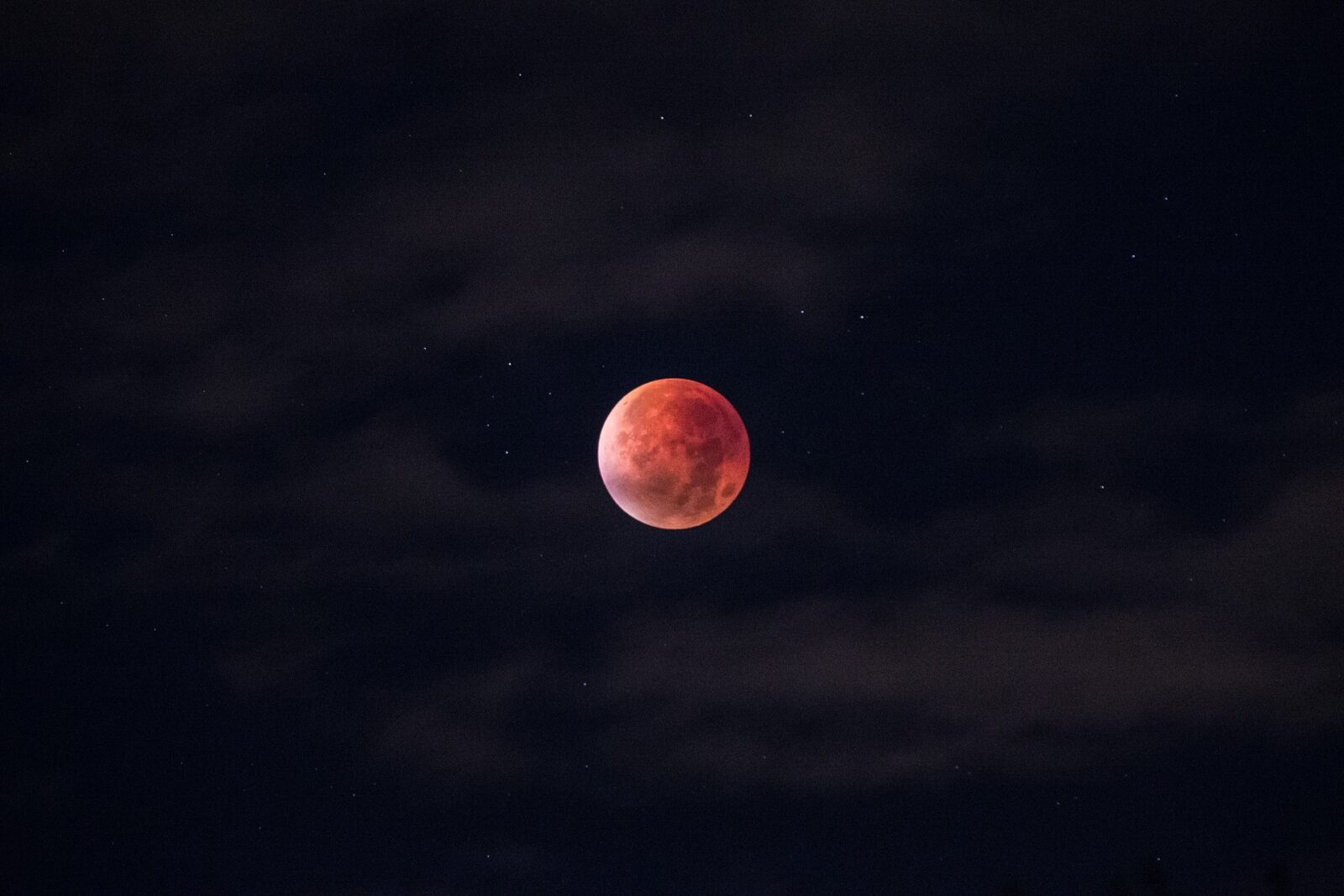
Snapshot:
-
What: Total lunar eclipse (“Blood Moon”) — the Moon turns copper-red.
-
When (UTC): Totality 17:30:48–18:52:51 GMT on Sunday, Sep 7 (82 minutes).
-
Global window (penumbra→penumbra): 15:28–20:55 GMT (5 h 27 m).
-
Best views: Asia, Australia, Pacific, East Africa (entire totality).
-
Partial at moonrise: Much of Europe and parts of Africa.
-
Not visible: The Americas (daytime).
-
Safety: 100% safe to watch with the naked eye. No filters needed.
Why this Blood Moon is special
-
Long totality (82 minutes): A deep immersion in Earth’s umbra (eclipse magnitude ≈ 1.362), darker than March 2025’s totality.
-
Enormous audience: Over 6 billion people can see at least some of totality; one of the most widely visible eclipses of the decade.
-
Saturn cameo: A bright “star” near the eclipsed Moon is Saturn, adding a photogenic pairing throughout the night.
-
Near-perigee Moon: The Moon is ~2.7 days before perigee; a touch larger than average (not a Supermoon), helping the disk look extra imposing in photos at low altitude.
Where you can see it
Regions with the entire total phase visible
-
Australia & New Zealand
-
Most of Asia: India, Southeast Asia, China, Japan, Central Asia
-
Eastern Africa
-
Parts of Russia & the Pacific islands
Regions with partial totality (typically at moonrise)
-
Europe (best from the east and southeast)
-
North & West Africa (moonrise during late totality / early partial)
Regions that miss totality
-
The Americas (eclipse occurs during daylight there)
Quick rule: If the Moon is above your horizon anytime between 17:30–18:52 GMT, you’ll see all or part of totality. If it rises after 18:52 GMT, you’ll still catch the later partial and penumbral phases.
Exact eclipse timeline (global moments)
All observers share the same instant for the phases; your local clock differs by timezone.
-
Penumbral begins: 15:28:25 GMT
-
Partial begins: 16:27:09 GMT
-
Totality begins: 17:30:48 GMT
-
Maximum: 18:11:47 GMT
-
Totality ends: 18:52:51 GMT
-
Partial ends: 19:56:31 GMT
-
Penumbral ends: 20:55:08 GMT
Totality length: 1 h 22 m • Whole eclipse: 5 h 27 m
City-by-city totality reference (local time)
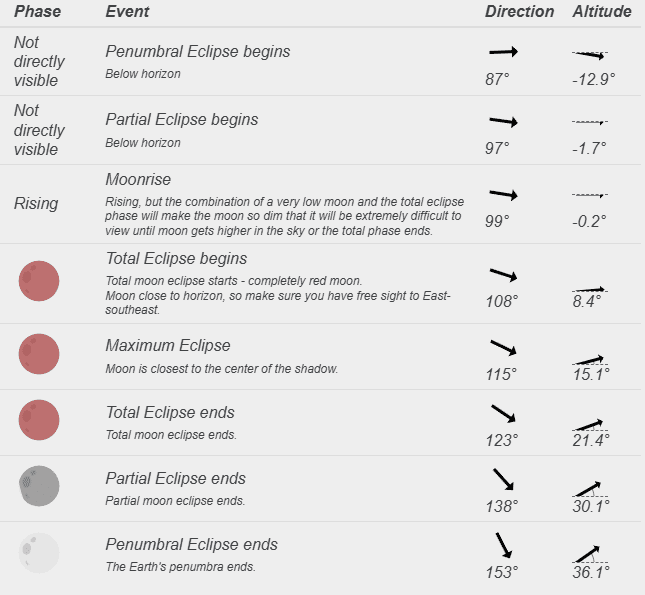
Local totality window shown where the Moon is above the horizon. A dash (—) means totality is below the horizon at that site, but later partial phases may be visible after moonrise.
Asia & Pacific
-
Bangkok: 00:30–01:52 ICT (Mon, Sep 8)
-
Beijing: 01:30–02:52 CST (Mon)
-
Hong Kong: 01:30–02:52 HKT (Mon)
-
Tokyo: 02:30–03:52 JST (Mon)
-
Perth: 01:30–02:52 AWST (Mon)
-
Sydney: 03:30–04:52 AEST (Mon)
-
Mumbai: 23:00–00:22 IST (Sun→Mon)
Middle East & Africa
-
Tehran: 21:00–22:22 IRST (Sun)
-
Cairo: 20:30–21:52 EEST (Sun)
-
Istanbul: 20:30–21:52 EEST (Sun)
-
Nairobi: 20:30–21:52 EAT (Sun)
-
Cape Town: 19:30–20:52 SAST (Sun)
Europe (many see totality at moonrise; duration varies by longitude)
-
Athens: 20:30–21:52 EEST • Moonrise 19:41
-
Rome: 19:30–20:52 CEST • Moonrise 19:30
-
Berlin: 19:30–20:52 CEST • Moonrise 19:37
-
Paris: 19:30–20:52 CEST • Moonrise 20:17 (totality very low/brief)
-
Madrid: 19:30–20:52 CEST • Moonrise 20:34 (catch late totality if horizon is perfect)
-
Warsaw: 19:30–20:52 CEST • Moonrise 19:06
-
Helsinki: 20:30–21:52 EEST • Moonrise 20:02
-
Kyiv: 20:30–21:52 EEST • Moonrise 19:25
-
Moscow: 20:30–21:52 MSK • Moonrise 19:03
-
London: 18:30–19:52 BST • Moonrise 19:30 BST → ~22 minutes of low, red Moon
-
Norwich: Moonrise 19:25 BST → ~27 minutes of totality
-
Manchester: Moonrise 19:41 BST → ~11 minutes of totality
-
Edinburgh: Moonrise 19:48 BST → ~4 minutes of totality
-
Belfast: Moonrise 19:57 BST → no totality; partial visible to 21:56, then penumbral to 22:55
Romania (your local reference)
-
Bucharest (EEST, UTC+3): Totality 20:30–21:52 (Sun) • Moonrise ~19:33 → Excellent, long totality high enough to enjoy.
What you’ll actually see (phase by phase)
-
Penumbral begins (subtle): A gentle gray wash, easy to miss.
-
Partial begins: A crisp, dark “bite” enters the lunar limb — very photogenic.
-
Totality: The Moon turns copper-red, sometimes brick or burgundy depending on Earth’s atmospheric dust and aerosols. Stars flourish in the darkened sky; Saturn glows nearby.
-
Totality ends: A bright sliver returns; the red fades.
-
Partial ends: The umbral bite slides off.
-
Penumbral ends: Full brightness resumes.
Why red? Sunlight skims through Earth’s atmosphere and is filtered & refracted onto the Moon. Blue light is scattered; red/orange survives — essentially every sunset on Earth projected onto the lunar surface.
Saturn near the eclipsed Moon
The bright, steady “star” close to the Blood Moon is Saturn. Closest approach is Sep 8 at ~17:10 GMT, but you’ll spot Saturn throughout totality. Binoculars reveal its yellow hue; small telescopes can hint at the ringed disk in steady air.
How dark will it be? (Danjon scale cheat-sheet)
Astronomers rate totality brightness from L=0 (very dark) to L=4 (bright copper). With a deep umbral immersion (mag ≈ 1.36), expect L=1–2 conditions if global skies are relatively clear of volcanic/wildfire aerosols; darker if not.
Weather, horizon & planning tips
-
Low Moon = dramatic photos. In Europe and North Africa, totality occurs near moonrise — use a clear E/SE horizon (beach, ridge, rooftop).
-
Check forecasts & transparency: Thin high cloud still lets you see a red disk, but clarity helps.
-
Scout a day early: Confirm sightlines to the E–SE (where the Moon rises).
-
City safety: Eclipses draw crowds. Pick well-lit public places or astronomy club events.
Photography quick guide (no telescope required)
Phones
-
Use Night Mode / Pro if available.
-
Lock focus on the Moon; dial down exposure to avoid a blown-out disk in partial phases.
-
Stabilize: prop the phone or use a mini-tripod.
-
For moonrise shots, compose with landmarks (bridges, skyline).
Mirrorless/DSLR
-
Lens: 200–400 mm for a big disk; 35–85 mm for “Moon + landscape”.
-
Partial phases: Start ~1/500–1/1000 s, f/8, ISO 200–400 (adjust for your lens/sky).
-
Totality (dimmer): 1/2–2 s, f/2.8–f/5.6, ISO 800–1600. Bracket exposures from 1/8 → 2 s.
-
Tripod + remote (or 2-s timer) to avoid shake.
-
RAW capture for best color control.
-
Bonus: Time-lapse from partial→total→partial makes a great sequence.
Common questions (fast answers)
Is the eclipse safe to watch?
Yes. Lunar eclipses are 100% safe with naked eyes, binoculars, or telescopes.
Will there be a Blood Moon tonight?
Yes — tonight (Sep 7–8). Totality 17:30–18:52 GMT.
Can the Americas see it?
No; the eclipse occurs during daylight there.
When is the next lunar eclipse?
Mar 2–3, 2026 — another total lunar eclipse (favours NE Asia, NW North America, Central Pacific).
When is the next total lunar eclipse after that?
After March 2026, the next totality is Dec 31, 2028 — a New Year’s Blood Moon (with a Blue Moon twist).
Do I need any special gear?
No gear needed. Binoculars enhance the view; a tripod helps for photos.
Local quick-look (convert from UTC)
Use the master times, then apply your offset:
Example: Bucharest (UTC+3) — Totality 20:30–21:52 EEST.
-
London (BST, UTC+1): 18:30–19:52, Moon rises 19:30 → ~22 min of red Moon, very low.
-
Paris (CEST, UTC+2): 19:30–20:52, Moon rises 20:17 → catch the tail of totality at a flat horizon.
-
Berlin (CEST, UTC+2): 19:30–20:52, Moon rises 19:37 → decent low-altitude totality.
-
Athens (EEST, UTC+3): 20:30–21:52, Moon already up — great show.
-
Cairo (EEST, UTC+3): 20:30–21:52 — excellent.
-
Nairobi (EAT, UTC+3): 20:30–21:52 — excellent.
-
Mumbai (IST, UTC+5:30): 23:00–00:22 — centered in the night.
-
Beijing (CST, UTC+8): 01:30–02:52 (Mon) — prime hours.
-
Tokyo (JST, UTC+9): 02:30–03:52 (Mon) — late, but worth it.
-
Sydney (AEST, UTC+10): 03:30–04:52 (Mon) — pre-dawn spectacle.
Understanding what you’re seeing
-
The Moon slides through Earth’s shadow: first the pale penumbra, then the inky umbra.
-
Deepest passage → darker, redder totality.
-
Colors vary by global air: dust, smoke, and volcanic aerosols can deepen the red.
Tonight’s September 7–8, 2025 total lunar eclipse is a don’t-miss, global sky event. If you have even a sliver of clear sky and the Moon above your horizon near totality, go look — no special equipment or expertise required. Bring a friend, a warm layer, and—if you can—binoculars or a camera. The Moon will carry the light of every sunrise and sunset on Earth across its face for 82 unforgettable minutes.
Clear skies and wide eyes.
Publisher tools (optional)
SEO Title: September 2025 Total Lunar Eclipse Tonight — Exact Times, Where to Watch, and How to Photograph the Blood Moon
Meta Description: The Moon turns red tonight during a 82-minute total lunar eclipse (Sep 7, 2025). See global and city times, visibility by region, Saturn nearby, and photo tips. Safe to watch with the naked eye.
Slug/Permalink: /september-2025-total-lunar-eclipse-guide
Tags: Lunar Eclipse, Blood Moon, Moon, Astronomy, September 2025