

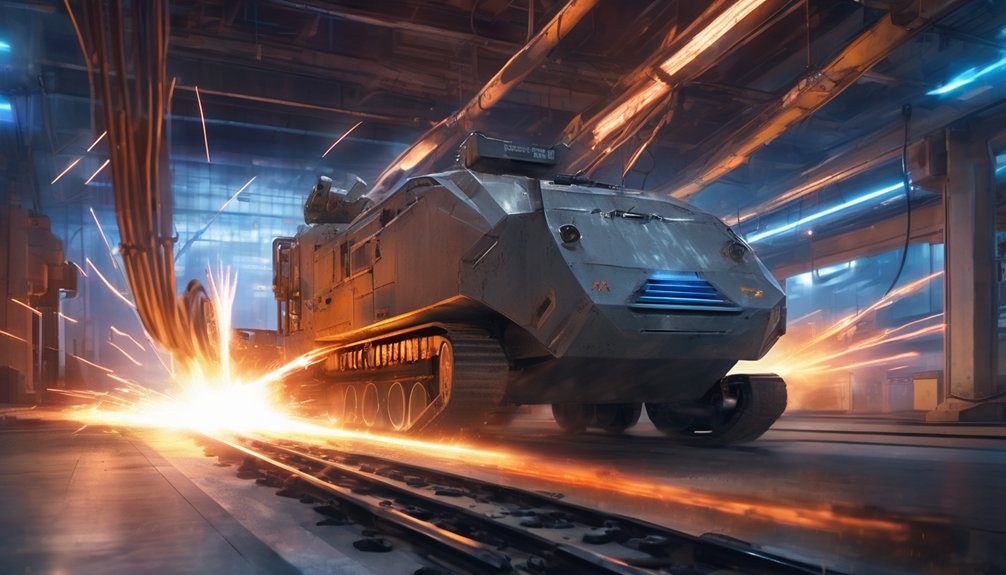
Railgun technology uses electromagnetic forces to accelerate projectiles at extremely high speeds along conductive rails, eliminating the need for traditional explosives. You benefit from greater range, improved accuracy, and less logistical support compared to conventional artillery. The design combines powerful conductive materials and precise components to create efficient propulsion. Militaries want railguns for these advantages and their potential to transform warfare with faster, safer, and more cost-effective weaponry. Exploring this technology reveals deeper insights into its future military impact.
Principles of Electromagnetic Propulsion
Although electromagnetic propulsion might seem complex at first, it operates on straightforward physical principles you can grasp with a basic understanding of magnetism and electricity.
In railguns, electromagnetic fields generate powerful forces that accelerate projectiles without traditional propellants. These fields interact through propulsion mechanisms, creating a Lorentz force that pushes the projectile along conductive rails.
Design and Components of Railguns
When you examine the design and components of railguns, you’ll find that each part plays an essential role in converting electrical energy into the high-speed propulsion of a projectile.
The railgun design includes two parallel conductive rails and a sliding armature that completes the circuit. Component materials must withstand extreme electrical currents and mechanical stresses, often using copper or aluminum alloys for conductivity and strength.
Insulating materials prevent short circuits, while structural components guarantee stability under recoil. Understanding these elements helps you appreciate how railgun technology achieves efficient and powerful electromagnetic propulsion.
Advantages Over Conventional Artillery
Because railguns use electromagnetic forces instead of explosive propellants, they offer several advantages over conventional artillery systems.
You’ll find railguns deliver higher projectile velocities, increasing range and accuracy while reducing the need for large explosive charges. This enhances battlefield mobility, as railgun systems can be lighter and require less logistical support.
Additionally, railguns improve cost efficiency by minimizing ammunition expenses and maintenance related to chemical propellants. Without relying on traditional explosives, you gain safer handling and storage conditions.
These factors combine to provide a more sustainable and flexible artillery option, aligning with modern military needs for rapid, efficient response.
Current Military Applications and Future Prospects
The unique advantages of railgun technology have attracted considerable interest from military organizations worldwide, leading to various experimental and operational deployments.
You’ll find naval applications at the forefront, where railguns offer long-range, high-speed projectiles without explosive propellants, enhancing ship defense and offensive capabilities.
Ground forces are also exploring these systems for precision strikes and reduced logistical burdens since railguns rely on electricity rather than traditional ammunition.
Looking ahead, ongoing research aims to improve durability and power efficiency, making railguns more practical and widespread.
As the technology matures, it could considerably alter military strategies and battlefield dynamics in the near future.
Frequently Asked Questions
What Materials Are Used to Handle the Extreme Heat in Railguns?
You’ll rely on heat resistant materials like tungsten and ceramics to handle extreme heat in railguns. Effective thermal management systems keep temperatures down, ensuring you maintain freedom of operation without damage or performance loss during intense firing.
How Do Railguns Impact Naval Ship Design and Deployment?
You’ll see ship architecture shift to support railgun weight and power needs, demanding smarter weapon integration. This boosts your fleet’s freedom to strike farther, faster, and with less reliance on traditional ammo logistics.
What Environmental Concerns Are Associated With Railgun Testing?
You’ll face environmental impact concerns during railgun testing, like noise pollution and electromagnetic interference. Testing procedures must balance innovation with protecting nature, ensuring your freedom to advance technology doesn’t harm the environment around you.
How Do Railgun Costs Compare to Traditional Missile Systems?
You’ll find railguns have higher upfront costs, but a cost analysis shows they reduce long-term expenses compared to missile systems. This missile comparison highlights your freedom to invest in innovative, sustainable defense technologies with lower operational costs.
Are There Any International Laws Regulating Railgun Development?
You won’t find specific railgun treaties yet, as military regulations haven’t fully caught up. But freedom-focused nations push for balanced rules ensuring innovation doesn’t compromise safety or escalate conflicts unnecessarily. Stay informed and advocate wisely.