

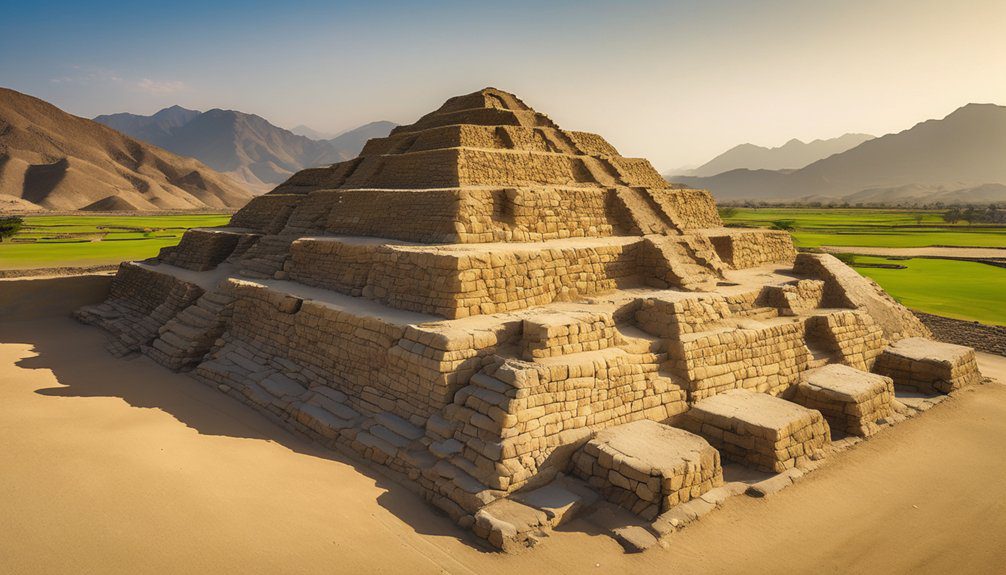
If you’re interested in the oldest pyramids outside Egypt, start with the Step Pyramid of Djoser in Sudan—an early stone construction reflecting ancient state power. In Peru, the Pyramid of Caral shows a unique Adobe design from a complex society around 2600 BCE. The Nubian Pyramids of Meroë, with their steep angles, reveal Kushite royal tombs. Mesopotamian ziggurats are tiered temple platforms, and Teotihuacan’s pyramids in Mexico highlight advanced urban planning. Exploring these sites offers rich insights into early civilizations’ architectural achievements.
The Step Pyramid of Djoser in Saqqara, Sudan
The Step Pyramid of Djoser, located in Saqqara, Sudan, represents one of the earliest large-scale stone constructions in human history.
You’ll find that Djoser architecture marks a significant shift from traditional mudbrick to stone, showcasing innovative design and engineering.
Saqqara’s significance lies in its role as a major necropolis, reflecting early Egyptian beliefs and state power.
By studying this pyramid, you can appreciate how the structure set a precedent for future monumental architecture.
Its layered, stepped form demonstrates not only technical skill but also a cultural move toward more permanent, imposing edifices symbolizing authority and eternal legacy.
The Pyramid of Caral in Peru
Moving from the ancient Egyptian tradition of monumental stone pyramids, you can observe a different architectural approach in the Americas with the Pyramid of Caral in Peru.
This structure, built by the Caral civilization around 2600 BCE, stands as one of the oldest examples of ancient architecture in the New World. Unlike Egyptian pyramids, it features a stepped design made from adobe and stone.
The Caral civilization’s careful urban planning and construction reflect an early complex society focused on communal and ceremonial life, highlighting a unique cultural expression of pyramid building far from Egypt’s influence.
The Nubian Pyramids of Meroë
Although they share the pyramid shape with their Egyptian counterparts, the Nubian pyramids of Meroë in present-day Sudan display distinctive features that reflect a separate cultural and historical context.
These pyramids, built by the rulers of Ancient Kush, showcase unique Nubian architecture characterized by steep angles and smaller bases.
When you explore Meroë, you’ll notice:
- Over 200 pyramids serving as royal tombs
- Intricate carvings depicting Kushite rulers and deities
- Construction using local sandstone and brick materials
This site reveals a powerful civilization that embraced its own identity while influencing and interacting with Egypt.
The Ziggurats of Mesopotamia
When you explore ancient Mesopotamia, you’ll find ziggurats standing as monumental examples of religious and architectural innovation.
These stepped pyramids showcase ziggurat architecture, characterized by their tiered design and massive size, built to connect earth and sky. You’ll notice they served as centers for ancient rituals, where priests performed ceremonies believed to honor and communicate with gods.
Unlike Egyptian pyramids, ziggurats were solid structures without internal chambers, emphasizing external grandeur.
Understanding their role helps you appreciate how these edifices symbolized both spiritual devotion and political power in early urban societies, reflecting a unique approach to pyramid construction and religious practice.
The Pyramids of Teotihuacan in Mexico
The Pyramids of Teotihuacan in Mexico stand as remarkable examples of Mesoamerican architecture and urban planning.
When you explore Teotihuacan architecture, you notice the precise Pyramid construction that reflects advanced engineering skills. These pyramids served religious, ceremonial, and social purposes, demonstrating the city’s significance.
Key features include:
- The Pyramid of the Sun, one of the largest in the Americas
- The Pyramid of the Moon, aligned with astronomical events
- The Avenue of the Dead, connecting major structures
You’ll appreciate how this site reveals the ingenuity and cultural depth of ancient Teotihuacan society.