

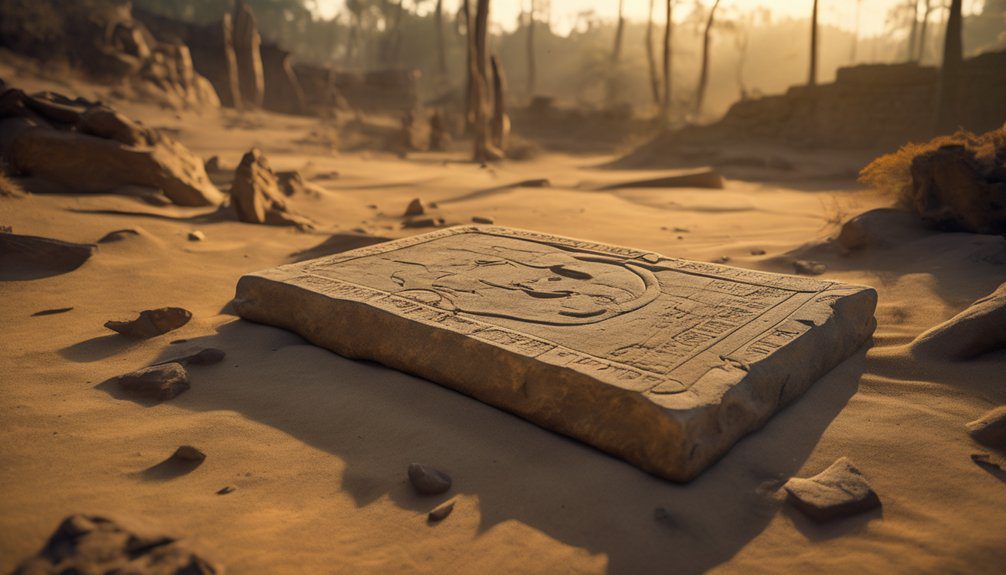
You still can’t fully explain some key history questions. For instance, the sudden disappearance of the advanced Indus Valley Civilization puzzles experts, partly because their script remains undeciphered. The true identity of Jack the Ripper has baffled investigators for over a century, with no conclusive proof against any suspect. Stonehenge’s purpose also remains unclear—it might have served as a calendar, observatory, or ceremonial site. Exploring these mysteries deepens your understanding of the past’s complexities.
The Disappearance of the Indus Valley Civilization
Although scholars have studied the Indus Valley Civilization for decades, its sudden disappearance remains a mystery.
You’ll find its advanced urban planning remarkable, with well-organized cities and drainage systems. Yet, the Indus scripts remain undeciphered, leaving much about their culture unknown.
You might wonder why such a sophisticated society vanished so quickly. Environmental changes, like shifting rivers or climate shifts, could have disrupted their way of life. Alternatively, social upheaval or external pressures might’ve played a role.
As you explore this topic, recognize how much about this civilization still challenges our understanding of history.
The Identity of Jack the Ripper
While the Indus Valley Civilization puzzles historians with its unexplained disappearance, another historical mystery has captured public attention for over a century: the identity of Jack the Ripper.
You’ll find numerous Ripper suspects linked to this Victorian crime, yet none definitively proven guilty. Investigators have examined doctors, butchers, and even members of the royal family.
The lack of modern forensic methods at the time leaves many questions unanswered. Despite extensive research, the Ripper’s true identity remains unknown.
This uncertainty continues to fascinate those who value freedom, truth, and the pursuit of historical clarity.
The Purpose of Stonehenge
What was the purpose of Stonehenge? You might expect a clear answer, but scholars still debate its true function.
Stonehenge’s astronomical alignments suggest it served as a calendar or observatory, tracking solstices and celestial events. Its ritual significance points to spiritual or ceremonial uses by ancient communities.
Consider these possibilities:
- A site for marking important solar and lunar cycles
- A place for religious gatherings and rites
- A monument symbolizing social or political power
While you may never know its exact purpose, Stonehenge remains a powerful reminder of humanity’s early quest for knowledge and meaning.
Frequently Asked Questions
Who Built the Great Pyramid of Giza?
You’ll find that Egyptian labor built the Great Pyramid of Giza through incredible pyramid construction techniques. They weren’t slaves but skilled workers who took pride, showing freedom in their craftsmanship and dedication to this monumental task.
What Caused the Fall of the Roman Empire?
You see, the Roman Empire fell because political corruption weakened leadership, economic decline drained resources, military overreach stretched forces thin, and barbarian invasions shattered borders. These combined, stripping away Rome’s freedom and strength.
Where Did the First Humans Originate?
You’ll find that the first humans originated in Africa, where human evolution sparked ancient migrations. Embrace this story of freedom, showing how your ancestors broke boundaries and shaped the world through relentless exploration.
How Were the Nazca Lines Created and Why?
You’ll find the Nazca lines were created using ancient techniques like removing surface stones, revealing lighter soil beneath. Nazca theories suggest they served as astronomical markers or ritual paths, inviting you to explore their mysterious freedom of interpretation.
What Happened to the Roanoke Colony?
You won’t find a clear answer about Roanoke’s fate; Roanoke theories suggest the Lost colonists either assimilated with nearby tribes or perished. Your quest for freedom mirrors their mysterious, unresolved journey.