

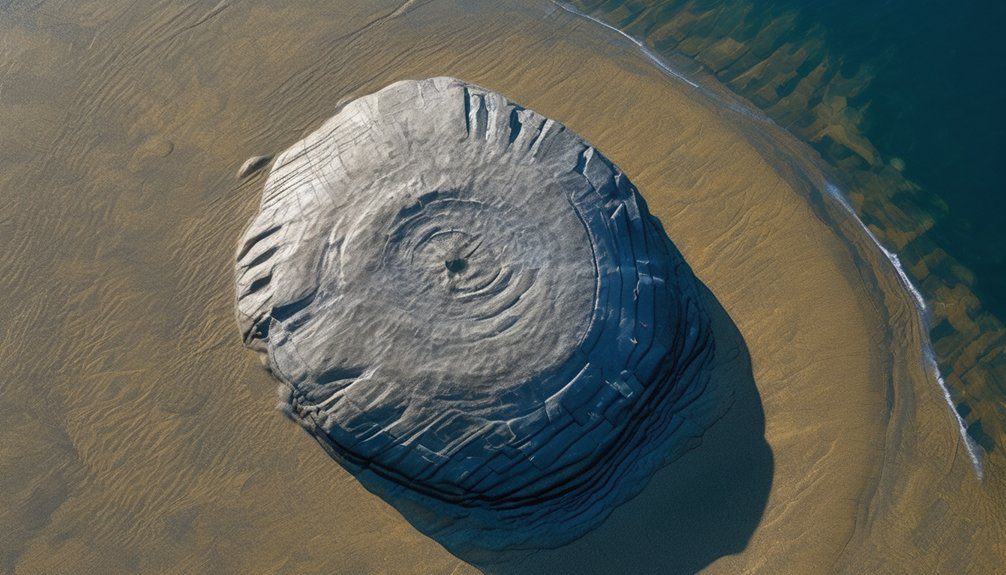
You’ll find that the latest scan data on the Baltic Sea UFO Rock uses advanced sonar and 3D imaging to reveal detailed underwater features not visible before. These new scans show unusual shapes and complex formations, sparking debate about whether the object is natural or artificial. Scientists urge caution, and ongoing analysis continues to clarify its origins. The findings have deepened understanding of the site, pointing toward further investigation to uncover its true nature.
Historical Background and Previous Investigations
Although the Baltic Sea UFO Rock gained widespread attention only in recent years, its discovery and subsequent investigations have a history that dates back several decades.
You’ll find that early explorers noticed underwater anomalies in the area, sparking curiosity about the object’s mystery origins.
Over time, various teams conducted surveys and dives to document its shape and structure, aiming to understand what it really was.
These efforts revealed unusual features unlike typical geological formations.
Technology Behind the Latest Scan Data
Understanding the historical context of the Baltic Sea UFO Rock sets the stage for examining the advanced technology used to capture the most recent scan data.
You’ll find that modern scan technology, such as high-resolution sonar and 3D imaging, plays an essential role in revealing detailed features beneath the water’s surface.
These tools collect vast amounts of raw data, which experts then process through sophisticated data analysis techniques.
This approach allows you to see the rock’s structure with greater accuracy, helping to distinguish natural formations from unusual shapes.
New Discoveries From the Recent Scans
As the latest scan data has been analyzed, several new discoveries have emerged regarding the Baltic Sea UFO Rock.
You’ll notice that the scans reveal previously unseen mysterious formations surrounding the main structure. These formations suggest complex underwater anomalies that weren’t detectable with older technology.
The data shows unusual shapes and patterns on the seafloor, hinting at geological or man-made origins. By examining these underwater anomalies closely, you gain a clearer picture of the site’s composition and layout.
This enhanced understanding helps you appreciate the rock’s unique characteristics without jumping to conclusions beyond the available evidence.
Implications and Theories Based on the Findings
The recent scan data revealing unusual formations around the Baltic Sea UFO Rock opens several avenues for interpreting its origin and significance.
You can consider these underwater anomalies as potential alien artifacts, but scientific caution is necessary. While some suggest extraterrestrial technology, others argue natural geological processes may explain the shapes and patterns observed.
By analyzing the data objectively, you’ll notice features that challenge conventional underwater formations, prompting ongoing debates among researchers.
These findings encourage further exploration and advanced scanning to determine whether the Baltic Sea UFO Rock represents a natural wonder or something more enigmatic.