

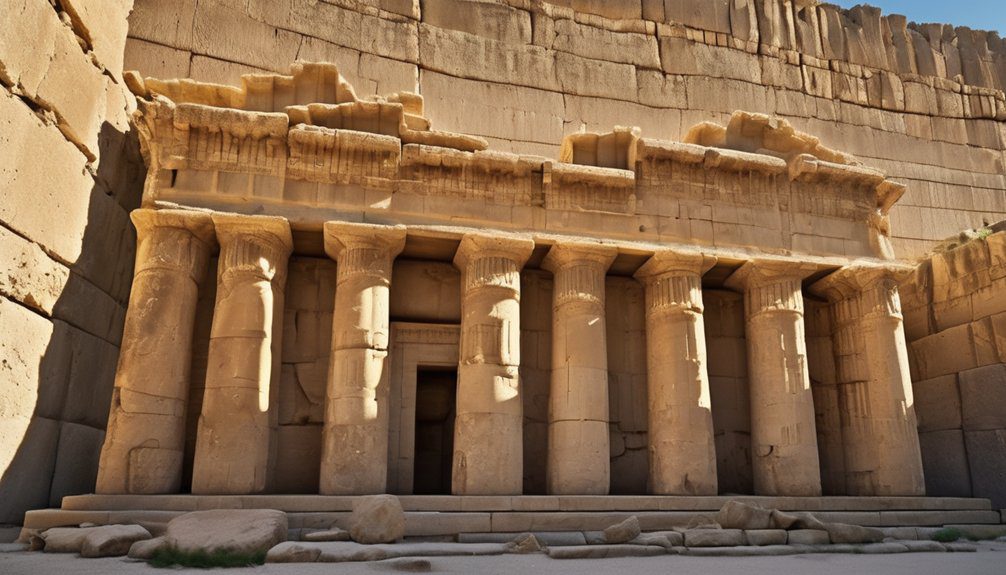
You can understand Baalbek’s massive stones by exploring how ancient machines and engineering aided their movement. Archaeological evidence shows advanced stone-cutting and quarrying techniques. Theories suggest the use of cranes, ramps, rollers, and even hydraulic systems, relying on human ingenuity rather than modern tools. Modern experiments recreate these methods, demonstrating their feasibility. Structural analysis reveals organized labor and precise engineering behind stone placement. Exploring these methods offers deeper insights into how ancient builders achieved such architectural feats.
The Enigma of Baalbek’s Megaliths
What makes the megaliths of Baalbek so enigmatic is their immense size and precise placement. You witness ancient craftsmanship that defies easy explanation, as these massive stones fit together with astonishing accuracy.
This monumental architecture showcases skills that suggest advanced knowledge and techniques, challenging assumptions about ancient builders. When you study these stones, you realize their weight and alignment raise questions about how they were moved and positioned without modern machinery.
This enigma invites you to explore beyond conventional ideas, appreciating the ingenuity and determination behind Baalbek’s impressive structures while considering the limits of ancient technology.
Historical Accounts and Archaeological Evidence
Although ancient texts offer limited details, historical accounts combined with archaeological findings provide valuable insights into the construction and purpose of Baalbek’s megaliths.
You’ll find that historical texts reveal the site’s religious significance, while archaeological findings show advanced stone-cutting techniques.
Key points include:
- Roman inscriptions referencing temple construction
- Evidence of quarry marks on stones
- Remnants of ancient tools nearby
- Structural analysis of stone placement
- Historical records of labor organization
These pieces help you understand how Baalbek’s enormous stones fit into broader cultural and engineering practices, without needing to speculate beyond available evidence.
Theories on Ancient Lifting and Transport Techniques
Since the massive stones at Baalbek weigh several tons each, scholars have developed various theories to explain how ancient builders managed to lift and transport them.
Some suggest the use of ancient cranes, which could have provided mechanical advantage through pulleys and levers. Others propose hydraulic systems, where water pressure might’ve assisted in raising heavy blocks.
These methods, combined with ramps and rollers, reflect practical solutions grounded in the knowledge and resources available at the time.
While definitive proof remains elusive, these theories offer plausible explanations, emphasizing human ingenuity rather than relying on speculative or mystical ideas.
Modern Experiments and Technological Insights
As researchers continue to explore the mysteries of Baalbek’s massive stones, modern experiments have played an essential role in testing ancient construction theories.
You can better understand how ancient machinery might’ve worked by examining these studies. Advanced technology helps recreate and analyze potential lifting and transport methods, revealing practical insights.
Consider these key areas explored:
- Replicating ancient pulley systems
- Testing lever and ramp efficiency
- Using 3D modeling for structural analysis
- Applying modern materials for weight simulation
- Measuring force requirements with current machinery
These experiments clarify how ancient builders could have moved enormous stones with limited tools.