

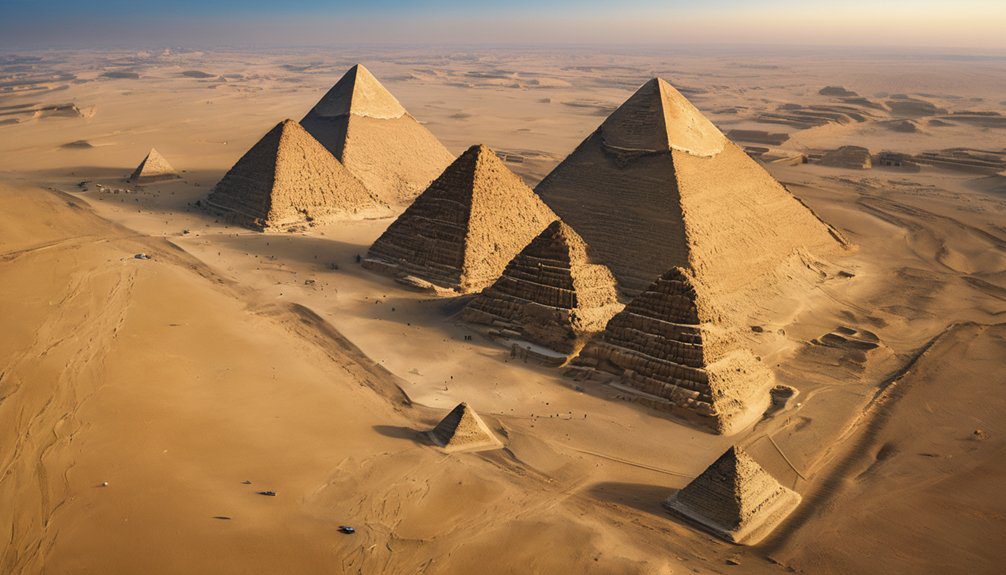
You might wonder if the pyramids are 10,000 years old, but geologists rely on radiometric dating and erosion analysis that show they’re about 4,500 years old. Geological surveys study the surrounding rock layers, while erosion patterns from wind and rain align with this timeline. Although some alternative theories suggest older dates, experts prioritize consistent, measurable evidence. Understanding these methods will give you a clearer view of the pyramids’ true age and history.
Geological Evidence and Dating Methods
Although the pyramids have stood for thousands of years, geologists use various scientific techniques to determine their precise age.
You’ll find that radiometric dating plays a key role, measuring the decay of radioactive elements in the surrounding rock to estimate when the stones formed.
Geological surveys also help by analyzing the layers of sediment and rock around the pyramids, providing context for their construction period.
These methods work together to offer a reliable timeline, allowing you to understand the pyramids’ age based on solid, measurable evidence, rather than speculation or myth.
Erosion Patterns and Environmental Factors
Understanding the pyramids’ age also involves examining erosion patterns and environmental factors that have affected their surfaces over time.
You’ll find that erosion rates depend on local climate and natural events, which change through centuries. Environmental changes like wind-blown sand, occasional rain, and temperature shifts all contribute to stone weathering.
By studying these effects, geologists estimate how long the pyramids’ materials have been exposed. Their findings suggest erosion aligns with thousands, not tens of thousands, of years.
Comparing Traditional and Alternative Theories
While traditional theories about the pyramids’ age rely heavily on archaeological and geological evidence, alternative theories often challenge these conclusions by proposing much older dates or different construction methods.
You’ll find that traditional beliefs base the pyramids’ construction around 4,500 years ago, supported by inscriptions and carbon dating.
Alternative hypotheses suggest ages up to 10,000 years, citing erosion patterns or lost civilizations.
As you compare these views, it’s clear that mainstream geology emphasizes consistent scientific methods, while alternative ideas often depend on reinterpretations or limited data.
Understanding both helps you critically evaluate the pyramids’ true age.