

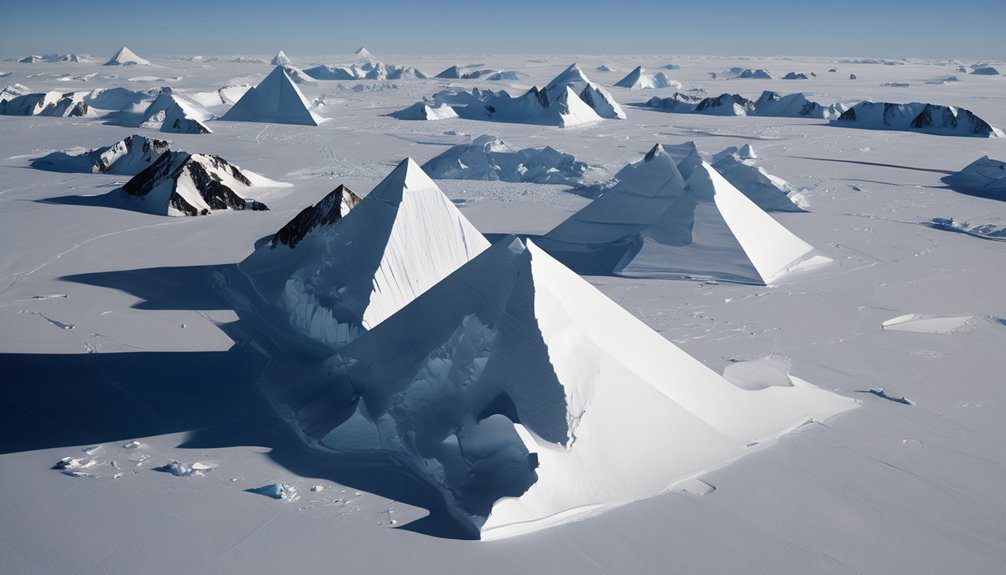
You’ll find that new satellite images reveal the pyramid-like structures in Antarctica are natural geological features shaped by erosion, freeze-thaw cycles, and wind. Historical research initially speculated about their origins, but modern studies use advanced imaging and analysis to confirm these formations result from consistent weather patterns on sedimentary rock. These technologies allow detailed examination without dangerous fieldwork, improving our understanding of Antarctica’s terrain and aiding future explorations. Further insights into these formations and their significance await your exploration.
Geological Characteristics of the Pyramid-Like Structures
Although these pyramid-like structures in Antarctica might resemble man-made formations at first glance, their geological characteristics tell a different story.
Careful structural analysis reveals that these shapes are natural geological formations shaped by erosion, freeze-thaw cycles, and wind. The sharp edges result from consistent weather patterns and the unique composition of rock layers.
You’ll find that their symmetry is typical of certain sedimentary rock formations rather than artificial construction. Understanding these features frees you from misconceptions and helps you appreciate the natural processes shaping our planet’s most remote regions through clear, evidence-based analysis.
Historical Context and Previous Research
Understanding the geological characteristics of Antarctica’s pyramid-like structures sets the stage for examining their historical context and the research that has shaped our knowledge about them.
You’ll find that previous findings have primarily focused on natural processes, such as erosion and volcanic activity, explaining their formation.
The historical significance lies in how these formations challenge early assumptions about Antarctica’s landscape, prompting scientific curiosity.
Research over decades has combined field studies and remote observations, gradually refining our understanding.
Satellite Imaging Techniques and Data Analysis
Since direct access to Antarctica’s remote terrain is limited, satellite imaging has become essential for studying the pyramid-like structures found there.
You rely on advanced satellite technology to capture high-resolution images, which undergo rigorous image processing to enhance detail and accuracy. This approach lets you analyze shapes, shadows, and textures without physical presence.
Key techniques include:
- Multispectral imaging for material differentiation
- Synthetic Aperture Radar (SAR) to penetrate clouds
- Digital elevation models for topographic mapping
- Automated feature detection algorithms
These methods empower you to examine the pyramids efficiently, maintaining freedom from on-site constraints.
Implications for Antarctic Research and Exploration
The advanced satellite imaging techniques you use to study Antarctica’s pyramid-like formations offer new opportunities for research and exploration across the continent.
These images help you better understand the climate impact on Antarctica’s terrain, allowing for more accurate monitoring of environmental changes.
While exploration challenges remain, such as harsh weather and remote locations, satellite data reduces the need for risky field missions.
This technology lets you plan safer expeditions and gather critical information remotely.