

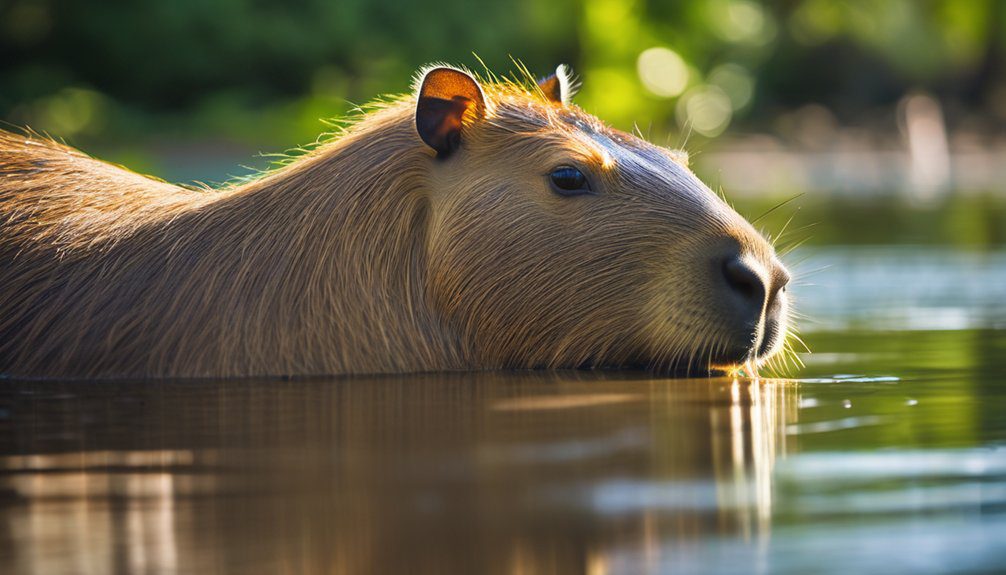
You’ll find capybaras so calm because their wetland environment encourages steady behavior and provides safety through water access. They live in social groups with clear hierarchies, reducing conflict and promoting relaxation. Their bodies are built to handle temperature changes and mild stress without high cortisol spikes. They rely on subtle communication to keep peace and avoid threats. These combined factors create their famously relaxed nature, with more details revealing how their traits support this balance.
Natural Habitat and Environmental Influences
Although capybaras are native to South America, you can find them in a variety of environments where water sources are abundant.
These semi-aquatic mammals thrive in wetland ecosystems such as marshes, riverbanks, and swamps. You’ll notice they rely heavily on water for predator avoidance, diving to escape threats quickly.
Their natural habitat offers both food and safety, allowing them to remain calm despite potential dangers. Understanding this connection between environment and behavior reveals how capybaras maintain balance in their lives, adapting seamlessly to the resources and challenges presented by their watery surroundings.
Social Structure and Group Dynamics
Capybaras live in social groups that usually consist of 10 to 20 individuals, but these numbers can vary depending on environmental conditions and resource availability.
Within these groups, a clear group hierarchy establishes order and reduces conflict, allowing members to coexist peacefully. Social bonding plays an essential role, as capybaras engage in grooming and close physical contact to strengthen ties.
This cooperative social structure helps them maintain calm and stability, even in challenging surroundings. Understanding their group dynamics reveals how capybaras balance individual needs with collective harmony, contributing to their remarkably relaxed demeanor.
Biological and Physiological Traits
When you examine their biological makeup, you’ll notice that capybaras possess several unique physiological traits that suit their semi-aquatic lifestyle.
Their thermoregulation strategies include a dense fur coat that helps manage body temperature both in and out of water. Additionally, capybaras have specialized blood flow mechanisms to dissipate heat efficiently.
Their stress response is also adapted to promote calmness; cortisol levels rise minimally during mild threats, allowing them to stay composed.
These biological and physiological features work together, enabling capybaras to maintain equilibrium in changing environments without expending unnecessary energy or reacting impulsively.
Behavioral Adaptations and Interactions
Understanding how capybaras manage their bodies in different environments helps explain their behavior in social and ecological contexts.
You’ll notice they rely heavily on communication signals, like vocalizations and body postures, to maintain group cohesion and avoid conflict. Their stress responses are subtle but effective, allowing them to stay calm even when predators are near.
Frequently Asked Questions
Can Capybaras Be Kept as Pets?
You can keep capybaras as pets, but you’ve got to check legal considerations first. Their pet care needs require space, social interaction, and water access, so be ready to provide freedom and proper environment for them.
What Do Capybaras Eat in Captivity?
You’ll feed your capybara a diet rich in grasses, hay, and fresh veggies. Their feeding habits thrive on natural, fiber-filled foods, so keep their meals simple and free to mimic their wild, calm lifestyle.
How Long Do Capybaras Live on Average?
You’ll find the capybara lifespan typically averages around 8 to 10 years in the wild, but they can live longer in captivity. Their average lifespan reflects their ability to adapt and enjoy life freely.
Are Capybaras Endangered or at Risk?
No, capybaras aren’t endangered, but you should care about capybara conservation since habitat destruction threatens their freedom. Protecting their wetlands guarantees they roam freely, keeping ecosystems balanced and these gentle creatures safe for generations.
How Do Capybaras Communicate With Humans?
You’ll notice capybaras communicate with you through subtle body language and soft vocalizations. They use these cues to express comfort or curiosity, inviting you to share a peaceful, trusting connection in their calm, free spirit.
