

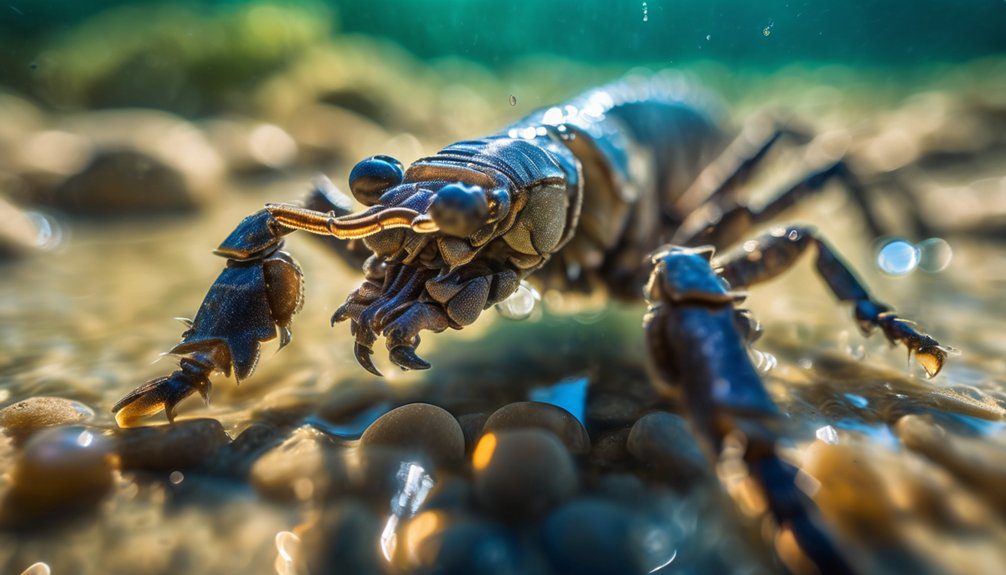
You can rely on scorpions’ unique respiratory system to hold their breath underwater for extended periods. Their book lungs trap air, allowing gas exchange even when submerged. Scorpions also slow their metabolism to reduce oxygen needs, while remaining mostly inactive to conserve energy. These adaptations help them survive brief underwater immersions without access to air. Understanding these traits can reveal how scorpions thrive in diverse environments and respond to challenging conditions.
Scorpion Respiratory System and Adaptations
Although scorpions are often associated with harsh desert environments, their respiratory system is specially adapted to support their survival in such conditions.
You’ll find that scorpion anatomy includes book lungs, which are unique respiratory organs designed for efficient gas exchange. These respiratory adaptations allow scorpions to conserve water and survive in dry habitats by minimizing moisture loss.
As you explore their system, you’ll notice that the book lungs’ layered structure increases surface area for oxygen absorption. Understanding these features helps you appreciate how scorpions maintain essential functions while embracing freedom in challenging environments.
Scorpions’ Survival Mechanisms Underwater
When scorpions face submerged conditions, they rely on specialized survival mechanisms that enable them to endure underwater for extended periods.
You’ll find that scorpion behavior adapts to underwater habitats through unique strategies:
- They slow their metabolism to reduce oxygen demand.
- Their book lungs trap air, allowing gas exchange even when wet.
- They enter a state of reduced activity to conserve energy.
These mechanisms allow scorpions to survive brief submersion without access to air.
Understanding these adaptations gives you insight into how these resilient creatures maintain essential functions despite challenging environments.
Scientific Observations and Experiments on Scorpion Submersion
Scientists have conducted various studies to observe how scorpions respond to submersion in water. Through underwater experiments, researchers have documented specific scorpion behavior that helps them survive temporary immersion.
Scorpions can trap air bubbles around their bodies, allowing them to hold their breath longer underwater. These observations reveal that scorpions don’t breathe underwater but rely on stored oxygen to endure submersion periods.
The experiments also show that scorpions remain mostly inactive to conserve energy while submerged. Understanding these behaviors helps clarify how scorpions adapt to challenging environments, offering insight into their resilience and survival strategies.
Frequently Asked Questions
How Long Do Scorpions Typically Live in the Wild?
You’ll find a scorpion lifespan in wild habitats typically lasts 3 to 8 years. They thrive independently, adapting to harsh environments, proving how resilience shapes their freedom and survival in nature’s untamed territories.
What Do Scorpions Eat in Their Natural Habitat?
You’ll find a scorpion’s diet mainly includes insects and small animals, helping you understand their role in nature. Remember, natural predators like birds and reptiles keep their freedom balanced within the ecosystem’s wild dance.
Are Scorpions Venomous to Humans?
Yes, scorpion venom can affect you, but most species cause mild human reactions like pain or swelling. Only a few have venom potent enough to be dangerous, so stay cautious but enjoy your freedom outdoors.
Where Are Scorpions Most Commonly Found Worldwide?
You’ll find scorpion habitats mostly in deserts, grasslands, and forests worldwide. Their distribution spans every continent except Antarctica, so wherever freedom calls, scorpions adapt and thrive in diverse environments.
How Do Scorpions Reproduce and Care for Their Young?
You’ll witness scorpions’ unique mating rituals, where males dance to impress females. After birth, the mother shows parental care by carrying her young on her back, ensuring their freedom to explore safely.
