

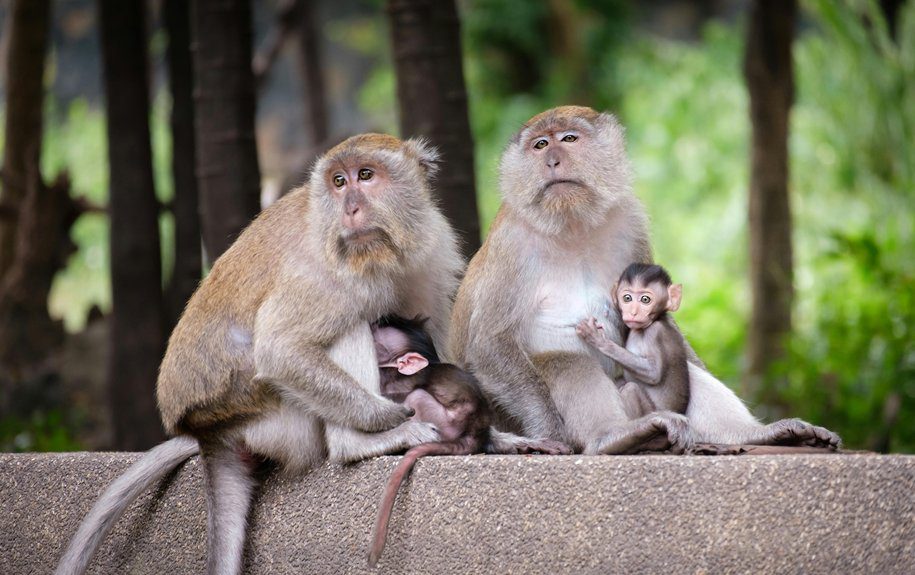
You might see monkey moms biting their babies as a natural behavior linked to social and evolutionary needs. This action can help assert dominance, manage sibling competition, or encourage infant responsiveness. Sometimes, it serves to align the infant’s behavior with group norms or to protect resources by reducing rivalry. Such behaviors are part of complex survival strategies shaped by social structures and reproductive goals. Understanding these reasons reveals more about primate family dynamics and care strategies.
Causes of Infanticide in Primates
Although infanticide might seem counterintuitive, it occurs in many primate species for various strategic reasons. Infanticide often arises from serious injury or death inflicted on infants, sometimes through exploitation, such as “aunting to death” by non-lactating females.
Dominant females may kill infants of lower-ranking mothers to reduce resource competition. Additionally, sexually selected infanticide happens when males kill infants to bring females back into estrus sooner, increasing their mating chances after taking over a troop.
While harsh, these behaviors are linked to reproductive strategies aimed at maximizing survival and gene propagation in primate groups.
How Social Structures Influence Infanticide
Understanding why infanticide occurs in primates requires looking closely at the social structures within their groups.
Social structures, such as multi-female groups, often reduce infanticide by creating paternity confusion, making it harder for males to target offspring. Yet, dominant females may kill lower-ranking females’ infants to secure resources.
Maternal responsiveness also plays a role; mothers defend their young and form alliances within these social hierarchies. Additionally, strong male-female bonds beyond mating can protect infants.
These dynamics show how social organization influences infanticide, shaping reproductive strategies and maternal behavior in complex ways.
Strategies Primates Use to Protect Their Young
When primates face threats to their offspring, they use a range of strategies to protect their young from harm. Mothers often recruit group members to defend infants who are particularly vulnerable to aggressive attacks.
In species where infanticide is a risk, females may mate with multiple males, creating paternity confusion that lowers the chance of targeted attacks. Social monogamy and pair bonding also enhance protection by involving a male partner.
Additionally, female behaviors during pregnancy can further obscure paternity, reducing aggressive behavior. These combined tactics help primates safeguard their young within complex social environments.
Evolutionary Benefits of Maternal Infanticide
If environmental pressures limit a mother’s ability to care for all her offspring, she might resort to maternal infanticide as a strategic choice. This behavior helps manage resource competition by eliminating infants less likely to survive.
In primates like tamarins, maternal infanticide allows mothers to focus their energy and resources on fewer offspring, increasing their reproductive success. By reducing the number of dependents, mothers improve the chances that surviving babies receive adequate care.
This evolutionary adaptation guarantees that mothers invest efficiently, enhancing their overall fitness and ability to reproduce successfully in challenging environments.
Frequently Asked Questions
Why Do Mother Monkeys Bite Their Babies?
You’ll see mother monkeys bite their babies as part of maternal instincts shaping social behaviors. These bites, though harsh, guide baby interactions, helping infants learn boundaries and adapt within their social group, balancing care and control.
Do Monkey Moms Love Their Babies?
You can see maternal instincts and bonding behaviors clearly in monkey moms, showing they do love their babies. Their actions also reflect complex social dynamics, where stress sometimes affects care but doesn’t erase their natural affection.
What Does It Mean if a Monkey Bites You?
If a monkey bites you, it’s a sign of monkey behavior expressing fear, stress, or territorial defense. The bite significance lies in animal communication, warning you to back off or respect their space to avoid escalation.
Why Do Monkeys Take Other Monkey Babies?
You’ll see monkeys take other babies due to social hierarchy and competition for infant care. Sometimes, non-mothers’ maternal instincts lead them to “aunt,” affecting survival, while dominance shapes these complex, instinctual behaviors.
